At a recent “Voices from North Korea” event hosted by the Alliance for Korea United at the University of Washington, Jihyang Kim, a North Korean escapee and a 2025 to 2027 Fulbright scholar pursuing graduate studies in curriculum and instruction at the University of Illinois Chicago, shared a story that was both deeply personal and profoundly unsettling. This wasn’t because of dramatic moments alone, but because of what it revealed about something most people rarely question: the ability to think freely.
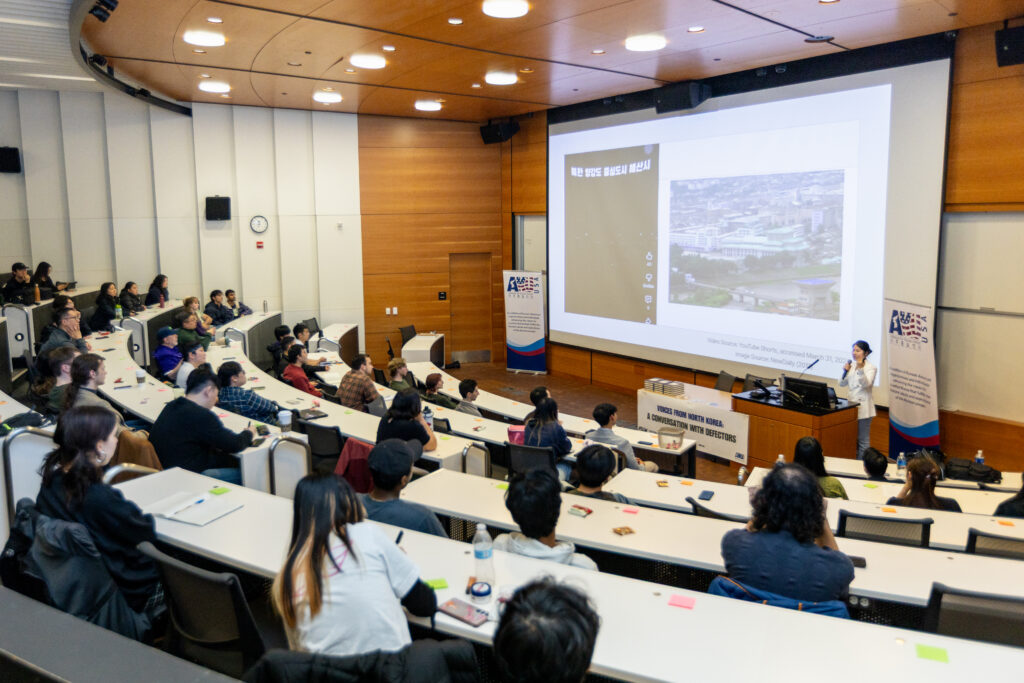
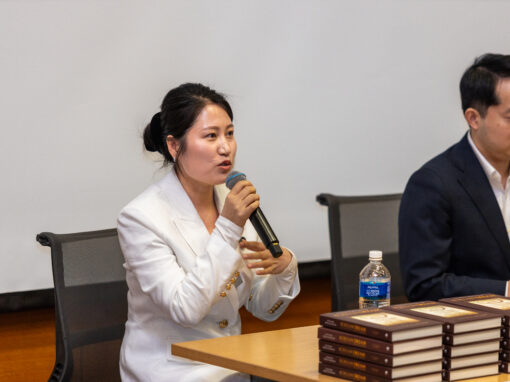
Jihyang Kim speaking at the AKU “Voices from North Korea” event at the University of Washington.
She began with a simple but piercing question: What would it feel like if every thought you had was already decided for you? For Jihyang, this was the reality of her childhood in North Korea. In school, learning did not involve curiosity or exploration. Students repeated what was written on the board, word for word. Questions were not asked, not because everything was understood, but because thinking differently was not permitted. Over time, she came to realize that thinking itself did not feel like something she created. It felt like something she received, like food rations distributed to sustain life but never to inspire it.
Jihyang grew up in Hyesan, a small city along the Yalu River that separates North Korea from China. From her home, she could see lights shining brightly across the border at night. They were close enough to spark curiosity, yet distant enough to remain unreachable. As a child, she wondered what life looked like on the other side: what people did, how they lived, and why their world seemed so different. That curiosity, at first innocent, gradually deepened into something more urgent as she grew older.
In 2009, a nationwide currency reform wiped out the value of people’s savings almost overnight. For Jihyang and her family, like many others, it meant sudden hardship and hunger. The gap between what she had been taught and what she experienced became impossible to ignore. Curiosity was no longer just about wanting to see another world; it became about survival and the need to understand whether a different life was possible.
At the age of 15, she began attempting to escape. It took four tries. On her third attempt, she was caught in China and forcibly returned to North Korea. What followed was a detention experience that exposed the harsh realities of the system she had grown up in. She was held in a small, overcrowded room with more than twenty others, under constant surveillance. Food was scarce, and movement was tightly controlled. Even the most basic human needs were stripped of dignity. Cameras monitored every action, including the use of the restroom, leaving her feeling so exposed that she sometimes chose not to eat to avoid it altogether. For 26 days, she endured conditions that reflected not just physical hardship but a deeper erosion of human rights and personal autonomy.
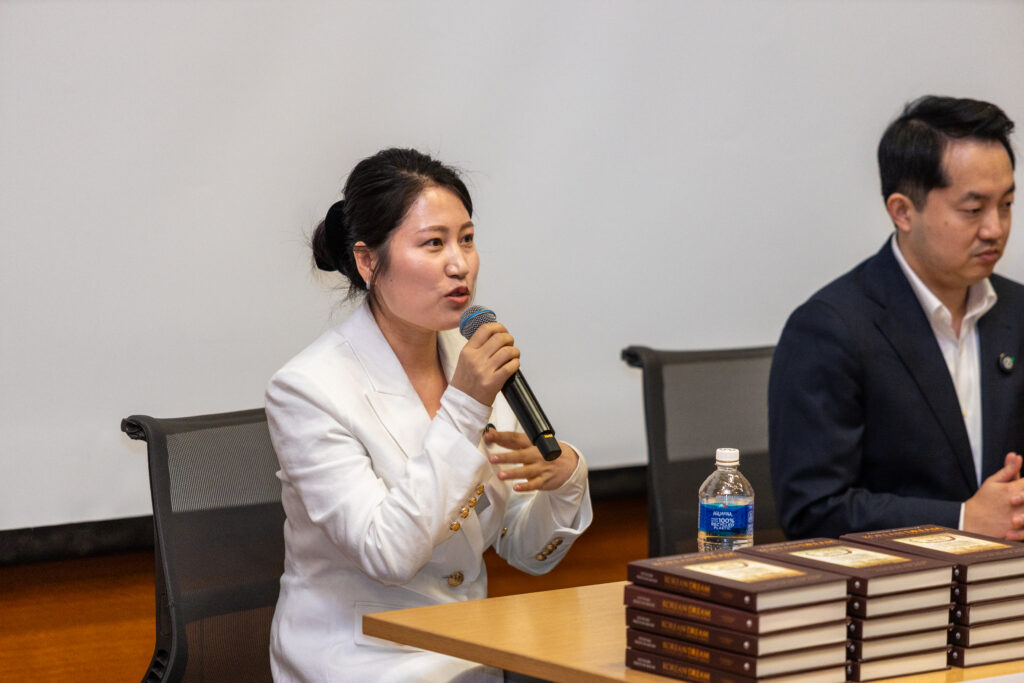
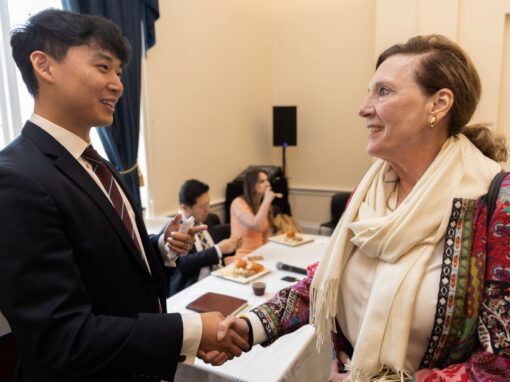
Jihyang Kim speaking at the AKU “Voices from North Korea” event at the University of Washington.
Despite the risks, she eventually succeeded in escaping and made her way to South Korea. There, she encountered something entirely unfamiliar; not material comfort, but the expectation of choice. People asked her what she wanted to do, what she wanted to study, and why. These were questions she had never been invited to consider before. At first, she found them confusing. She had spent her life learning how to repeat answers, not how to form them. The process of thinking for herself felt foreign, even overwhelming.
Gradually, however, that unfamiliar space became a place of growth. She began to understand education not as memorization, but as a tool for empowerment. It was no longer about absorbing information; it was about learning how to question, interpret, and imagine. For Jihyang, education became the pathway through which she could reclaim her voice, something she had never fully possessed before.
Today, as a Fulbright scholar studying curriculum and instruction, she is committed to using education to support others, particularly students from marginalized and disadvantaged backgrounds. Her work reflects a belief shaped by her own experience: that education holds a dual power. It can be used to control, as she witnessed in her early life, but it can also be used to liberate. The difference lies in whether it encourages obedience or critical thinking.
Jihyang’s story is not simply about escaping a country. It is about the transformation from silence to expression, from imposed identity to self-determination. It challenges common assumptions about freedom by highlighting something often overlooked: the ability to think, question, and choose is not universal. For millions, it remains restricted.
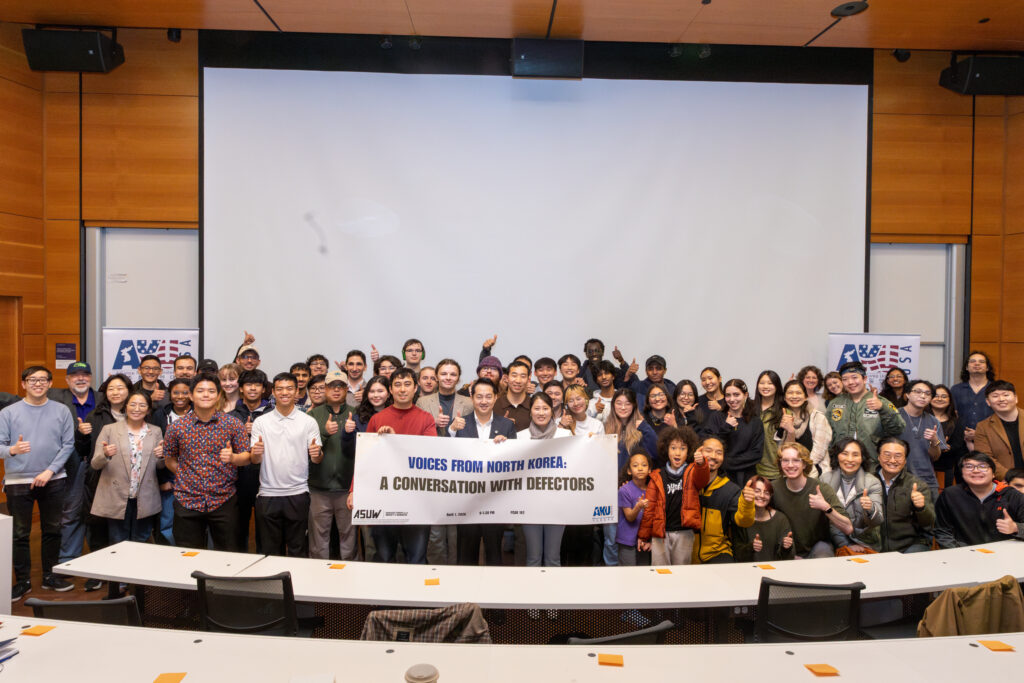
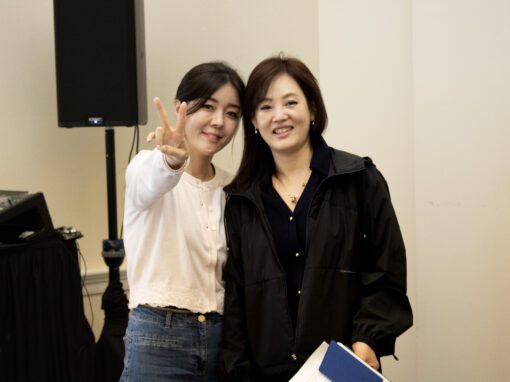
Group photo from the AKU “Voices from North Korea” event at the University of Washington.
In sharing her journey, she also redefines what it means to move forward. Her goal is not only personal success, but the empowerment of others who have experienced similar limitations. She envisions a future where North Korean escapees are recognized as individuals capable of leadership, contribution, and change.
Her closing words returned to the question she posed at the beginning, but this time directed outward. What will you do with your voice? It is a question that lingers, inviting reflection not only on her story, but on the freedoms many take for granted.
Jihyang’s journey is a powerful reminder that a future of freedom and dignity for all Koreans is possible, and it begins with a shared vision. The Korean Dream calls on people around the world to support peaceful reunification grounded in human rights, shared identity, and the ideal of benefiting all humanity. Join the One Korea Global Campaign movement to raise awareness, advocate for change, and stand in solidarity with those still seeking the freedom to think, choose, and live with dignity.
Disclaimer: This story has been adapted from Jihyang Kim’s testimony shared during the “Voices from North Korea” event hosted by the Alliance for Korea United at the University of Washington in April, 2026. The content has been edited for clarity, flow, and storytelling purposes while preserving the integrity of her experience.