The International Forum on One Korea: Capitol Policy Forum, held on April 29, 2026, at the Cannon House Office Building in Washington, D.C., brought together policymakers, experts, civil society leaders, and North Korean escapees to examine a bold shift in strategy for addressing the Korean Peninsula. Convened by the Global Peace Foundation (GPF), alongside partners including Action for Korea United, Defense Forum Foundation, Alliance for Korea United USA, and One Korea Foundation, the forum challenged decades of policy centered narrowly on denuclearization and instead advanced a comprehensive vision of a free and unified Korea as the strategic framing that can resolve the security and human rights issues on the Korean Peninsula.
Held during North Korea Freedom Week under the theme “Free and Unified Korea Policy Endgame,” the forum centered on a clear message: Korean unification must be understood not as a distant aspiration, but as the necessary framework for resolving both the security threat posed by the North Korean regime and the ongoing human rights crisis facing its people. Opening the program, Jeremy Graham, director of Strategic Development of GPF, emphasized the importance of elevating voices often marginalized in policy discussions—those of North Korean escapees—so that “the voices and the need for a free and unified Korea” remain at the forefront of international dialogue. What followed was a series of testimonies and policy discussions that built a compelling case for rethinking both the problem and its solution through a comprehensive vision rooted in Hongik Ingan, freedom, and the economic potential of a unified Korea.
The first panel, featuring North Korean escapees, anchored the discussion in real-life experiences. Hu Kang-il, head of the Committee for the Democratization of North Korea, reframed unification as a deeply personal and moral necessity. “For North Korean escapees, unification is not simply a political event,” he said. “It means being reunited with family members. It is the restoration of a life worthy of human dignity.” His remarks highlighted a recurring theme throughout the forum: that the division of the peninsula is not only a geopolitical issue but also a deeply human one affecting millions who remain separated from their families and denied basic freedoms.
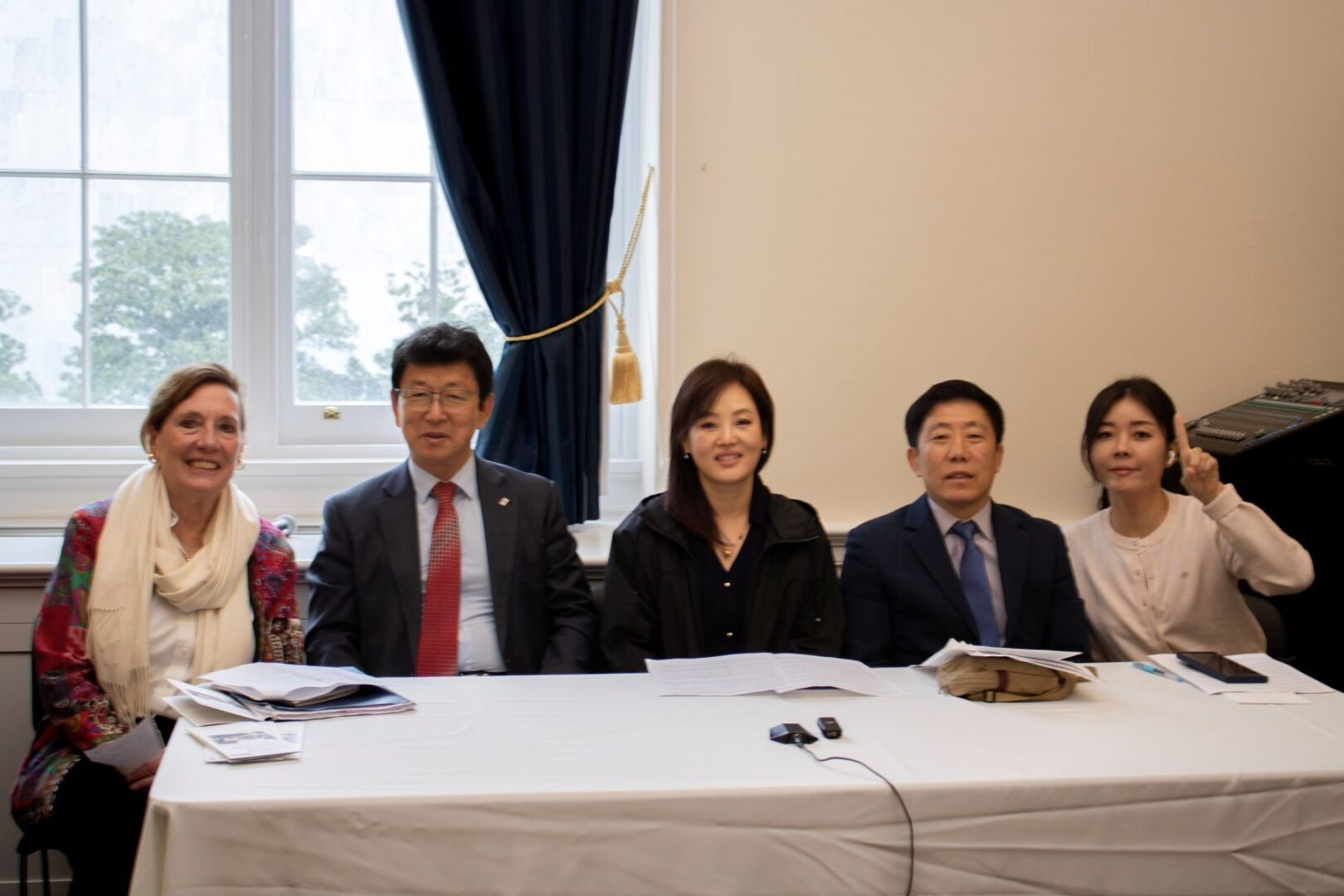
Session I panel included (left to right): Dr. Suzanne Scholte (moderator), Kang-Il Hu, Ji-Young Kim, Sang-Hak Park and Ga-Young Kim
Speakers repeatedly emphasized that North Korean escapees are not passive victims but active agents of change. “North Korean escapees are not merely beneficiaries; they are agents of change,” Hu asserted, calling for sustained international support to strengthen escapee-led organizations working on human rights advocacy and information dissemination. Their testimonies illustrated both the severity of conditions inside North Korea and the transformative power of access to truth.
One escapee shared a pivotal childhood moment that altered the course of their life: “When I was 13 years old, I secretly listened to an outside radio broadcast. In the voice coming from that small radio, I heard about a world where human beings could live with dignity.” That experience, though dangerous, sparked a process of questioning and ultimately led to escape. The speaker concluded with a powerful insight: “Information is the starting point of change. I am living proof of that.”
This emphasis on information as a catalyst for transformation was echoed across multiple testimonies. Another participant described ongoing efforts to send leaflets and media content into North Korea despite significant personal risk, explaining that “the North Korean regime fears truth more than guns, and it fears outside information more than missiles.” These accounts painted a critical tension: while military and economic strategies dominate international discourse, it is often the quiet flow of information that has the most profound impact on individuals within closed societies.
Speakers also raised concerns about the limitations of traditional humanitarian aid. One escapee recounted witnessing how aid intended for vulnerable populations was often diverted by authorities. “If aid does not actually reach the people, it can end up being used to maintain and strengthen the North Korean regime,” they warned, urging the international community to rethink delivery mechanisms to ensure assistance reaches those most in need.
Perhaps one of the most striking testimonies came from a former kindergarten teacher, who described the systemic indoctrination of children from an early age. “In kindergarten, the first thing children learn is not play, but loyalty and obedience,” she said, recounting how even basic education was subordinated to political messaging. Her appeal was both urgent and deeply human: “Children are not objects of politics; they are the owners of the future.”
The second panel shifted from testimony to strategy, examining the role of the U.S.-ROK alliance for a free and unified Korea and the broader international community. Moderator Ms. Olivia Enos, a senior fellow at the Hudson Institute who specializes in human rights and national security challenges in Asia, challenged the prevailing assumption that security concerns alone define the alliance, arguing instead that shared values are equally foundational. “Our shared commitment to defending human rights and values is a strength, not a weakness,” she said, reframing human rights as integral to long-term stability.
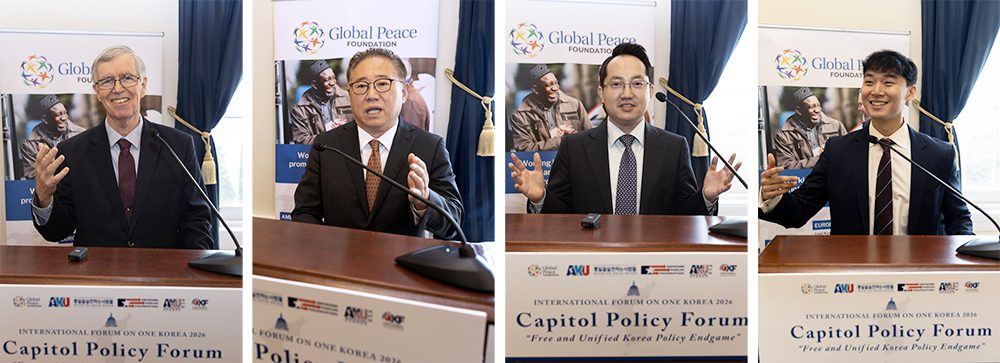
Session II Panel included (left to right): President James P. Flynn, Rev. Kenneth Bae, Hyunseung Lee, and Namsik Yoo
Mr. James P. Flynn, international president of the Global Peace Foundation, introduced the concept of the “Korean Dream,” a unifying vision rooted in the ancient Korean ethos of Hongik Ingan, meaning living for the greater benefit of humanity. He argued that unification must be understood as renewal. “Unification is not absorption; it is the building of a new nation grounded in freedom and human dignity,” he explained. At the same time, he warned against settling for incremental solutions that fail to address root causes. “Policy discourse is drifting toward ‘cold peace,’ but that is adaptation to failure, not a resolution.”
Reverend Kenneth Bae, founder and president of New Korea Foundation International and New Korea Hope Broadcasting, brought a sense of urgency to the discussion, drawing from his experience as a former prisoner in North Korea. He described worsening conditions, including food shortages and severe punishment for those attempting to escape. “Survival rates in these prisons are less than 30%. We are hearing reports of people starving to death,” he said, painting a stark picture of the humanitarian crisis. His conclusion was unequivocal: “The time for reunification is now. It is the only way for the people to be free and live with human dignity.”
Mr. Hyunseung Lee, another North Korean escapee and lead program strategist of the North Korea Initiative at Global Peace Foundation and program director of the North Korean Young Leaders Assembly, offered a critical assessment of longstanding U.S. policy. “The U.S. has operated under the slogan of ‘managing the threat,’ but that just gave the regime time to perfect its nuclear arsenal,” he argued. Calling for a more decisive approach, he added, “We must stop trimming the branches and address the source.” His remarks reflected a broader consensus that incremental management strategies have failed to produce meaningful change.
Namsik Yoo, director of Youth Programs at Alliance for Korea United-USA, reinforced the moral dimension of the issue, describing unification as more than a policy goal. “Reunification is a moral imperative,” he said, highlighting the role of youth and diaspora communities in building a grassroots movement for change. The panel discussion and subsequent Q&A further emphasized the effectiveness of information dissemination, with speakers noting that a majority of North Korean refugees had accessed outside media before escaping. “Out of 35,000 North Korean refugees, more than 60% of them heard radio programming before they escaped,” Reverend Bae shared, emphasizing the transformative power of truth.
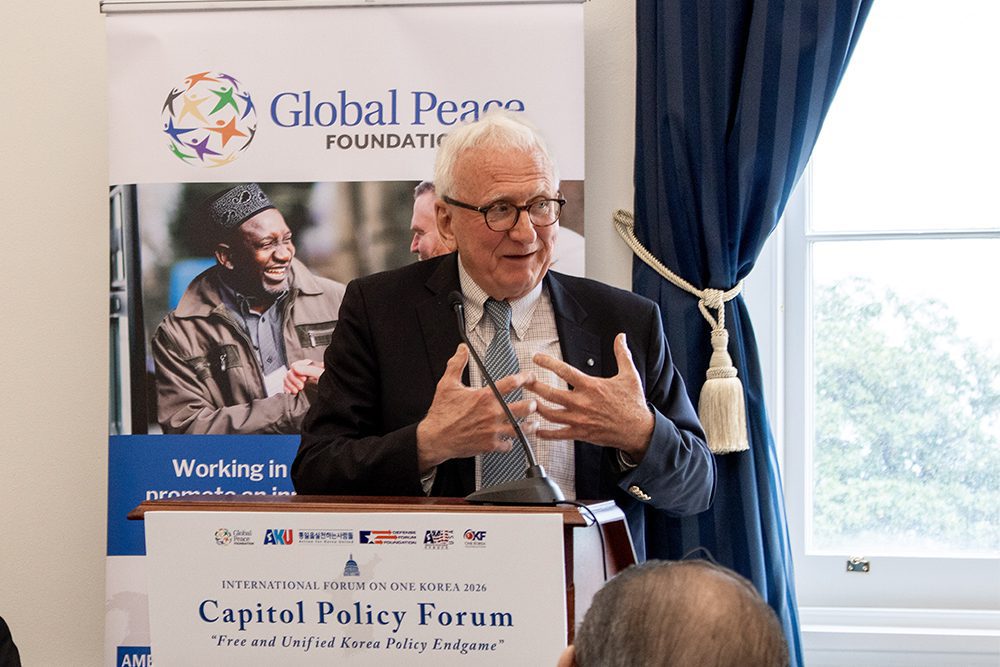
Ambassador Robert Joseph, keynote speaker at the International Forum on One Korea 2026
Ambassador Robert Joseph, senior scholar at the National Institute for Public Policy and former Under Secretary of State for Arms Control and International Security, brought decades of policy experience to the discussion. He delivered a clear critique of the prevailing approach to North Korea, stating that “diplomacy focused solely on denuclearization has failed and continues to fail.” He argued that the core issue lies not only in weapons development but also in the regime itself, which depends on both nuclear capability and systemic human rights abuses. “The Kim regime has at its core the belief that its very survival is based on the twin pillars of nuclear weapons and horrific human rights denial,” he explained.
Ambassador Joseph called for a fundamental shift in strategy, positioning unification as the most viable path forward. “A unified and free Korea is not some distant aspirational goal, but the best and perhaps only viable means to ending the security threat,” he said, urging policymakers to integrate human rights into security frameworks and support civil society-led efforts.
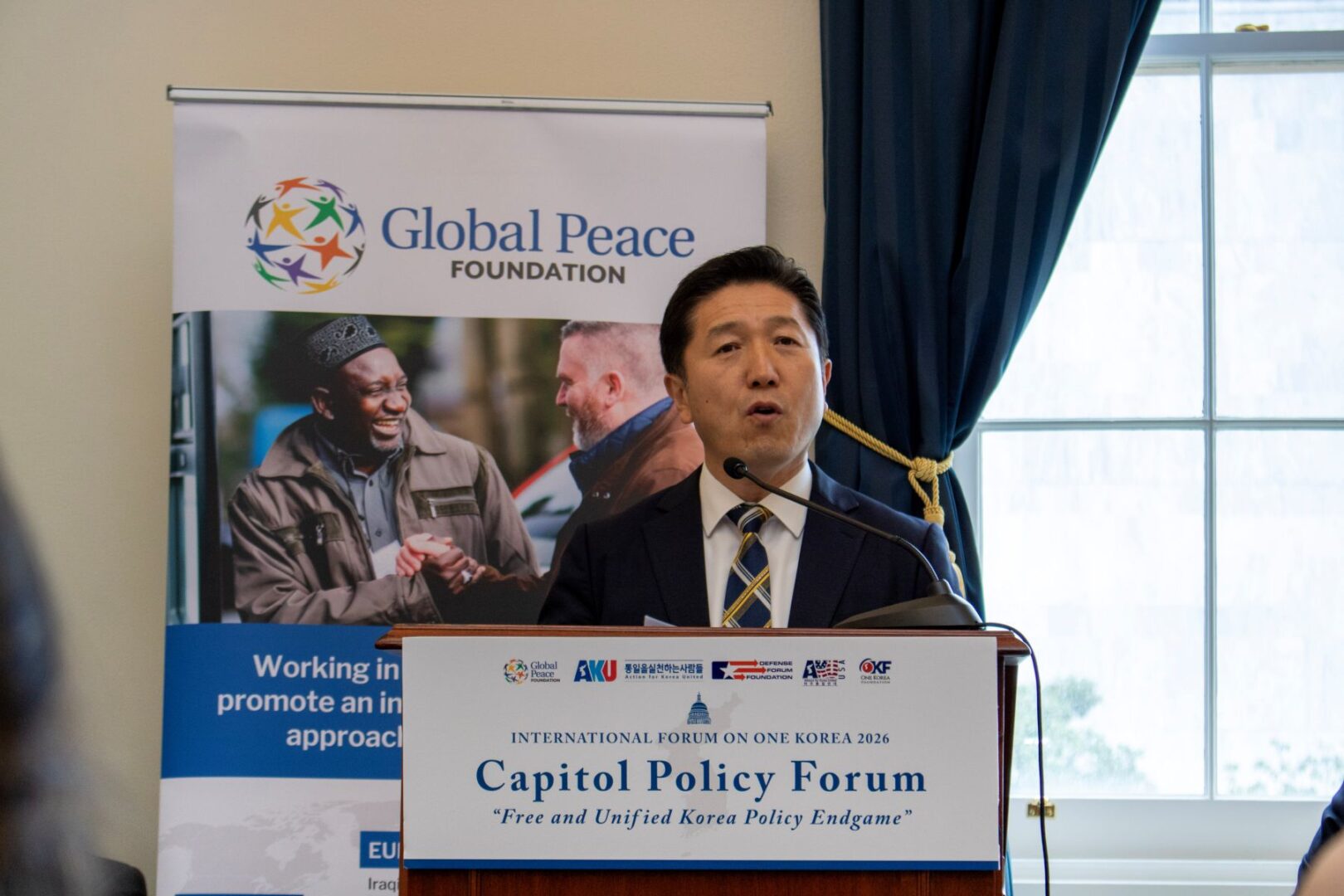
Action for Korea United Co-chair Inteck Seo
The forum concluded with a special presentation by Inteck Seo, co-chair of Action for Korea United, who clearly articulated the “One Korea” message at the heart of the forum. He rejected North Korea’s “two states” theory and called instead for a single, free, and unified nation. Seo argued that decades of alternating sanctions and negotiations have not fully addressed the root of the North Korean issue: the continued division of the Korean Peninsula and the absence of freedom for the North Korean people. Presenting the Korean Dream, rooted in the spirit of Hongik Ingan, as a shared vision that rises above ideology and factionalism, he emphasized that peaceful unification must be led by Korean civil society, with support from the United States and the international community. He also stressed that expanding access to truth and offering a hopeful vision of freedom to the North Korean people are essential to building a Korean-led path toward peaceful reunification.
Across all sessions, the forum made it unmistakably clear that lasting peace on the Korean Peninsula cannot be achieved without addressing the underlying issues of human rights and systemic repression. As one escapee poignantly stated, “A free and unified Korea is a concrete goal that we must build together.”
The forum’s call to action aligns with the broader vision of the One Korea Global Campaign, led by the Global Peace Foundation, which seeks to advance peaceful reunification through values-based, people-centered engagement across nations. As momentum builds, individuals and institutions alike are invited to take part in shaping this future by lending their voice and support. You can stand with this vision by signing your support for the Korean Dream through the Korean Dream 10 Million Campaign and contributing to ongoing efforts that promote freedom, human rights, and unity on the Korean Peninsula by supporting One Korea Global Campaign initiatives. Together, these collective actions help move the goal of a free and unified Korea from aspiration to reality.