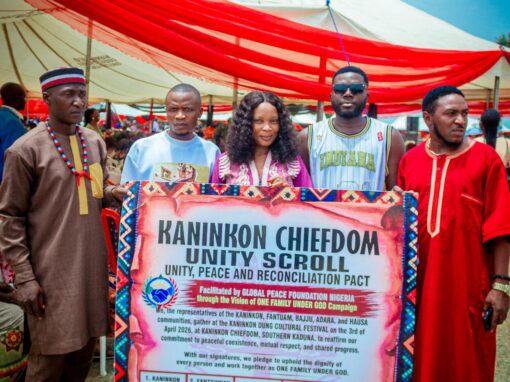
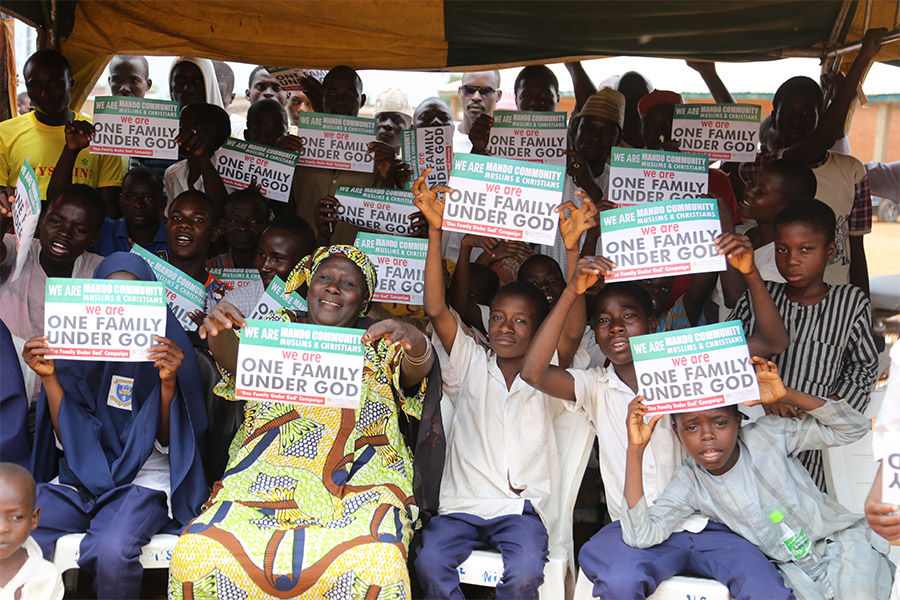
Nigeria’s Mandu community show support for interfaith peacebuilding at the One Family under God campaign Peace Festival
In today’s world, fractured by division and conflict, the call for peace rooted in shared human values has never been more urgent. On June 26, 2025, this call took center stage during a virtual seminar on Value-Based Community Peacebuilding, organized by the Global Peace Foundation (GPF) Nigeria in collaboration with the Education, Dialogue and Value System Initiative (EDVISI). The event drew 80 participants from across Nigeria, including religious leaders, educators, legal experts, security officials, and grassroots representatives, united by a common goal to explore how values can serve as the foundation for building more cohesive and resilient communities.
The seminar began with a profound premise that peace starts with seeing every individual as part of One Family under God. From there, discussions unfolded across Christian, Islamic, cultural, and community perspectives, showing that despite differences, the path to peace converges on shared values of respect, compassion, forgiveness, and reconciliation.
Rev. Dr. Kehinde Babarinde, National Director of EDVISI, emphasized the Christian perspective by presenting the “3 Rs of Peace”: Respect, Reconciliation, and Restoration. He emphasized that lasting peace is achieved when people place human dignity above all else, embrace love as the foundation of relationships, and extend compassion in moments of conflict.

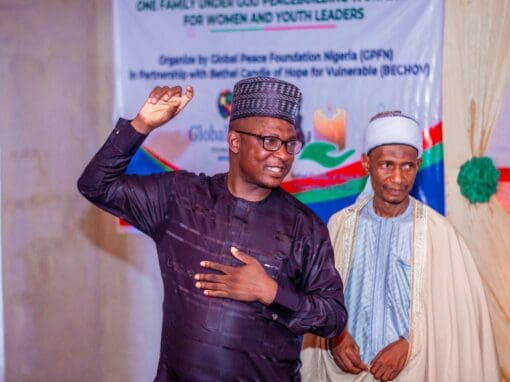
GPF Nigeria Director Rev. Hayab speaks during community dialogue session in the Plateau community.
Building on this, Rev. John Joseph Hayab, Country Director of GPF Nigeria, elaborated on community-based approaches to peacebuilding. Drawing lessons from initiatives in Southern Kaduna, he explained how empowering youth and women economically, fostering dialogue over confrontation, and addressing root causes of conflict, such as poverty and exclusion, can transform communities. He called on participants to be agents of peace, reminding them that violence, such as the recent killings in Plateau State, can only be prevented when people choose dialogue and refrain from spreading divisive narratives.
From the Islamic perspective, Imam Muhammad Alfa-Na, an Islamic Cleric, Jama’atu Islamiyya of Niger, highlighted that Islam itself is founded on peace. He drew from the teachings of the Prophet Muhammad, who emphasized compassion, respect, and even interfaith accommodation, reminding participants that true faith is reflected in kindness and peaceful coexistence.
Adding cultural depth, Chief Tunji Oyedokun Esq., a Solicitor, Chartered Arbitrator, Human Resource Manager & Adjunct Lecturer, Lagos Business School, introduced the Yoruba traditional system of reconciliation, where disputes are first resolved at the family or compound level through open dialogue and truth-telling. Supported by councils of elders and wise proverbs, these indigenous practices prevent conflict escalation and promote healing within communities. His contribution highlighted the importance of integrating traditional wisdom with modern approaches to conflict resolution.
Participant reflections further enriched the seminar. Dr. Victor Akerele stressed that peace must begin at the family level, while Esther Ayandokun placed emphasis on forgiveness as a Christian value central to rebuilding broken relationships. Abubakar Mohammed challenged participants to live out unity consistently, not just in private spaces but also in political and public life. AIG DNS Opadokun noted how forgiveness has been used strategically by the Nigerian Police to build trust in conflict-affected regions, reinforcing the practical power of value-based approaches.
Participants left the seminar with deeper respect for other religions and cultures, new perspectives on non-violent conflict resolution, and stronger commitments to promote inclusive peace within their communities. Calls were made for greater involvement of women, youth, and persons with disabilities in peace efforts, as well as for the national expansion of such initiatives.
This initiative reflects the Global Peace Foundation’s conviction that lasting peace is best achieved when communities themselves are empowered to lead the process. Through its community-driven peacebuilding approach, GPF works with local leaders, faith communities, and grassroots stakeholders to restore trust, strengthen social cohesion, and advance reconciliation based on shared values. Value-Based Community Peacebuilding has become a cornerstone of this work, offering a framework where interfaith collaboration, family strengthening, and service to others converge to create lasting harmony. In Nigeria and beyond, GPF continues to demonstrate that when communities embrace universal values like love, respect, forgiveness, and compassion, they not only heal divisions but also lay the groundwork for resilient, prosperous, and peaceful societies.
Learn more about GPF’s work in this area: Community-driven Peacebuilding