
Across diverse societies, communities, and organizations, everyday citizens are finding new ways to bridge divides, strengthen relationships, and build more peaceful societies. While conflict and polarization remain significant global challenges, sustainable peace continues to grow through ethical leadership, shared values, strong families, and communities willing to work together across differences. This people-centered vision is at the heart of the Global Peace Foundation’s approach to peacebuilding.
In the inaugural episode of the Global Peace Foundation (GPF) Podcast, hosts Lan Tsubata and Jeremy Graham spoke with Mr. James Flynn, International President of GPF, about the organization’s values-based model for building peace, and why peacebuilding is both a global challenge and a personal responsibility.
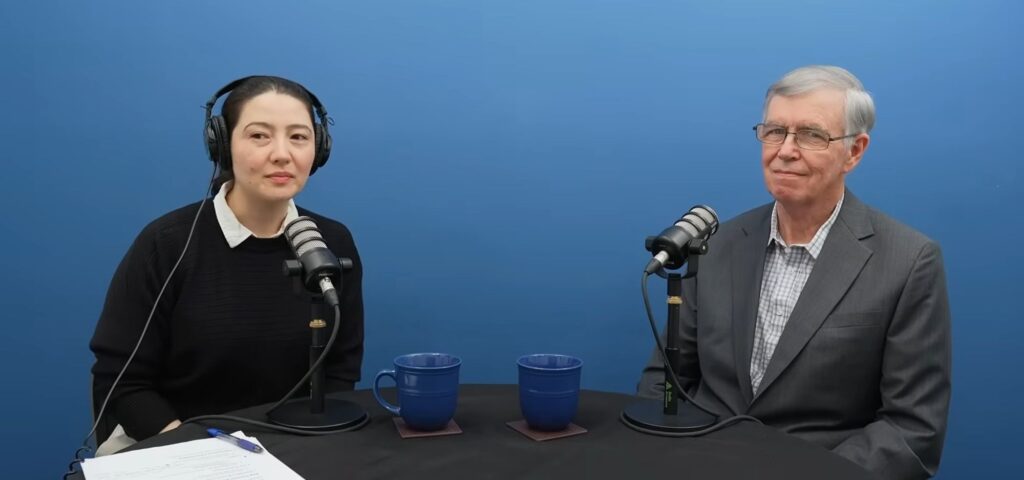
Inaugural Global Peace Foundation Podcast featuring James Flynn
GPF advances a values-based approach to peacebuilding through community-driven initiatives, education transformation, youth and leadership development, interfaith cooperation, family strengthening, and cross-sector partnerships in countries around the world. At the center of its mission is a simple but far-reaching vision: One Family Under God.
For Mr. Flynn, this vision is rooted in a fundamental reality often overlooked in public discourse: human beings are relational by nature.
“We all begin in families,” he explained. “We find meaning and value through relationships with others.”
That perspective was shaped early in his own life. Growing up as one of seven brothers working in a family flower business, Mr. Flynn learned lessons in cooperation, responsibility, and collective contribution. Observing the balance and harmony within nature later led him to a difficult contrast: the fragmentation often present in human society.
“The natural world reflects order and harmony,” Mr. Flynn noted. “But human societies struggle with learning how to live and work together successfully.”
This challenge, he argues, lies at the heart of peacebuilding.
A Shared Human Identity
According to Mr. Flynn, “One Family Under God” is more than a slogan. It offers a framework for overcoming division by emphasizing shared human identity above ethnic, religious, political, or social differences.
“Different faith traditions may describe our origin differently – God, Allah, Creator – but humanity shares a common source,” he said. “Recognizing that interconnectedness is foundational to building peace.”
The idea becomes especially relevant in an era marked by identity conflict and social polarization. Mr. Flynn warned that many of history’s worst atrocities have followed a familiar pattern: the dehumanization of the “other.”
“If you study genocide, there is a process where another group is demonized and stripped of its humanity,” he explained. “Recognizing the dignity and value of every person is essential if peace is to be possible.”
This principle, the intrinsic value and dignity of every human being, is one of the universal principles that guide GPF’s work.
Mr. Flynn distinguished between principles and values, concepts often treated interchangeably but critically different in GPF’s framework. Principles, he explained, are enduring truths that govern human life and relationships. Values are the choices individuals and societies make about how they will live.
“Human beings have agency and freedom,” Mr. Flynn said. “Values are the ways we choose to live.”
The work of peacebuilding, therefore, requires cultivating shared values that strengthen social trust and cohesion.
From Conflict Response to Conflict Prevention
The discussion also clarified the distinction between peacekeeping, peacemaking, and peacebuilding.
Peacekeeping focuses on halting immediate violence. Peacemaking involves negotiations and settlements between conflicting parties. Peacebuilding, however, addresses the long-term conditions that make peace sustainable.
“Preventing conflict is wiser, more effective, and less costly than spending decades rebuilding after violence,” Mr. Flynn said.
That preventive approach is evident in GPF’s work in Nigeria, where teams have spent more than 15 years implementing the grassroots “One Family Under God” campaign in communities facing religious and ethnic tensions.
Rather than beginning with abstract dialogue alone, the approach combines relationship-building with practical cooperation. Traditional leaders, faith communities, women, and youth collaborate on local initiatives such as wells, bridges, and market access projects, shared efforts that strengthen trust across community divides.
“When people work together to solve common problems, they begin building relationships,” Mr. Flynn explained. “Those relationships become critical when crises emerge.”
GPF has applied similar principles in reconciliation initiatives in the United States, including work addressing long-standing racial divisions through sustained dialogue and community engagement.
The Need for Moral and Innovative Leadership
A recurring theme throughout the conversation was leadership, specifically what GPF calls moral and innovative leadership.
Mr. Flynn credited Dr. Hyun Jin Preston Moon, founder and chairman of GPF, with championing this framework globally.
Innovation alone, Mr. Flynn argued, is insufficient.
“Science and technology are often value-neutral,” he said. “The question is whether innovation is guided by a moral compass.”
In an age of rapid technological advancement, that balance is increasingly important. Societies have gained extraordinary scientific and technological capabilities, but ethical and moral development has not always advanced at the same pace.
GPF’s leadership framework challenges individuals to examine their deepest motivations, pursue meaningful goals, take ownership of those goals, and collaborate with others to create impact.
“The more meaningful your motivation, the greater the potential of your vision,” Mr. Flynn said.
Peacebuilding Begins with People
While GPF’s long-term vision includes transforming nations through stronger families, ethical leadership, education, and values-driven civic engagement, Mr. Flynn emphasized that peacebuilding does not begin at the national level.
It begins with individuals.
“Every day presents an opportunity to act with compassion, concern, or kindness toward another person,” he said.
For GPF, peacebuilding is not a completed destination or a specialized task reserved for diplomats, policymakers, or institutions. It is an ongoing process rooted in everyday human choices and relationships.
“Every person can be a peacebuilder,” Mr. Flynn concluded. “Peacebuilding is never done.”
To hear the full conversation and explore more insights on values-based peacebuilding, leadership, and the vision of One Family Under God, listen to the inaugural episode of the GPF Podcast on YouTube or Spotify.
Learn more about the Global Peace Foundation’s work and initiatives.