More than 350 participants from 55 countries gathered virtually on June 4, 2026, for the Ubuntu Africa Interfaith Virtual Summit, a landmark convening that brought together faith leaders, traditional authorities, policymakers, youth representatives, civil society leaders, scholars, and development practitioners committed to advancing peace, ethical leadership, and sustainable development across Africa.
Organized through a collaboration between the African Union Commission Citizens and Diaspora Organizations Directorate (AUC CIDO), the Global Peace Foundation (GPF), United Religions Initiative (URI) Africa, and the Intergovernmental Authority on Development (IGAD) Centre of Excellence for Preventing and Countering Violent Extremism, the summit was held under the theme “From Dialogue to Transformation: Advancing Peace, Ethical Leadership, and Sustainable Development in Africa through Faith, Ubuntu, and the Golden Rule.”
The event opened with Christian and Muslim prayers led by Bishop Dr. John Warari Wakabu of Kenya and Ambassador Sheikh Saleh Habimana of Rwanda, setting a tone of unity, mutual respect, and shared commitment to peace. Participants were reminded that Ubuntu – “I am because we are”- offers a powerful moral framework for addressing Africa’s most pressing challenges through solidarity, empathy, and collective responsibility.
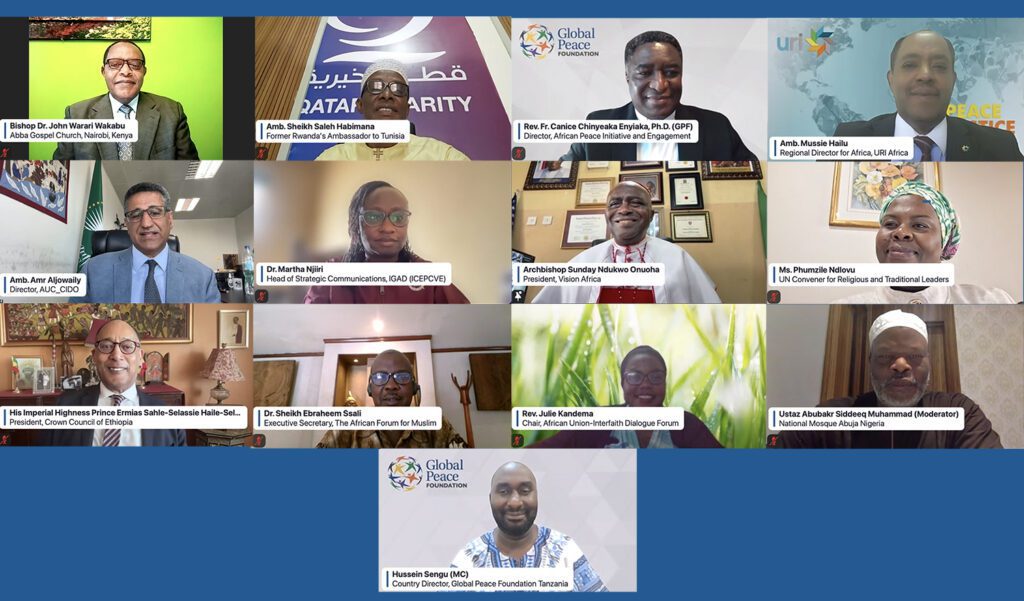
Ubuntu Africa Interfaith Virtual Summit Group Photo
In his opening remarks, Rev. Fr. Canice Chinyeaka Enyiaka, Ph.D., director of the African Peace Initiative at the Global Peace Foundation, emphasized that Africa’s challenges, including conflict, corruption, social fragmentation, youth unemployment, and declining trust in institutions, require more than political or economic solutions. He called for a values-based approach to peacebuilding rooted in integrity, compassion, justice, responsibility, and respect for human dignity. He challenged religious leaders to reclaim their moral voice and champion ethical leadership, accountability, and social cohesion across the continent, noting that “lasting peace is built not merely through agreements, policies, or institutions, but through the transformation of individuals, families, communities, and nations.”
Representing URI Africa, Ambassador Mussie Hailu highlighted the organization’s longstanding commitment to interfaith cooperation and peaceful coexistence. He noted that the principles of Ubuntu and the Golden Rule provide practical solutions to contemporary challenges such as hate speech, discrimination, xenophobia, and violence. He further called for stronger collaboration among faith communities to promote understanding, empathy, and inclusive development.
Dr. Martha Njiiri, head of Strategic Communication at the IGAD Centre of Excellence for Preventing and Countering Violent Extremism, highlighted the critical role of faith leaders in fostering peace and resilience. She emphasized that preventing violent extremism requires strengthening social cohesion, ethical leadership, and shared responsibility. Dr. Njiiri also
highlighted the growing challenge of misinformation and hate speech in digital spaces, urging faith leaders to champion responsible communication, digital literacy, and truth-based leadership.
Delivering the keynote address, Ambassador Amr Aljowaily, AUC director for Citizens and Diaspora Organizations Directorate (CIDO), connected the summit’s themes to the aspirations of the African Union’s Agenda 2063. He described Ubuntu and the Golden Rule as ethical foundations for advancing peace, governance, and sustainable development. He also highlighted the African Union’s ongoing work through the Interfaith Dialogue Forum and other initiatives that engage faith communities as essential partners in peacebuilding, social cohesion, and development. Emphasizing the need to move beyond discussion, he stated that “Africa’s spiritual and ethical traditions can be mobilized not only to inspire, but also to organize action.”
A high-level panel discussion brought together respected religious, traditional, and civic leaders from across the continent. Speakers explored practical ways to translate the values of Ubuntu and the Golden Rule into action by addressing corruption, strengthening moral leadership, empowering youth, promoting interfaith cooperation, protecting human dignity, and fostering social justice.
Archbishop Sunday Ndukwo Onuoha of Nigeria stressed the moral responsibility of faith leaders to confront corruption, injustice, and division, arguing that religion must move beyond dialogue and become a force for transformation. Ms. Phumzile Ndlovu of South Africa called for stronger implementation of policy commitments and greater investment in youth opportunities, while His Imperial Highness Prince Ermias Sahle-Selassie of Ethiopia highlighted the role of traditional leadership in preserving cultural values and amplifying community voices.
Other panelists stressed the importance of youth empowerment, ethical leadership, community service, and institutionalized interfaith collaboration. Dr. Sheikh Ebraheem Ssali of the African Forum for Muslim Councils urged faith communities to move from being commentators on conflict to active agents of peacebuilding. “Dialogue without action cannot transform societies,” he said, calling for sustained partnerships, joint programs, and collective service that embody both Ubuntu and the Golden Rule. Rev. Julie Kandema, Chair of the African Union Interfaith Dialogue Forum, emphasized mentorship, entrepreneurship, and character formation as key to raising a new generation of ethical leaders.
Building a peaceful, prosperous, and resilient Africa requires ethical leadership, active citizenship, strong families, interfaith cooperation, and communities united by shared values. Reflecting the Global Peace Foundation’s commitment to values-based peacebuilding, the summit called on leaders, faith communities, and citizens alike to translate the principles of Ubuntu and the Golden Rule into practical initiatives that strengthen social cohesion, restore trust, and advance sustainable development.
Learn more about how GPF is working with partners around the world to build peaceful and flourishing societies: What We Do | Global Peace Foundation.