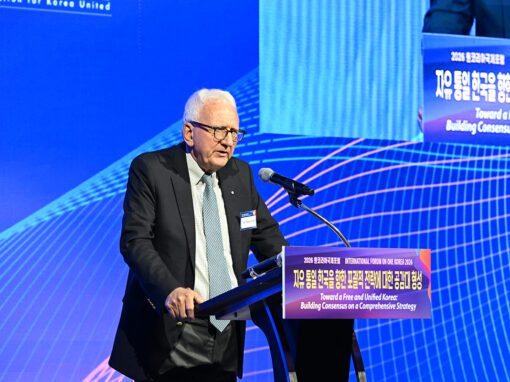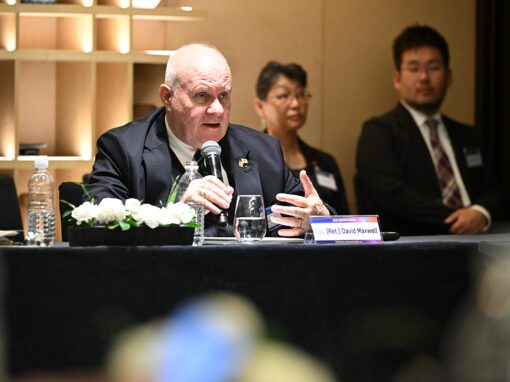
The following remarks were delivered by Ambassador Robert Joseph at the 2026 International Forum on One Korea in Seoul. A longtime contributor to Global Peace Foundation forums on Korean unification and security, Joseph brought decades of experience in arms control, nonproliferation, national security, and diplomacy to the discussion. He also chaired the U.S. Free and Unified Korea Working Group, which developed the 2026 policy paper Toward a Free and Unified Korea: Resolving the Korea Challenge at Its Source.
When we think about U.S. and South Korean policy toward North Korea, as well as the policies of the broader international community, I believe it’s accurate to say that our two principal objectives, advancing our national security interests, especially denuclearization on the one hand, and ending the grotesque human rights abuses in the North on the other, have been treated by policymakers for far too long as distinct and mostly unrelated issue areas.
Our contention is that by treating these objectives in separate siloes, we have failed to achieve either goal, whether that is the end of the North’s nuclear program or an improvement in the lives of the North Korean people. It is essential that we recognize the interconnections between these two goals.
Some of you may know that my association with the cause of human rights and freedom for the people of North Korea came about after years of working in the national security arena to end the North’s nuclear weapons program. At some point while I was still in government, I concluded that something was fundamentally wrong with the whole concept of addressing the nuclear threat through diplomacy alone. The paradigm was flawed. Some critical, essential element was missing.
While perhaps obvious to many, administration after administration failed to accept that the Kim regime has at its core the belief that its very survival is based on two pillars: nuclear weapons and the denial of the basic rights of its citizens. For this single reason, only the end of the artificial division of the peninsula and the establishment of a free and unified Korea will bring a permanent resolution to both challenges.
Failure should be a powerful teacher. Unfortunately, despite North Korea having violated every nuclear-related commitment it has made, U.S. and South Korean policy continues to call for denuclearization negotiations.
As recently as last week, on the margins of the UN General Assembly session, President Lee reportedly urged the United States to ease sanctions on Pyongyang in exchange for a freeze on the North’s nuclear and missile programs, one of the oldest bad ideas on record. And this came after Kim Jong Un’s sister declared that “only an idiot” would think the North would halt its nuclear program. Enough said.
Kim Jong Un is a third-generation despot ruling a regime that, as documented by the U.N., commits crimes against humanity in the treatment of his own people. He is also personally directing the rapid buildup of the nuclear arsenal. If we fail to change policy, it is almost certain that in the next few years the North will possess hundreds of nuclear weapons and the means to deliver them with modern missiles. Imagine a world in which Kim possesses 200 or 300 nuclear weapons, threatening its neighbors and with a proven record of selling everything at its disposal for a price, of course.
Meanwhile, the U.S. and international response is in effect to place North Korea on the back burner. There is a clear unwillingness in Washington and Seoul to accept that there are irreconcilable interests with Kim’s regime and an inability to design more effective policies and capabilities to prepare for the growing threat.
Yet, despite decades of failure, U.S. and South Korean policy is stubbornly resistant to change. The fact remains that, as long as the Kim dynasty rules North Korea, it will expand its nuclear arsenal and, as the last of the totalitarian states, it will continue to oppress its citizens.
In the interim, as the Korean people work to advance the cause of freedom and unification, applying maximum economic and political pressure while ensuring deterrence is the best means for the United States to manage the threat until the North falls from its own internal contradictions.
And this is where our working group report makes its most valuable contributions. Looking at the prospects for unification from a geostrategic, cultural, and economic perspective, we conclude that the national security and human rights challenges on the peninsula can only be resolved by ending the division of the Korean nation and the establishment of a free and unified Korea.
Our report identifies three steps as a pathway to this end.
First, we need to win the intellectual debate. Progress toward unification as a practical goal has been stymied by long-standing misinformation and persistent economic and policy myths. Our report takes on those myths directly. Each one is convincingly debunked. For example, false assertions that unification will lead to war or that unification is too costly.
Having experts on our working group, like David Maxwell on security and Nick Eberstadt, provide enormous credibility to the report. On the economic front, no one is better than Nick, who has compellingly demonstrated that economic transformation brought about by unification is best viewed not as an insurmountable encumbrance but as a strategic investment opportunity.
Second, integrating the history, culture, and founding ideals of the Korean nation adds an essential dimension often missing from conventional analyses. Yet, the consequences of the artificial division of the peninsula remain profound, including a constant risk of military escalation with the nuclear-armed regime in the North and its systemic crimes against humanity.
A sustainable strategy must incorporate the cultural heritage and founding ethos of the Korean people. Here, we draw on Dr. Moon’s Korean Dream framework that emphasizes the universal principles articulated in democratic founding documents. In this way, unification is rightly understood as the historical completion of the Korean people’s destiny, and as such, it serves to mobilize the support of citizens across geographic and generational divides.
Third, our report turns on its head the traditional view of human rights held by policymakers. Far from treating human rights as a secondary issue or an impediment to national security negotiations, we advocate putting human rights upfront in our national strategy. Greg Scarlatoiu and Hyunseung Lee provided invaluable insights in this context, including the critical need for more focused and effective efforts to convey information to the North Korean people.
Finally, let me conclude with our recommendations for decision-makers.
One: Emphasize in official U.S. and ROK policy documents that a free and unified Korea is the primary objective and the only permanent solution to the nuclear threat and human rights abuses in the North. Diplomacy in the form of negotiations to achieve denuclearization has for far too long been the problem masquerading as the solution. The real solution is a free and unified Korea. This is the exact reason Kim Jong Un has sought to extricate unification from the DPRK constitution and from longstanding official North Korean policy. Accepting this dictate is a betrayal of the Korean people.
Two: Integrate human rights upfront into our broader security strategy. This is essential if we are to move from failure to success.
Three: Washington and Seoul should establish a joint mechanism to develop contingency plans for the essential tasks that may arise in the transition period, including efforts such as humanitarian response, WMD recovery and security, and economic integration.
Four: Strengthen public diplomacy campaigns to counter the myths associated with unification.
Five: Engage regional stakeholders through diplomatic channels, including China, not to seek their approval but to reduce misunderstandings and address concerns.
Six: Prepare the financial architecture with outreach to international institutions to facilitate investment in a unified Korea.
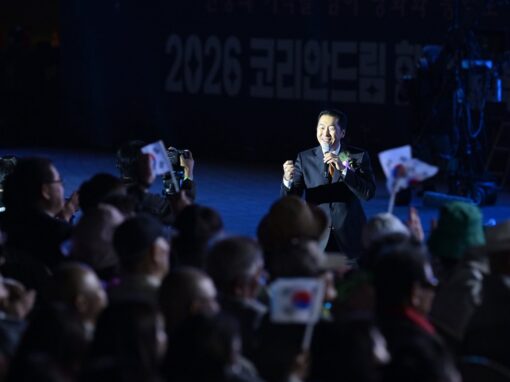
And seven: I think this is particularly important: strengthening civil society engagement, especially Korean-led civic initiatives to promote unification. Today’s conference and tomorrow’s festival fit precisely with this recommendation.
I understand that many of you here today are leaders in Action for Korea United, the largest civic coalition for unification in the history of modern Korea. Your leadership in this cause for a free and unified Korea is absolutely vital. I applaud you.
I want to close with a thought suggested by Michael Marshall at times of transformative change. A strong sense of national vision and purpose is necessary for a country to navigate successfully. Dr. Henry Kissinger strongly emphasized this idea in a speech to the Asan Institute in 2010.
He said that in questions about world order, the issue always comes down to the question, and here I quote: “Does there exist a vision of the future? And does there exist the ability and commitment to achieve it?”
I know the Korean people everywhere will answer that question with a resounding “yes!”
The vision is the Korean Dream, and the commitment to achieve it is embraced by the Korean people. This is a defining moment in history. This is a time for action. Shame on those who would abandon the people of North Korea and further divide the Korean people. There is only one Korean people and one Korean nation.
Thank you for your attention.