Korea’s division was never meant to become permanent. Yet more than eight decades after liberation, the peninsula remains split between two systems, two realities, and two futures.
That division is not only a Korean tragedy. It is a regional security challenge, a human rights crisis, and an unfinished question at the heart of Northeast Asia’s future.
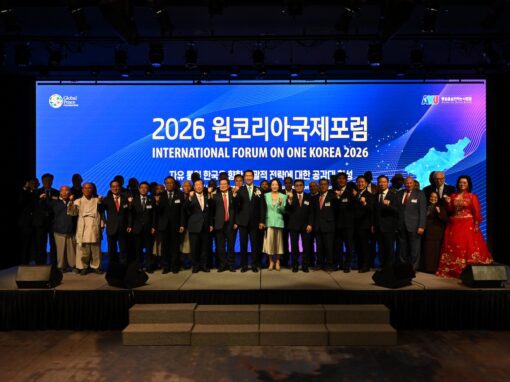
The International Forum on One Korea 2026 gathered leaders, policymakers, experts, and civil society representatives in Seoul under the theme “Toward a Free and Unified Korea: Building Consensus on a Comprehensive Strategy.” Hosted by the Global Peace Foundation and Action for Korea United, the forum asked what it will take to move beyond managing division and begin preparing seriously for a free and unified Korea.
Held just ahead of Gaecheonjeol, Korea’s National Foundation Day, the gathering carried deeper historical meaning. Gaecheonjeol recalls the founding of the Korean nation and the ideal of Hongik Ingan, to broadly benefit humanity. For many speakers, that ideal offered more than symbolic language. It framed unification as a question of national identity, moral responsibility, and Korea’s possible contribution to the wider world.
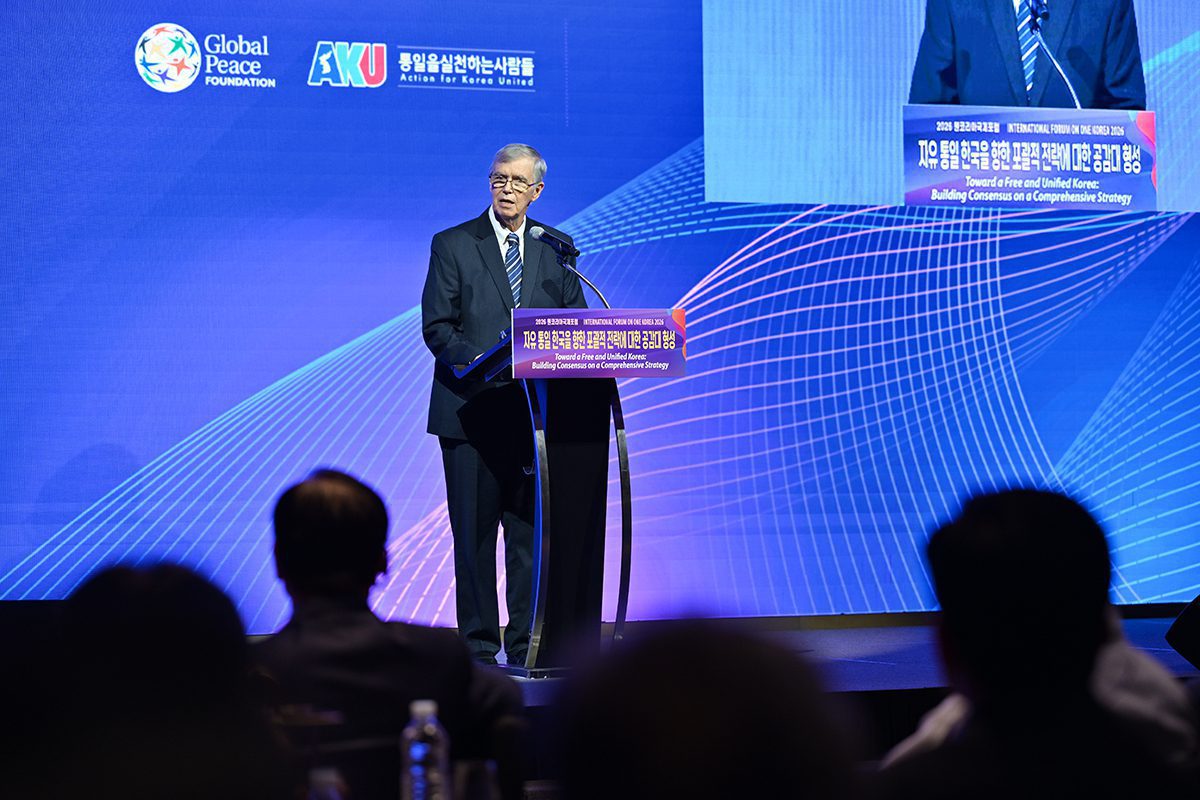
Mr. James P. Flynn, international president of the Global Peace Foundation, delivers opening remarks.
Opening the forum, Global Peace Foundation International President James P. Flynn said the division of the Korean Peninsula has “endured for more than eight decades, separating families, denying freedom to millions, and threatening global security.” He added that participants gathered with the conviction that division “can be overcome” and that the steps taken together can help make that future possible.
Flynn described the Korean Dream as a vision that connects security, human rights, and economic opportunity within a framework grounded in freedom and the rule of law. Most importantly, he said, it is “a vision to be owned by and led by the Korean people.”
A Moment That Calls for Action
Throughout the opening session, speakers warned that Korean unification cannot be treated as a distant or abstract issue.
Hon. Seung-joo Baek, former member of the National Assembly of the Republic of Korea and senior advisor to Action for Korea United, stressed that freedom must be both protected in South Korea and extended throughout the Korean Peninsula. “Building a free and unified Korea cannot be left to the government alone,” he said. “It must be led by citizens who are willing to take action.”
Former National Assembly Speaker Hon. Jin-pyo Kim called Korean unification “a defining challenge of our time,” saying it must be addressed not by one generation or political camp, but by the Korean people together with the international community. He added that, in the face of North Korea’s hostile two-state theory, international consensus must be translated into “practical action.”
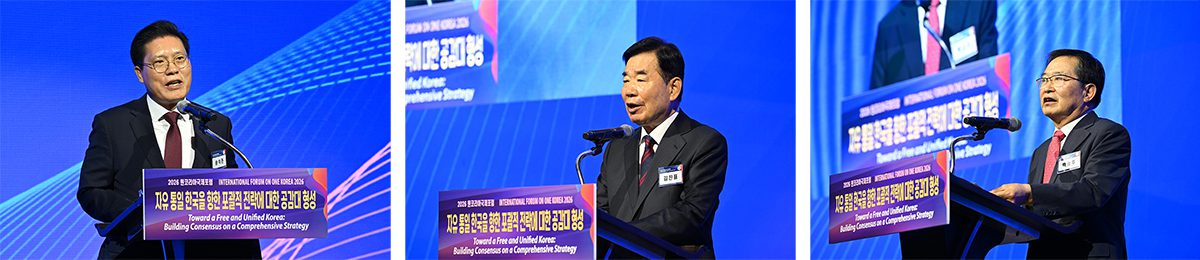
From left to right: Hon. Seok-jun Song, Hon. Jin-pyo Kim, Hon. Seung-joo Baek
Hon. Seok-jun Song, chairman of the Foreign Affairs and Unification Committee of the National Assembly, also connected unification to Korea’s broader historical purpose, saying that a unified Korean Peninsula based on the spirit of Hongik Ingan can become “a starting point for global peace and shared prosperity.”
The urgency of the issue is also reflected in South Korea’s constitutional framework. Article 4 of the Constitution of the Republic of Korea states that the Republic of Korea “shall seek unification” and formulate and carry out a policy of peaceful unification based on a free and democratic basic order.
Together, the opening remarks set the tone for the forum: unification was presented not only as a policy goal, but as a responsibility requiring public will, civic leadership, international cooperation, and concrete strategy.
Beyond Denuclearization Alone
One of the forum’s strongest arguments was that the Korean Peninsula cannot be stabilized through a narrow focus on denuclearization alone.
Amb. Robert Joseph, former U.S. Under Secretary of State and senior scholar at the National Institute for Public Policy, argued that past policy has treated national security and human rights as separate issues for too long. By keeping those objectives in separate silos, he said, policymakers have failed to achieve either the end of North Korea’s nuclear program or an improvement in the lives of the North Korean people.
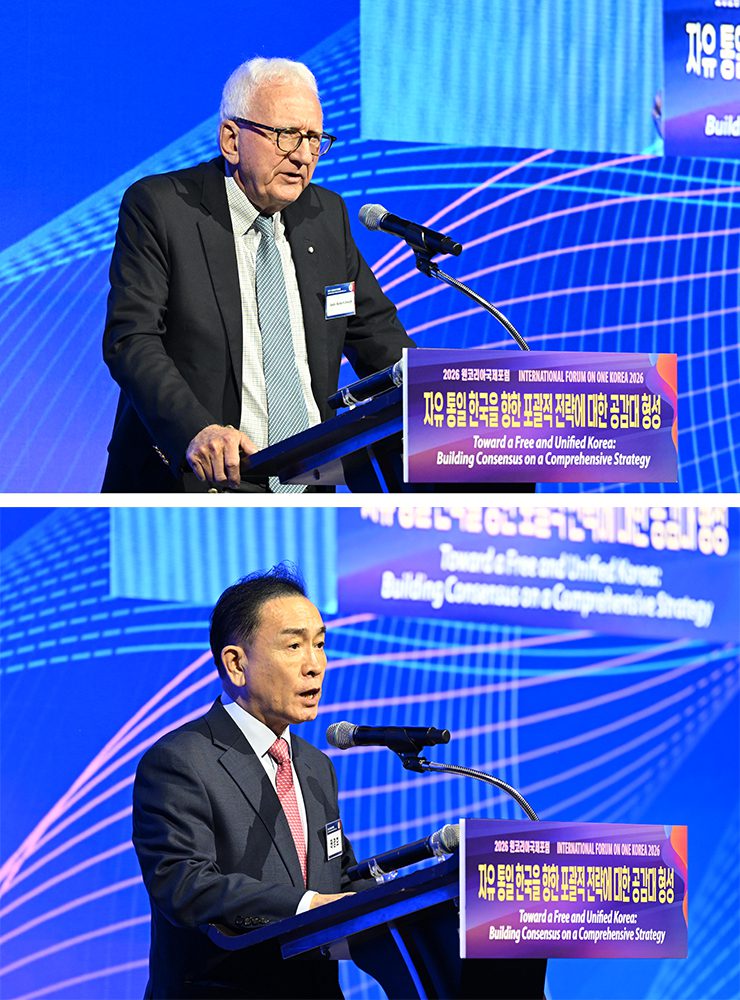
Top to bottom: Amb. Robert Joseph and Hon. Yong-ho Thae
Amb. Joseph was direct in his assessment: “Only the end of the artificial division of the peninsula and the establishment of a free and unified Korea will bring a permanent resolution to both challenges.”
He urged decision-makers to place a free and unified Korea at the center of official policy, integrate human rights into security strategy, strengthen public diplomacy, prepare for transition, and support Korean-led civil society initiatives. He said the work of Action for Korea United and the forum itself fit directly into the need for stronger civic engagement around unification.
The human rights dimension remains central to this discussion. The United Nations Human Rights Council established the Commission of Inquiry on human rights in the Democratic People’s Republic of Korea to investigate “systematic, widespread and grave violations” of human rights, including violations that may amount to crimes against humanity.
Hon. Yong-ho Thae, former secretary of the Foreign Affairs and Unification Committee of the National Assembly, echoed the need to shift strategy. He called for a free and unified Korean Peninsula to become a common goal of the ROK-U.S. alliance and the international community, while urging a move away from policy centered only on nuclear and crisis management toward a strategy for free unification.
He also emphasized the role of information and civil society, saying external information should be expanded so that North Koreans can become “the main body of change,” while grassroots unification efforts and international solidarity led by civil society should be strengthened.
The Korean Dream and the Responsibility of This Generation
In his keynote address, Dr. Hyun Jin Preston Moon, chairman of the Global Peace Foundation, framed the moment not as a routine policy debate but as a turning point for the Korean people.
“We stand at a tremendous watershed moment in the history of our people and our civilization,” he said. Korea, he argued, faces a choice: “We can make history and realize the dreams of our ancestors,” or allow circumstances on the peninsula to dictate the future of the Korean people.
Dr. Moon rooted that choice in Korea’s founding ideal of Hongik Ingan—to live for the benefit of all humanity. He described this ideal as one of Korea’s greatest contributions to the world, saying that while products and entertainment may bring immediate pleasure, “a vision and an ideal can change the face of our humanity.”
For Dr. Moon, unification is not only a political objective. It is a moral agenda tied to the unfinished destiny of the Korean people. He argued that Korea’s division was “a foreign construct thrust upon us,” not the natural outcome of Korean history, and said the international community has a responsibility to support the Korean people’s dream for a unified peninsula rooted in the Korean Dream.
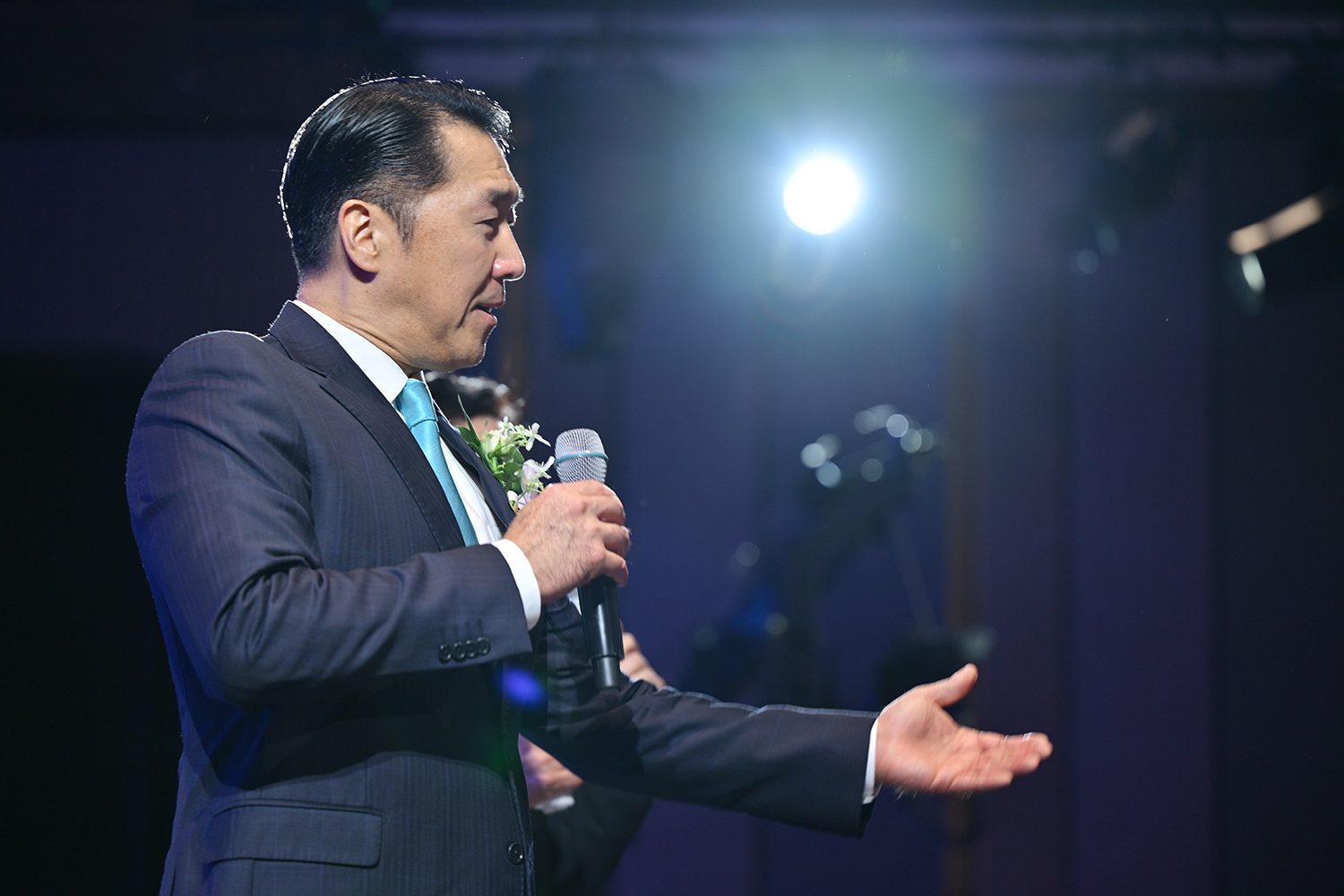
Dr. Hyun Jin Preston Moon delivers the keynote speech at the International Forum on One Korea
He also challenged Korean leaders and citizens to take ownership of that future. “Through the Korean Dream, I’m telling the Korean people: we need to take ownership over our destiny,” he said. “You need to lead us with moral authority that allows the Korean people to rally behind the Korean Dream and unify our peninsula.”
That call was especially directed toward this generation. Dr. Moon warned that North Korea is working to make division permanent and to gain international acceptance for that framework. “We absolutely cannot allow that framework to take root, not only here on the peninsula, but within the minds of the international community,” he said.
Near the close of his address, he returned to the power of shared ownership: “Because one person can have a dream, it is but a dream. But if everyone can share and own that dream, it becomes a reality.”
In that frame, the Korean Dream is not simply an idea to be discussed. It is a responsibility to be claimed, a vision to be carried, and a future that must be prepared for by Koreans in the South, the North, and the diaspora.
Turning Strategy Into Policy and Public Action
The afternoon plenary moved from vision to policy and implementation.
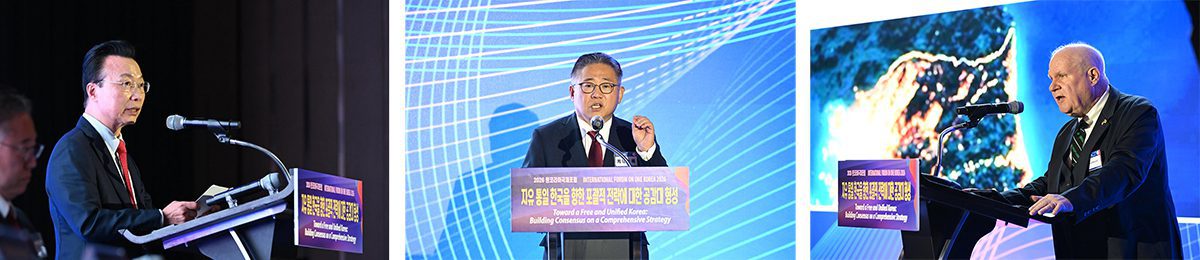
Left to right: Dr. Chun-sig Kim, Rev. Baek-san Kim, Col. (Ret.) David Maxwell
Col. (Ret.) David Maxwell, vice president of the Center for Asia Pacific Strategy, urged participants to treat unification as a subject that must be discussed honestly and publicly. “Talk about it. Study it. Listen to those who oppose it. Answer their concerns honestly,” he said. He also called for honesty about both the costs of unification and the costs of permanent division, while urging support for human rights, information access, and government preparation for peaceful unification.
Dr. Chun-sig Kim, former president of the Korea Institute for National Unification, addressed the risks of two-state thinking. He argued that North Korea’s hostile two-state theory is aimed at preserving the regime and strengthening nuclear threats, while South Korea’s own peaceful two-state approach could risk entrenching division rather than guaranteeing peace.
Kim called for South Korea to strengthen the ROK-U.S. alliance and extended deterrence while maintaining denuclearization as a goal. At the same time, he emphasized the need to preserve the special inter-Korean relationship oriented toward unification and maintain a shared national identity while consistently pursuing free and peaceful unification.
Rev. Kenneth Bae, president of the New Korea Foundation, brought the discussion to the human level by focusing on information access for the North Korean people. “For people who are isolated, this work is about telling them, ‘You have not been forgotten,’” he said. “It is also about giving them the possibility of thinking for themselves and making their own choices.”
Rev. Bae warned that reduced support for broadcasting and other information channels has weakened the flow of outside information into North Korea. But, he said, “the North Korean people’s need for information and their need for freedom do not disappear.”
He described information not as propaganda, but as a way to create space for independent thought. “The purpose of bringing information into North Korea is not to tell North Korean residents what they must think,” he said. “The purpose is to provide accurate information and show them different ways of life, thereby opening a space where they can think for themselves.”
Regional Cooperation and the Work Ahead
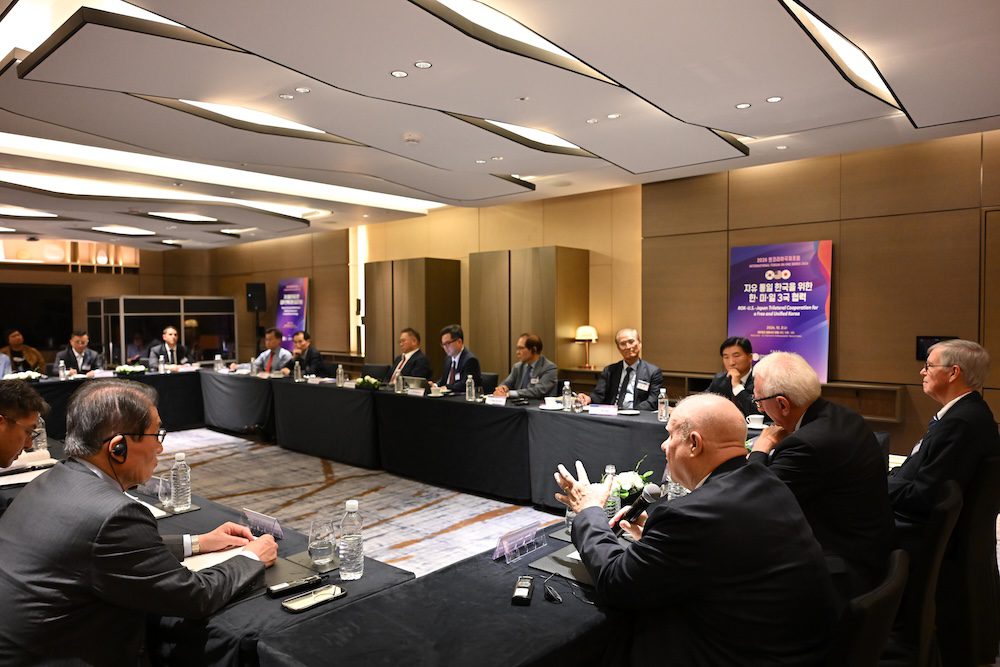
Roundtable: ROK–U.S.–Japan Trilateral Cooperation for a Free and Unified Korea
The forum also included a roundtable on ROK-U.S.-Japan trilateral cooperation for a free and unified Korea, underscoring the importance of regional alignment. The roundtable pointed to the broader strategic significance of unification for Northeast Asia and the Indo-Pacific.
That regional dimension has become increasingly important. Since the 2023 Camp David Summit, the United States, Japan, and the Republic of Korea have deepened security cooperation, including real-time DPRK missile warning data sharing and a multi-year trilateral exercise plan.
The day’s discussions made clear that a free and unified Korea is not simply a slogan or a distant hope. Speakers framed it as a strategic necessity, a human rights imperative, a civic responsibility, and a historical task that requires preparation now.
Korea’s division has lasted so long that it can begin to feel permanent. But history is not only shaped by what people accept. It is shaped by what they prepare for.
On Gaecheonjeol, the ideal of Hongik Ingan calls Korea back to a purpose larger than survival, division, or rivalry. It points to a future where Korea’s freedom and unity could serve not only the Korean people, but the wider region and the world.
That future will not arrive by accident. It will require courage, strategy, public conviction, civil society action, and international cooperation.
The question now is not only whether a free and unified Korea is possible.
It is whether this generation is willing to prepare for it.