Esteban Jiménez
I met Esteban Jiménez, a Colombian classmate, while studying peace and conflict studies in Germany. During one of our conversations, I asked him how growing up in Colombia had shaped his understanding of peace, conflict, and his responsibility towards his community. His response took me back to his childhood, his mother’s experiences, the decisions his parents made to protect their children, and the opportunities that eventually influenced the work he does today.
One thing that particularly caught my attention was his disagreement with how his mother understood their family’s experience of Colombia’s internal conflict. “Mom would always say: we have been fortunate because we haven’t suffered the consequences of the internal conflict in Colombia,” he recalled, “but I have always doubted this particular perspective of hers. In my opinion, our lives were shaped by conflict.”
His mother’s own childhood had been spent in Aranjuez, a neighbourhood in Medellín where she witnessed the emergence of Los Priscos, an armed group associated with Pablo Escobar. After marrying, she and her husband moved to El Peñol, where she began working as a teacher. The area experienced tensions between the Colombian army and the guerrilla group Ejército de Liberación Nacional (ELN). Teachers faced the threat of being taken hostage, and military activity was part of everyday life.
Esteban remembers one particular night when military helicopters were flying unusually low, and the ground seemed to rumble. A flare eventually landed in their window. He and his brother, still children, thought aliens had arrived and were going to abduct them.
His parents eventually decided to move their family away from the environment. They returned to Medellín and settled in the north of the valley because they did not want their children growing up surrounded by violence. As Esteban explained, they feared that staying in the area would mean their children’s life options would always be limited by local violence.
I found this part of his story particularly significant. His parents recognized that the environment in which children grow up can influence the opportunities available to them. Their decision to move was an investment in their children’s future, even though the children themselves may not have fully understood the reasons behind it at the time.
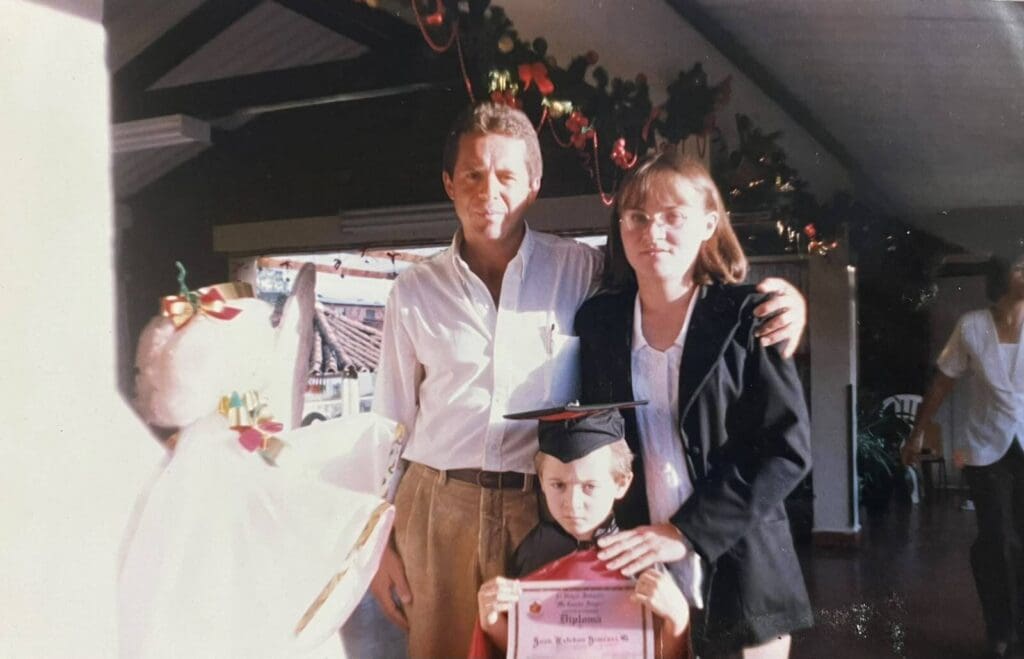
Esteban with his parents in El Peñol
The opportunities that change a child’s direction
For Esteban and his brothers, education became an important part of building a different future. He spoke about meeting a German professor, Wolf Wilms, who introduced him to theater and the German language. He later studied English in high school and French at university, while continuing to explore theatre and music, particularly playing the guitar.
At the time, he did not imagine how much these experiences would influence his future. Yet they opened doors he had never anticipated. He performed at the National Theatre Mannheim in 2011, participated in an exchange semester in Giessen in 2019, and has since returned to Germany several times for educational opportunities. Today, he is pursuing a degree in peace and conflict studies.
What makes this part of his story especially interesting is how those early opportunities have influenced what he and his brothers do today. Together, they run a nonprofit organization in Colombia called Teatro Baggenuff, which uses theater and language learning to create opportunities for young people.
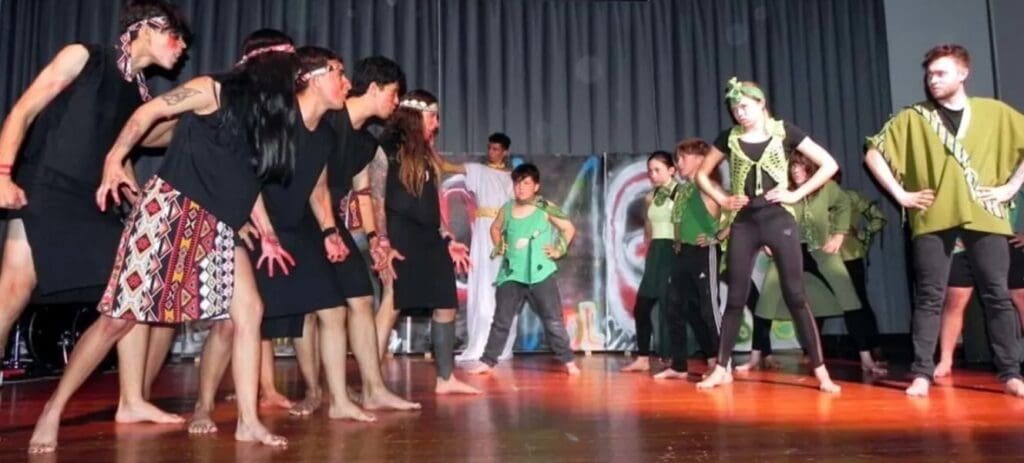
This is part of the joint project with students of the Nardini Schule in Walldürn, called “der Stern auf dem wir leben” in Walldürn, Germany, in 2024
Esteban has witnessed young actors and actresses develop their abilities, discover new interests, and pursue different careers. Some have gone on to become scientists, artists, and engineers. He sees how exposure to art and education can help young people imagine possibilities beyond the circumstances in which they grew up.
He does not describe his work as an obligation to repay society for the opportunities he received. Instead, he told me, “I just want to build my country forward.” Teaching someone German, English, or French for free during his spare time is one way he contributes.
He believes his country needs “more acts of love, more science, more art, more cultural exchanges.”
This connection between what families nurture in children and what those children eventually contribute to society speaks to an important aspect of the Global Peace Foundation’s approach to peacebuilding. The family is the first place where children experience care, learn values, and develop their understanding of relationships and character. These early lessons can influence how they relate to others and the contributions they make as adults.
The influence of women and families extends beyond the home
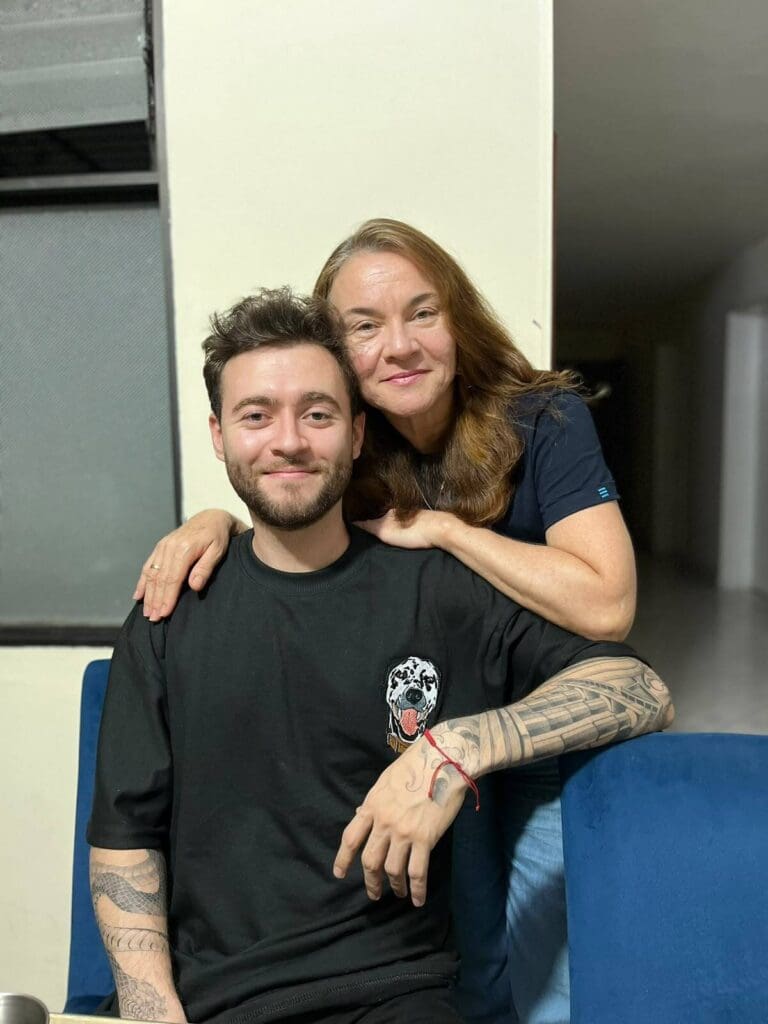
Esteban with his mother
Esteban’s mother’s experiences and his parents’ decisions feature prominently in his story. Although he did not describe his mother’s experiences as a deliberate peacebuilding effort, her life illustrates how women can shape the conditions in which the next generation grows. Her work as a teacher, her experiences of insecurity, and the family’s decision to seek a safer environment all form part of the story of Esteban’s upbringing.
This is an important dimension of recognizing women’s contributions to peacebuilding. Their influence can be seen in how they nurture children, support education, make decisions about family welfare, and help create environments where younger generations can develop their potential. The effects of these contributions can extend into schools, community organizations, and wider society.
Families also provide children’s earliest experiences of managing relationships and differences. The way adults communicate, listen to one another, and handle disagreements can influence how children approach similar situations outside the home. Respect, responsibility, kindness, and consideration for others are values that children can carry into their relationships with people with different perspectives and backgrounds.
For Esteban, the importance of dialogue also extends to Colombia’s national experience. When I asked what communities need to move from division towards greater trust and cooperation, his response was direct: “Colombia needs to talk.”
He referred to the 2016 peace agreement with the FARC-EP and the work of Colombia’s Special Jurisdiction for Peace (JEP). The institution has helped victims and former combatants engage with the country’s history of violence, acknowledge crimes, seek forgiveness, and contribute to efforts to locate missing bodies.
For him, these conversations are necessary to understand what caused the conflict and how similar experiences can be prevented in the future. His reflections reinforced the importance of creating spaces where people can listen to difficult experiences, acknowledge harm, and work towards rebuilding relationships.
Creating opportunities for young people
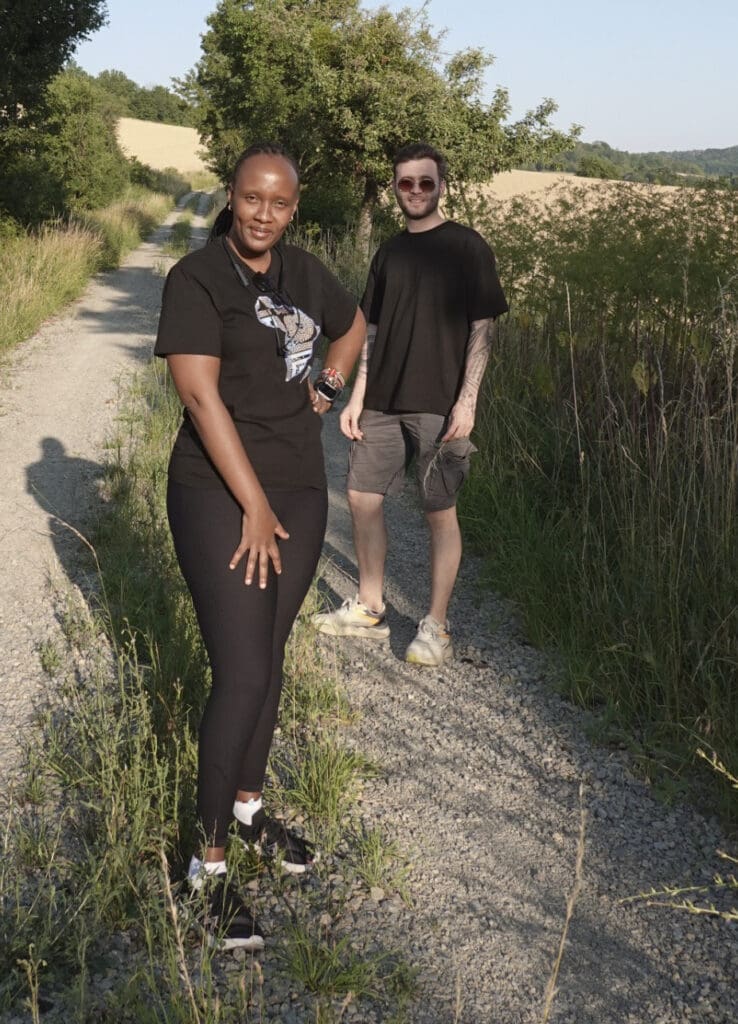
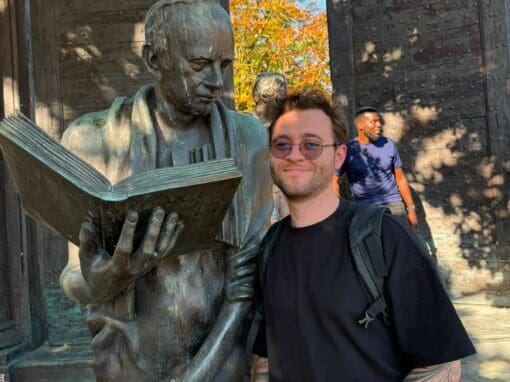
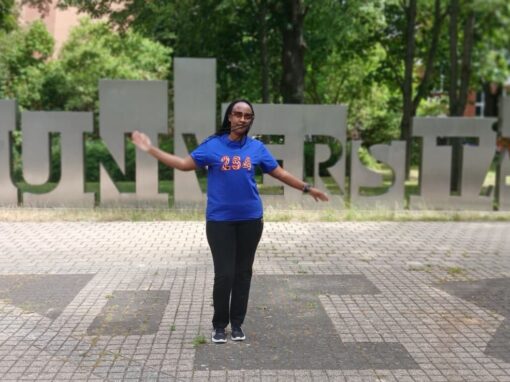
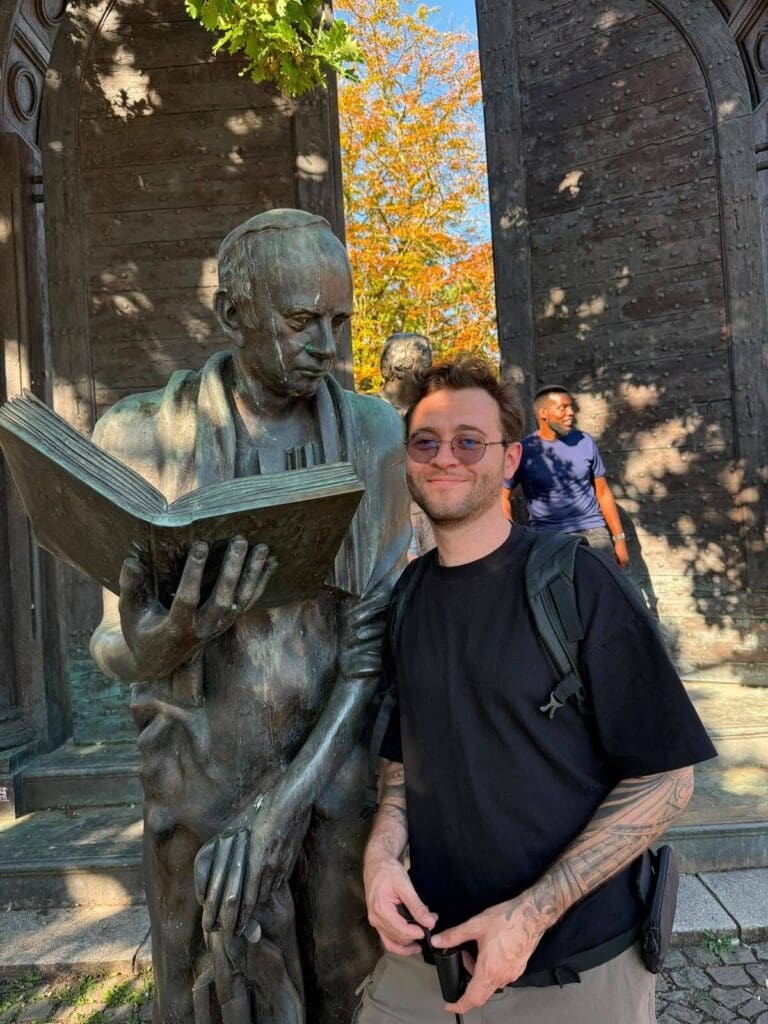
Esteban and Wairimu
Our conversation also turned to what young people need to build peaceful and resilient communities. Esteban identified three important requirements: “zero weapons, actual access to education, and decision-making.”
His response recognizes that young people’s opportunities are shaped by the wider conditions in which they live. Families can encourage learning and nurture children’s abilities, but they also need communities and institutions that provide access to education, meaningful participation, and safer environments.
Teatro Baggenuff offers one example of how community initiatives can complement the role of families. Through theater and language learning, young people gain opportunities to develop their interests, express themselves, and explore different possibilities for their futures.
Before we ended our conversation, I asked Esteban what gives him hope for Colombia. His answer was not an attempt to offer easy optimism. He spoke instead about his family and friends, who have shown him that meaningful lives can be built despite violence.
He also shared a thought that stayed with me: “Life is action.”
I left our conversation thinking about the many ways a family’s experiences can influence the future of an entire community. Esteban’s parents made decisions to give their children a different environment. The opportunities he encountered through education, theater, and language learning helped shape the person he became. Today, he and his brothers are extending some of those opportunities to other young people.
His story is a reminder that the values, care, and opportunities nurtured within families can travel far beyond the home. A parent encouraging a child’s education, a mother creating opportunities for her children, a family supporting creativity, or an individual sharing a skill with a young person can all contribute to shaping a generation that values learning, kindness, and service to others.
These contributions may begin within individual families, but their influence can reach schools, communities, and society at large. As Esteban’s experience shows, the opportunities children receive today can become the opportunities they create for others tomorrow.
In an earlier article, I shared my own path into peacebuilding and how my experiences working with communities shaped my interest in contributing to social change. If you haven’t read it yet, discover how I became a peacebuilder: I Wanted to Be a Writer and Found My Way into Peacebuilding, and the experiences that continue to shape my understanding of peace and community development.