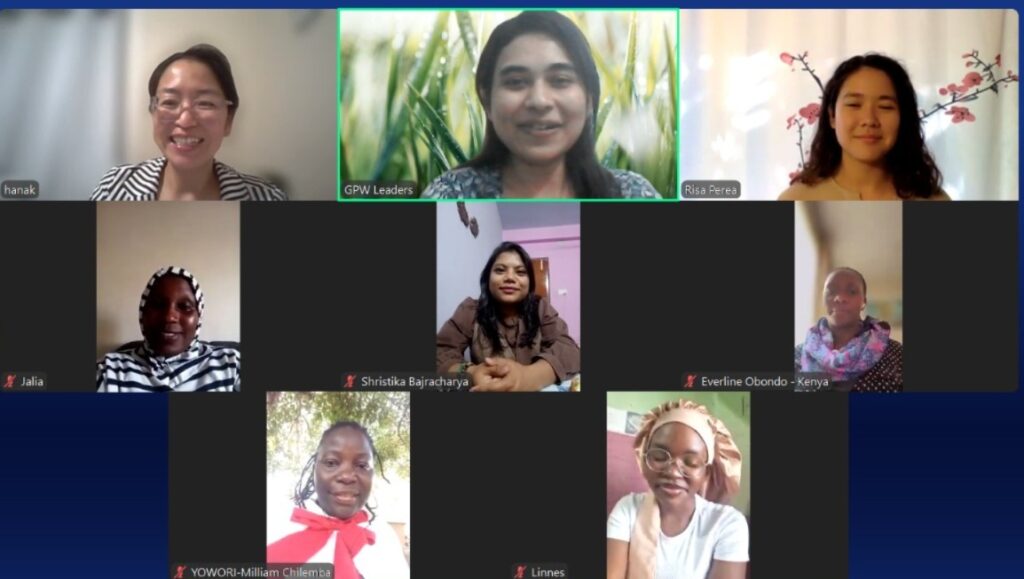
Study series participants
“A leader with empathy understands the suffering of others and acts from compassion.”
These words, shared by Tahmina Supti during the final Global Peace Women Learning Circle on the Korean Dream Study Series, captured the spirit of the session and the essence of the journey the participants had walked together. The meeting brought together women leaders from across continents who had spent months reflecting on the vision of the Korean Dream and how it could guide families, communities, and nations toward peace.
As the session began, participants turned on their cameras, smiling warmly as they posed for a group photo. There was laughter, gratitude, and a quiet awareness that this final gathering marked both an ending and a new beginning. The theme, “From the Korean Dream to One Family Under God,” invited reflection on how the principles discussed could be lived out in daily life.
The president of Global Peace Women, Hanako Ikeno, described the session as bittersweet. She had come to enjoy the monthly meetings, which had evolved into a close circle of learning and friendship. Her message centered on the call to dream big. She reminded the group that when people dream too small, they get stuck in moments that seem like victory but are only steps in a larger story. Dreaming big, she said, means believing that no vision for peace or prosperity is beyond reach.
She spoke passionately about the power of women and the role of families in peacebuilding. Quoting Mother Teresa, she said that peace and war begin in the family. She explained that while women contribute to peace through leadership in public spaces, their most enduring influence is within the home. The way a woman nurtures her family, resolves conflict, and chooses peace each day shapes the tone of a community and, ultimately, a nation. Every act of patience, kindness, and faith at home, she said, is an investment in lasting peace that can echo for generations.
The participants then took part in a group discussion on moral and innovative leadership. Each woman was asked to name a quality that defines a good leader. Shristika from Nepal chose courage and the willingness to challenge limitations. Jalia from Uganda spoke about creativity and the need to think differently in order to solve problems. Linnes from Malawi highlighted honesty and transparency as cornerstones of trust. Milliam from Malawi emphasized the importance of open communication and involving others in finding solutions. Evelyn from Kenya shared about servant leadership and the joy of serving others with humility. Tahmina added empathy, explaining that it allows leaders to understand others’ struggles and act with compassion.
Each reflection deepened the understanding that leadership rooted in values can transform lives and build stronger communities. These insights are connected directly to the vision of the Korean Dream, which calls for living for the benefit of all humanity.
The session’s mentor, Risa Perea, guided participants through a reflection on how moral leadership and family values can drive national transformation. She explained that lasting change begins not with money or policy but with vision and principles. Drawing from the example of Paraguay, she shared how the Global Peace Foundation’s work had helped inspire progress through education, service, and moral renewal. Paraguay’s transformation, she said, demonstrated that when a nation builds on shared values and strong families, it can achieve both social stability and economic growth.
Risa reminded everyone that moral and innovative leadership begins in everyday life. She encouraged the women to see their roles in their families and communities as the foundation of peacebuilding. Even small acts of love and responsibility, she said, are powerful steps toward a better world.
As the meeting drew to a close, the participants reflected on their own countries and how they could carry forward the vision of One Family under God. They spoke about strengthening families, building moral societies, and facing challenges such as poverty and inequality with renewed faith.
The final session ended with gratitude and a sense of shared purpose. Through the Learning Circle, participants had not only studied the Korean Dream but had also discovered how to live it. They left inspired to continue their work in their communities, knowing that peace begins at home and grows outward, to communities and then to nations.
Explore previous sessions of the GPW Korean Dream Study Series
Learn more about the One Korea Global Campaign and the Korean Dream
Sign your support for the Korean Dream: https://globalpeace.info/intl-for-one-korea