The Global Peace Foundation (GPF) and the University of Baltimore (UBalt) College of Public Affairs have deepened their long-standing partnership through a formal Letter of Cooperation signed in October 2025. This renewed agreement opens new avenues for joint educational initiatives and applied research, grounded in a shared commitment to peacebuilding education and fostering coexistence.
Signed by GPF International President James P. Flynn and UBalt President Kurt Schmoke, the Letter of Cooperation underscores both institutions’ commitment to advancing scholarship, expanding learning opportunities, and supporting research that fosters peace and reconciliation. On January 20, the Baltimore Cross-Community Reconciliation Project (BCCRP) leadership team, along with faculty and staff from UBalt’s College of Public Affairs, including Interim Dean Ivan Sascha Sheehan, joined Presidents Flynn and Schmoke on campus to celebrate the expanded partnership.
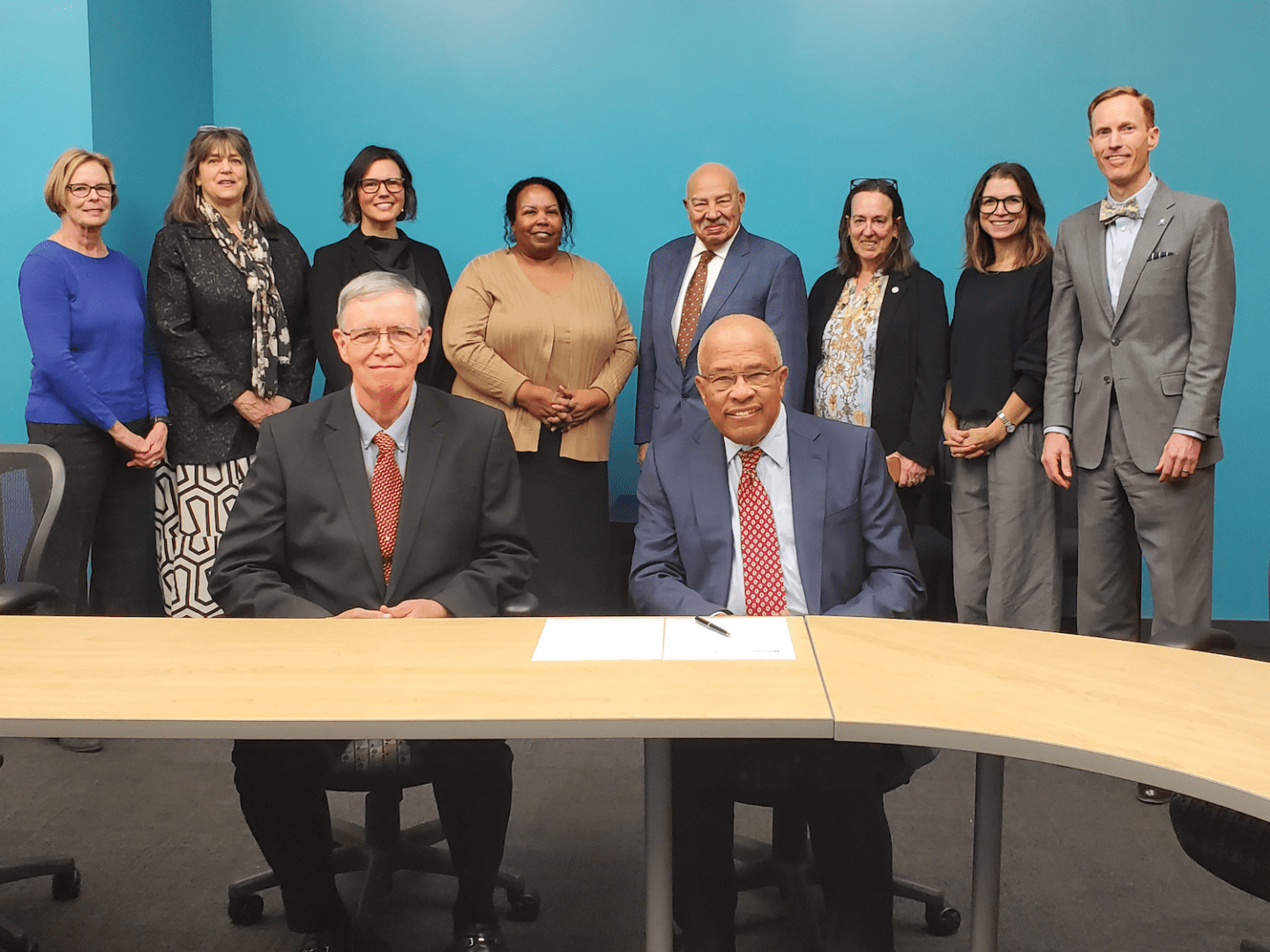
GPF International President James P. Flynn (left) and UBalt President Kurt Schmoke (right) expand partnership for the Baltimore Cross-Community Reconciliation project.
There was a very warm exchange between the two presidents, along with a commitment to maintain direct contact going forward. President Schmoke remarked, “We’re excited because we have so many programs that are similar to the mission and goals of the Global Peace Foundation, both here domestically and abroad.” Highlighting the importance of relationships and our common humanity as our most important identity, President Flynn stated, “We’re very excited about and committed to this project here in Baltimore. It’s a really important effort, and something that we can learn from and make a model.”
UBalt has played a pivotal role in supporting the GPF-sponsored BCCRP since its launch in 2022. Faculty and administrators helped secure a dedicated campus space for facilitated dialogue sessions, strengthening the project’s capacity to engage participants in meaningful conversation, reflection, and skill-building.
The collaboration has continued to grow, particularly through Dr. Shelly Clay-Robison’s involvement as a BCCRP stakeholder and co-author of a joint qualitative research study examining how cross-community engagement contributes to racial healing and community resilience. The study’s findings were published in August 2025 in the Journal of Transdisciplinary Peace Praxis under the title “Building Peace Through Connection: The Baltimore Cross Community Reconciliation Project as a Model for Racial Healing and Community Resilience.”
As stated by Dr. Sheehan, “Our 2026 Carnegie Foundation Classification for Community Engagement reflects something deeply embedded in our institutional DNA. We view community engagement not as outreach, but as collaboration – an ongoing partnership characterized by reciprocity and the mutually beneficial exchange of knowledge and resources. That framework guides our work with the Global Peace Foundation and strengthens the impact we can achieve together.”
A range of new collaborative opportunities is now under consideration, reflecting the partners’ shared ambition to deepen impact. These include expanded instructional engagement, greater involvement of graduate students in facilitating the Baltimore Police Academy’s Our Shared Humanity sessions, enhanced internship pathways, graduate certificates in peacebuilding, and the development of global programming and leadership forums. Each of these emerging initiatives is designed to strengthen the partnership’s reach while cultivating the next generation of peacebuilders.
Together, GPF and UBalt are advancing a shared vision: equipping communities with the knowledge, tools, and relationships needed to build a more peaceful, connected, and resilient Baltimore.