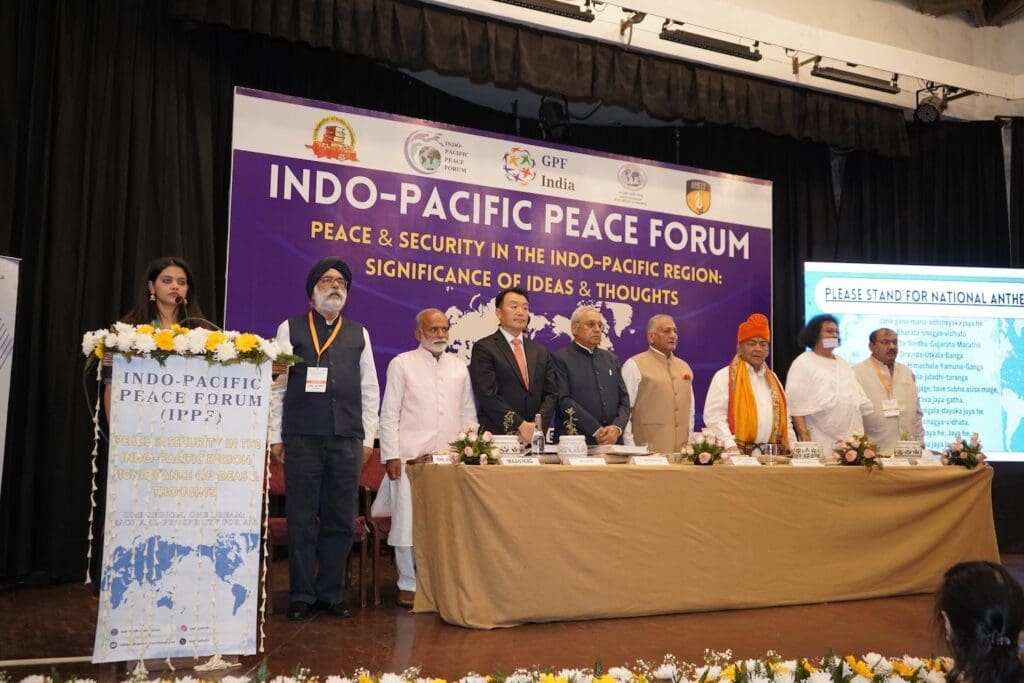
Speakers at the Indo-Pacific Peace Forum 2025.
Stretching from the eastern coast of Africa to the western shores of the Americas, the Indo-Pacific region encompasses the tropical waters of the Indian Ocean and the Western and Central Pacific Ocean. Rich in natural resources, this vast expanse is home to over 40% of the world’s population, generates 60% of global GDP, drives two-thirds of global economic growth, and includes 65% of the planet’s oceans and 25% of its landmass.
Despite its immense potential, the region has long been plagued by socio-economic and environmental challenges, with ripple effects felt far beyond its borders. Its growing strategic importance has drawn the attention of global powers — from the U.S. and Europe to Asia-Pacific nations — making it both a zone of opportunity and a potential flashpoint for conflict.
At the Pacific Islands Forum in 2019, Fiji’s Prime Minister Frank Bainimarama issued a stark warning: “We cannot protect our people or our resources if global rivalries turn our Blue Pacific into a battlefield.”
As global tensions escalate with each passing day, the impacts are increasingly concentrated on the people and the planet. This raises a vital question: Can the Indo-Pacific Peace Forum become a beacon of hope?
This question was at the heart of a recent gathering at the India International Centre in New Delhi, where over 250 subject experts, diplomats, policymakers, social workers, and youth leaders convened. The consensus was clear: open dialogue and sustained engagement on Indo-Pacific issues are essential steps toward building a more peaceful, cooperative, and sustainable future for generations to come.
Indo-Pacific Peace Forum 2025: Shaping Stability Through Dialogue, Diplomacy, and Development
On March 19–20, 2025, the Indo-Pacific Peace Forum (IPPF) hosted a landmark conference in New Delhi on “Peace and Security in the Indo-Pacific: Significance of Ideas and Thoughts.” With General (Dr.) Vijay Kumar Singh, Governor of Mizoram, as Chief Guest, the event spotlighted the Indo-Pacific as a region of immense natural wealth and geopolitical significance, urging sustainable development to safeguard future generations.
IPPF President Dr. Markandey Rai emphasized the concept of “cultural brotherhood” and the importance of the Blue Economy, warning of the ecological threat posed by overfishing. He stressed that protecting 40% of the world’s population in the region requires equal attention to the 75% of marine life found there. Dr. Rai also announced the Delhi Declaration—a roadmap for peace over the next three years.
A book titled “Peace and Security in the Indo-Pacific Region: Shaping Stability,” co-authored by Dr. Priyaranjan Trivedi and Dr. Markandey Rai, was launched during the conference. It serves as a comprehensive analysis of regional conflicts and resolutions.
Dr. Trivedi proposed creating Indo-Pacific Research Centres and designating ambassadors in key countries, leveraging the Indian diaspora’s strategic presence. He noted the diaspora’s influence across nations like the U.S., Fiji, Singapore, and Gulf states in strengthening diplomatic and cultural ties.
Spiritual voices, including H.H. Acharya Lokesh Muni Ji Maharaj, advocated for Peace Education—practical, values-based learning for students—to preempt future conflicts and build lasting harmony.
India’s geographic position and historical role as a civilizational bridge were reflected throughout the conference, particularly in its evolving Indo-Pacific strategy, which seeks partnerships based on shared interests, regional stability, and issue-based coalitions.
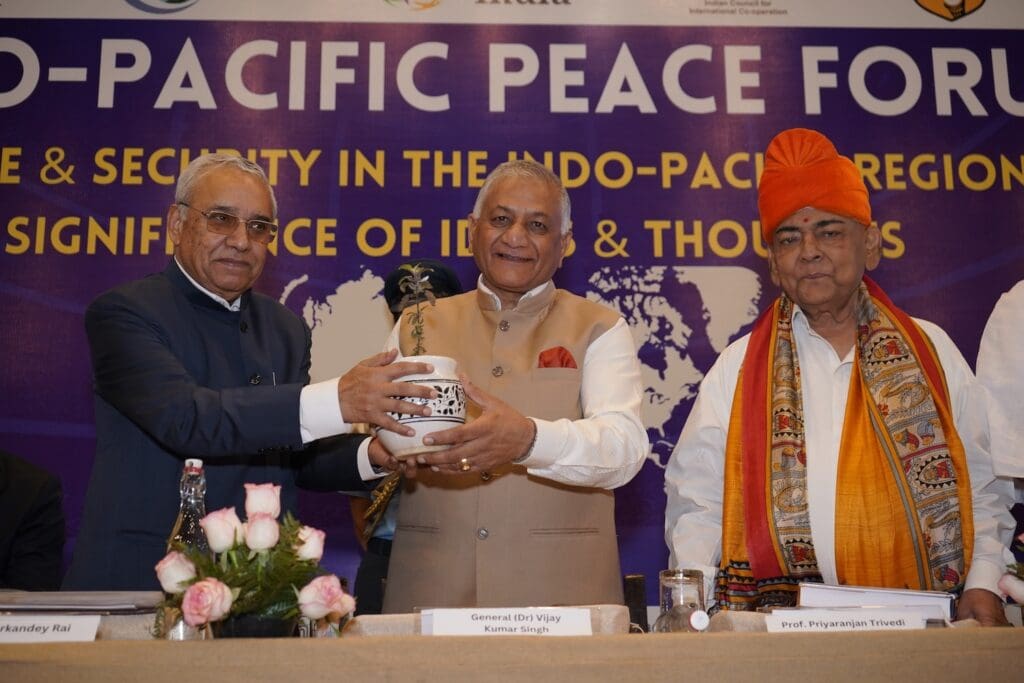
Dr. Markandey Rai (left) presents gifts to speakers at the Indo-Pacific Peace Forum 2025.
Key Highlights
1. Geopolitics, Security, and Economic Landscape
Chair: Amb. Ketan Shukla
This session analyzed geopolitical complexities and India’s balancing act in a rapidly shifting strategic context. Highlights included:
- A proposal for QUAD 2.0 focusing on disaster management.
- Discussions on SAGAR, Act East, and ABB initiatives.
- Advocacy for Swadeshi principles and India’s strategic use of Andaman & Nicobar Islands as a counter to China’s BRI.
- The call for leadership in AI, startups, and supply chain innovation.
2. Role of Indian Diaspora in Fostering Peace and Security
Chair: Prof. Ajay Kumar Dubey
This panel spotlighted the diaspora as a soft power force for diplomacy, development, and cultural exchange. With 32 million Indians in 136 countries:
- Contributions in the U.S., Mauritius, and Singapore were cited.
- The role of inner peace and humanitarian values was emphasized.
- Gender, historical, and geopolitical dimensions of diaspora diplomacy were explored.
- The session concluded with a call for inclusive, empathetic international engagement.
3. Maritime Security, Trade, and Transport
Chair: Rajesh Kharadji
The panel explored:
- The India-Middle East-Europe Economic Corridor (IMEEC).
- Climate threats to Pacific Islands and the ecological impact of deep-sea mining.
- Strategic protection of undersea cables and maritime cyber infrastructure.
- Strengthening regional cooperation for resilient, sustainable sea-based economies.
4. One Korea Campaign
Chair: Prof. Satyanshu Srivastava
Focusing on peace and reunification in the Korean peninsula, panelists discussed:
- India’s equidistant diplomacy and potential peacebuilding role.
- Leveraging cultural tools like Bollywood, yoga, and student exchange.
- Feminist and human rights perspectives for people-centered diplomacy.
- Space diplomacy and spiritual education as innovative pathways forward.
5. Relevant Peace Initiatives and Opportunities
Chair: Amb. Gurjeet Singh
Key ideas included:
- Transforming macro-concepts like QUAD into people-centric programs.
- Educating future leaders in negotiation and conflict resolution.
- Using economic diplomacy, cultural exchange, and student mobility for long-term peace.
- Proposed frameworks like HIPPO and DIPPO to assess peace-related initiatives.
- Calls for youth empowerment and global-local collaboration.
6. Blue Economy, SDGs & Regional Development
Chair: Dr. H.R.P. Yadav
Focusing on sustainability and maritime cooperation:
- Challenges like marine pollution, overfishing, and skill shortages were discussed.
- India’s SAGAR Mala and IORA efforts were presented as regional models.
- Youth and women’s involvement was promoted for grassroots engagement.
- The session emphasized multi-stakeholder collaboration over resource competition.
The Indo-Pacific Peace Forum 2025 presented a comprehensive roadmap for peace rooted in diplomacy, education, sustainability, and strategic partnerships. From diaspora engagement and blue economy planning to gender-inclusive and youth-led peacebuilding, the conference underscored the Indo-Pacific as a region not just of conflict potential, but of collaborative possibility. India’s role—as a cultural, diplomatic, and strategic bridge—remains central in steering this vision toward a peaceful and prosperous future.