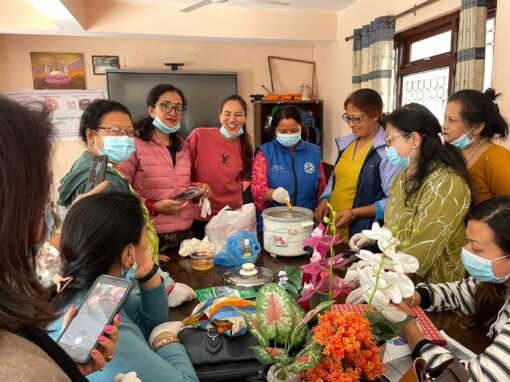
In January 2026, Global Peace Foundation (GPF) Nepal convened women, students, educators, and community partners across Kathmandu to cultivate sustainable living practices while strengthening families and community responsibility. This work builds on the foundation of the Green Homes: Green Kathmandu initiative, first launched in January 2023 in collaboration with Kathmandu Metropolitan City Wards 5 and 15 to confront the capital’s mounting environmental challenges of poor waste management, water and air pollution, and limited access to sustainable agriculture.
Since its inception, the Green Homes project has aimed to empower households to become eco-friendly, self-sustaining units through practical, community-based trainings, from rooftop gardening and rainwater harvesting to upcycling plastic waste, eco-friendly soap and sanitary pad production, and solid waste management. Over the years, these efforts have not only reduced environmental risk and expanded sustainable household practices but also supported health, income generation, and resilience among participating families.
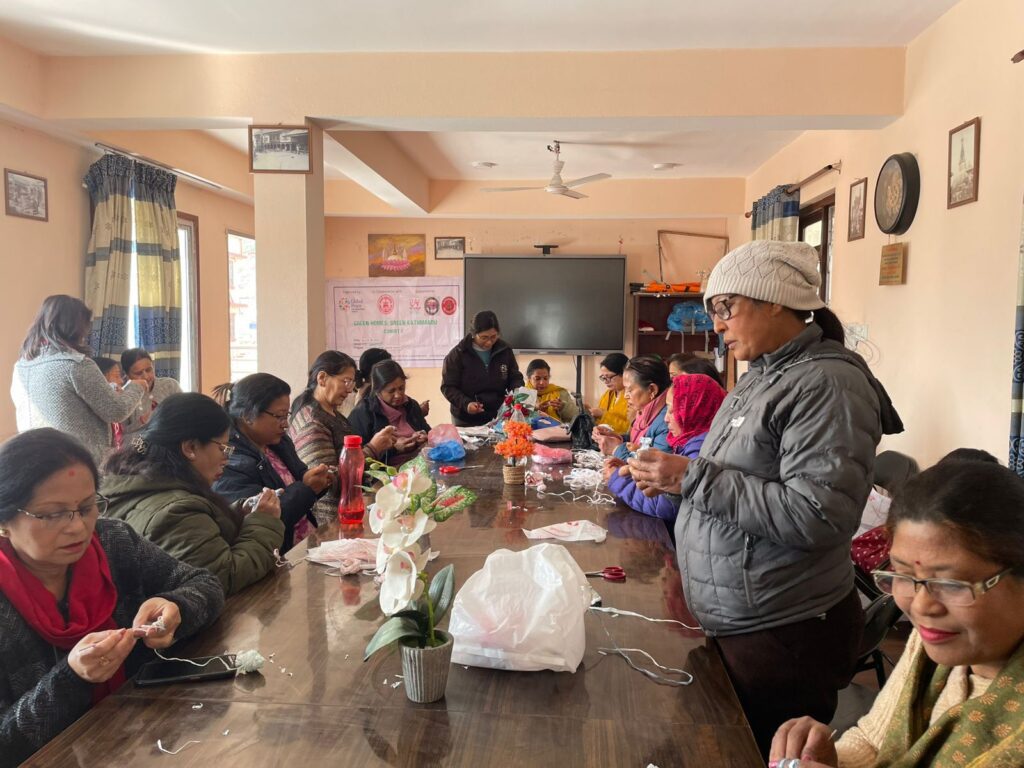
Participants upcycling plastic into new products
Through the integrated initiatives of Green Homes: Green Kathmandu, Green School, and WASH (Project Sparsha), the January 2026 program reached 102 participants and demonstrated how practical skills, rooted in shared values and community engagement, can drive lasting environmental and social transformation. Women from Kathmandu Metropolitan City Ward 15 gathered for a three-day training focused on transforming waste into opportunity. Items typically discarded, particularly milk plastics, were repurposed into hats, frocks, fish decorations, bags, and bath sponges. What began as a lesson in recycling quickly evolved into a lesson in creativity, dignity, and income potential. By the end of the training, 65 percent of surveyed participants were able to independently produce all the upcycled products taught.
Soniya Maharjan, one of the participants, captured the spirit of the experience: “Through this training on making upcycling products, I learned that the milk plastics we throw away every day can be reused to create useful items for daily life. I am also excited that this skill can help us earn some income by selling these upcycled products.”
The program continued in Ward 5 with a three-day rooftop farming and hydroponics training. Participants learned how to prepare soil mixtures, cultivate seedlings, manage crop diseases, and produce improved Bokashi and biofertilizers. A field visit to a hydroponics site offered hands-on exposure to innovative, space-efficient farming methods suitable for urban households. For many, it was the first time seeing hydroponics in practice.
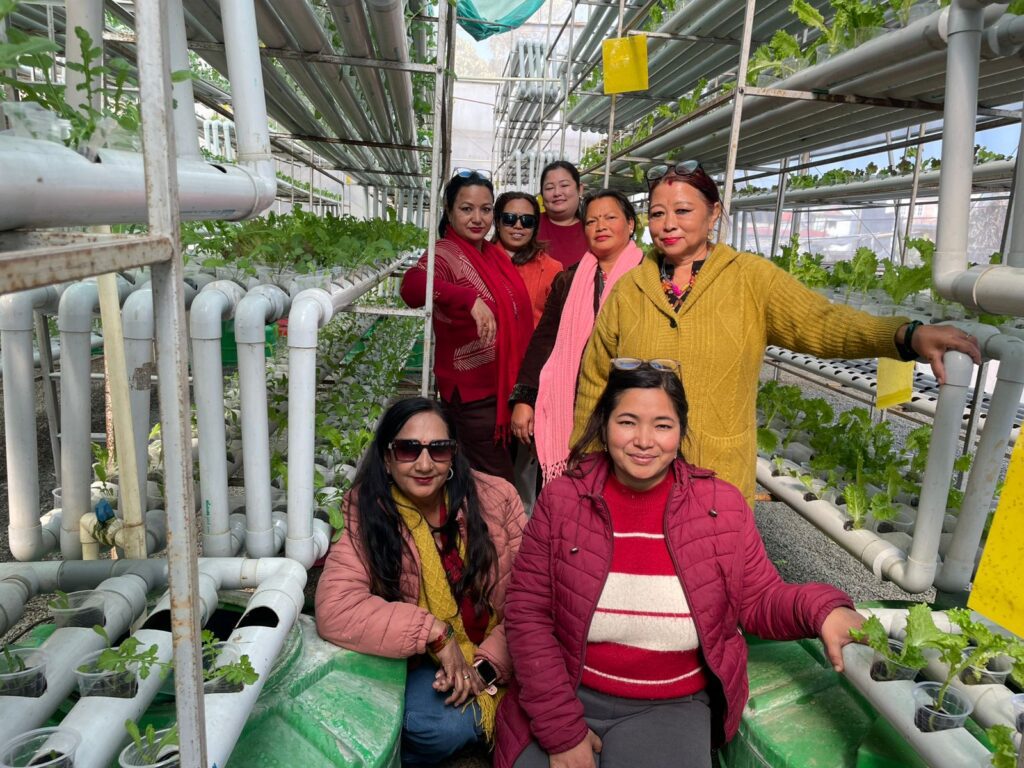
Participants at the rooftop farming training
Suchita Shrestha reflected on the transformation in her understanding: “Through this training, I gained valuable knowledge and practical skills in rooftop farming, including preparing soil mixtures, cultivating seeds, making improved Bokashi, using biofertilizers, and understanding hydroponics. I now understand how these techniques can help grow healthy plants efficiently, even in limited spaces. I am hopeful that I will be able to apply these skills at my home, which will allow me to grow my own vegetables and contribute to a greener environment.”
While women strengthened sustainable practices at home, students stepped forward as environmental champions through the Green School initiative at Shree Saraswati Secondary School in Changunarayan. Students participated in training sessions on rooftop farming and soil fertility, learning to prepare effective microorganisms and Bokashi compost. They later showcased their learning in a school exhibition featuring bin composting, vermicomposting, sanitary pad management, and upcycled products they had created themselves. Parents, teachers, and guests commended not only the technical knowledge displayed but also the students’ clarity and confidence in presentation.
Hari Sundar Chuka, a guest at the exhibition, observed: “I appreciated their confidence and the practical knowledge they displayed in solid waste management and rooftop farming. Their ability to explain and demonstrate these concepts shows their understanding and active learning.”
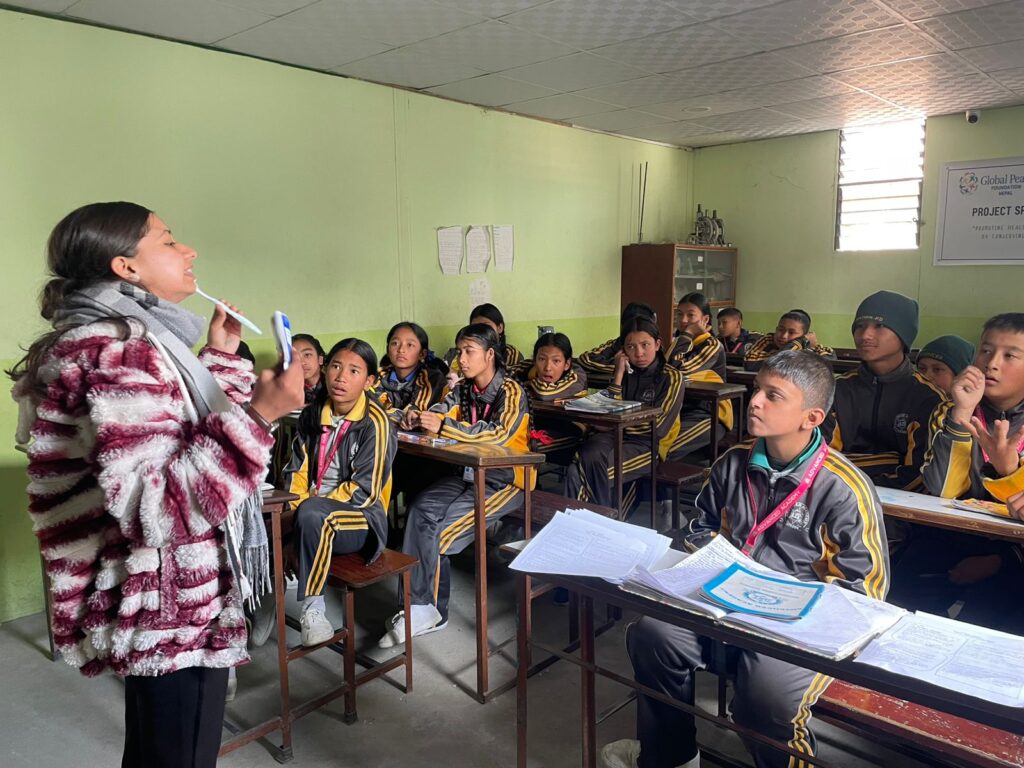
Students participating in the WASH oral hygiene presentation
The integration of environmental sustainability with personal health was further reinforced through WASH (Project Sparsha) at Advance Academy in Bode. Grade 6 students participated in an interactive session on oral hygiene, where they learned about tooth structure, common dental diseases, proper brushing techniques, and healthy eating habits. Aarushi Shrestha, a student participant, shared: “This was my second session of participating in the session of GPF Nepal. I really felt good. I learned about oral hygiene and caring about my teeth. I will always follow the learning from today and care for my oral hygiene management.”
Ongoing monitoring and coordination with local wards will support participants as they implement these practices at home and in their communities. By equipping families and students with practical skills and shared responsibility, the initiatives lay a clear pathway toward measurable, community-led environmental improvement across Kathmandu.
Learn more Nepal | Global Peace Foundation