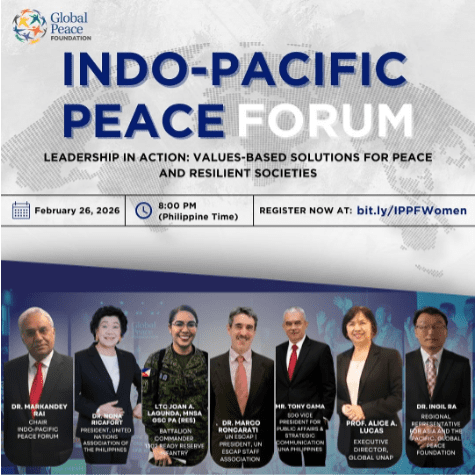
Event poster for the Indo-Pacific Peace Forum
In February 2026, Global Peace Foundation (GPF) Asia Pacific brought together 200 delegates from across the region for the women’s segment of the Indo-Pacific Peace Forum, held virtually under the theme “Leadership in Action: Values-Based Solutions for Peace and Resilient Societies.” The forum highlighted the critical role of women and families in advancing peacebuilding efforts in an increasingly complex and interconnected world.
Organized in collaboration with Global Peace Women (GPW) Philippines, the forum emphasized GPF’s unifying vision of One Family Under God as a foundation for addressing regional tensions and fostering long-term stability. Participants engaged in dialogue on how shared values, ethical leadership, and interfaith collaboration can bridge divides and strengthen social cohesion across the Indo-Pacific region.
A Shift toward Collaborative Peacebuilding
The forum presented the importance of moving beyond traditional security approaches toward more all-encompassing, holistic strategies. Discussions revealed that sustainable peace cannot rely solely on military deterrence but must also incorporate economic resilience, environmental action, technological governance, and people-to-people engagement.
Delegates highlighted the growing recognition that women play a vital role in peace processes. Evidence shared during the forum indicated that peace agreements are significantly more likely to endure when women are actively involved. This insight reinforced the need to expand women’s leadership, particularly in mediation, humanitarian response, and community engagement within conflict-prone areas.
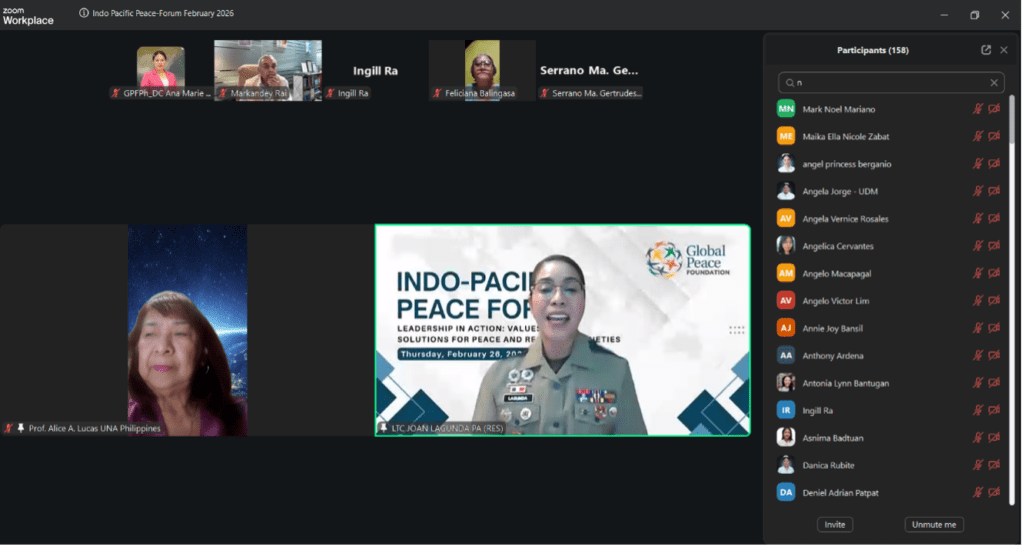
Screenshot from the Indo-Pacific Peace Forum
Values at the Core of Leadership
A central message of the forum was the need for a shift in leadership paradigms from hierarchical, ego-driven models to servant leadership grounded in self-mastery and ethical decision-making. Speakers emphasized the philosophy of “I exist for you,” encouraging leaders to prioritize service, empathy, and collective well-being. The integration of values reflected in frameworks like the Philippine Army’s Malasakit (compassion), Disciplina (discipline), and Kagalingan (competence) approach demonstrated how institutional cultures can evolve to support more humane and effective leadership practices.
Strengthening Regional Cohesion
Participants expressed a shared commitment to fostering regional unity through dialogue and cooperation. The forum highlighted the importance of multilateral partnerships in addressing both traditional and emerging challenges, including geopolitical tensions, maritime disputes, and technological risks.
“Strong partnerships, respect for international law, and collaborative security efforts are crucial in addressing shared challenges,” said Angel Nicollette S. Coroña.
Further testimonies from delegates reflected a strong consensus: peace and stability in the Indo-Pacific require sustained collaboration across governments, civil society, and communities. Trust-building, respect for international law, and inclusive engagement were identified as essential pillars for preventing conflict and promoting resilience.
“I was particularly struck by the shared recognition that multilateral dialogue and trust-building are essential in managing strategic competition while preventing conflict escalation,” shared Juliana Casandra Villarin, a participant.
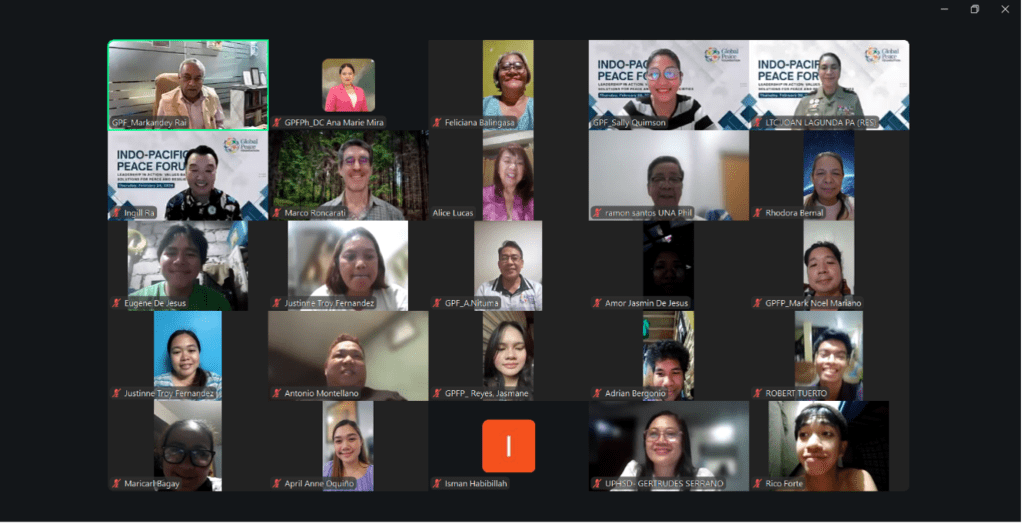
Screenshot from the Indo-Pacific Peace Forum
From Dialogue to Action
Beyond the discussions, the forum set the stage for tangible follow-through. Plans include expanding mentorship opportunities for women, promoting gender-inclusive policies, and developing accessible resources such as digital toolkits on self-mastery and leadership. By institutionalizing values-based approaches and empowering women as key agents of change, the Global Peace Foundation and its regional partners aim to translate dialogue into sustained impact across the Indo-Pacific.
Through initiatives like the Indo-Pacific Peace Forum, GPF Asia Pacific is helping to shape a future where leadership is defined not by power, but by purpose, and where women and families stand at the center of building resilient and peaceful societies.