Cross-Community Reconciliation
Many cities across the United States are a complex rich mix of racial, ethnic, and religious communities. E Pluribus Unum (“Out of many, one”), a motto on the Great Seal of the United States and adopted by the Continental Congress in June 1782, envisions a republic comprised of many peoples, united as Americans.
Yet historically, the stain of slavery, the Jim Crow era that institutionalized racial discrimination, and displacement and mistreatment of Native Americans during the nation’s westward expansion have had lasting repercussions in minority communities that continue to this day.
Underscoring the capacity of a self-governing constitutional republic to correct historical wrongs, the U.S. government, with public support, has taken necessary steps to advance a more free and just society, including emancipation and the abolition of slavery with the passage of the Thirteenth Amendment (1865), Supreme Court rulings that rejected “separate but equal” justifications for discrimination (1954); the Civil Rights movement that led to the landmark Civil Rights Act (1964), and state and federal legislative actions addressing the rights of indigenous peoples.
But laws and restitution cannot by themselves resolve the impact of generational injustice. Neither can it rectify the abuse of power in the enforcement of laws. The healing of history is always complicated, yet the acknowledgment of history is essential, amends must be made, and reconciliation is possible step by step as we work together to build a shared future for our children and our children’s children. Community-driven peacebuilding brings out the humanity, empathy, and compassion needed to come to a resolution.
In partnership with Co-operation Ireland, Global Peace Foundation launched the Cross-Community Engagement (CCE) pilot program in Jersey City, New Jersey, in 2016. The CCE approach in Jersey City, part of the New York metropolitan region, was based on Cooperation Ireland’s thirty-year history of working with Protestant and Catholic communities. The project model was adapted to fit a diverse, urban U.S. context.
Based on the CCE model, GPF USA advanced a transformative project, infused with GPF’s core peacebuilding approach, entitled Cross-Community Reconciliation (CCR), first introduced in October 2019 in Billings, Montana, to bridge divisions, reduce racial discrimination, and increase empathy and understanding in Montana territories that are home to twelve tribal nations. The ongoing project fosters friendships across racial identities and changes perceptions that once stalled collaboration between Native and non-Native groups. The CCR program has also since been launched in Baltimore, Maryland.
Building Our Shared Future: Block by Block
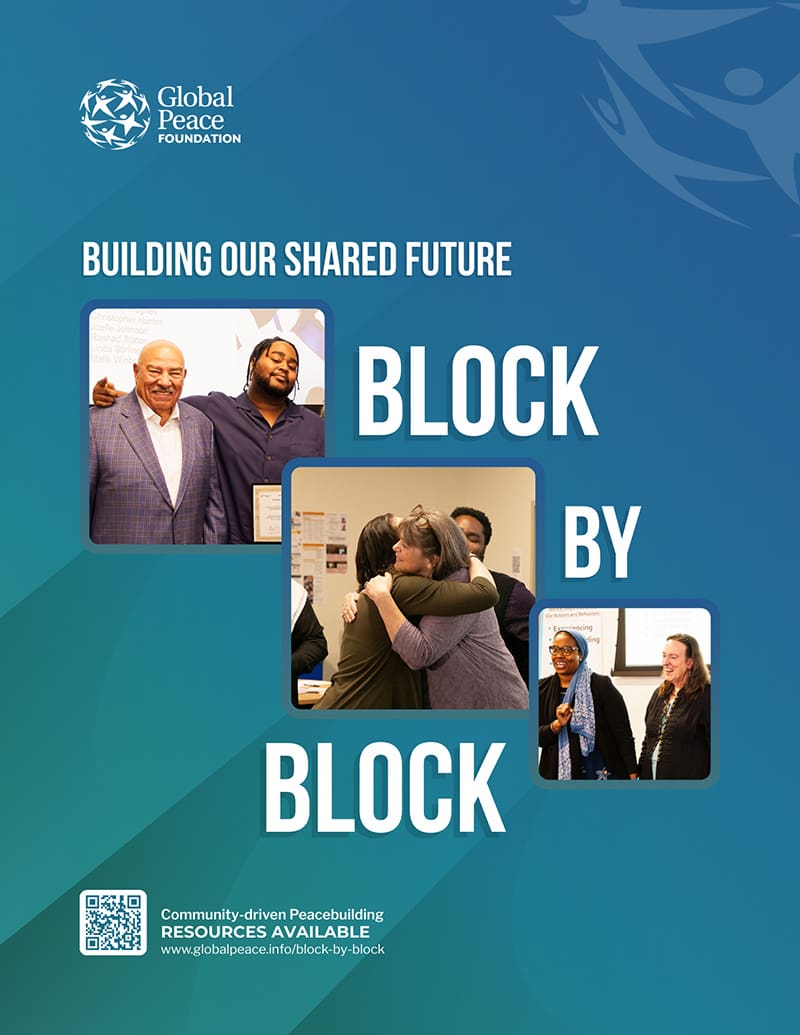
Building Our Shared Future Block by Block is a much-needed experiential learning program, uniquely designed for group study in communities and neighborhoods. Historically, peacemaking has only been the purview of public officials and diplomats, yet today the role of civil society in peacebuilding has made significant progress in creating social cohesion and an increased sense of community in our cities.
The heart or core of peacebuilding is reconciliation—a process that drills down to the grassroots level and focuses on mending the human relationships fractured by years of division and mistrust. Reconciliation requires intentional effort and practical actions to bridge divides and build trust. Key steps include engaging in open dialogue, acknowledging past wrongs, and fostering empathy through active listening and shared experiences. Collaborative efforts, such as community projects or joint celebrations, can help create mutual understanding. Educating oneself about others’ perspectives, committing to restorative practices, and practicing forgiveness are crucial.
Cultivating a deep longing, desire, vision, and understanding of peace—peace in our hearts, in our families, our neighborhoods, in our communities, and in our nations—is the only way to work to make global peace a reality.
How the Group Study Works
- Introductory meetings and orientations with the leadership of the community / neighborhood / group.
- Introductory presentation to the community to generate involvement.
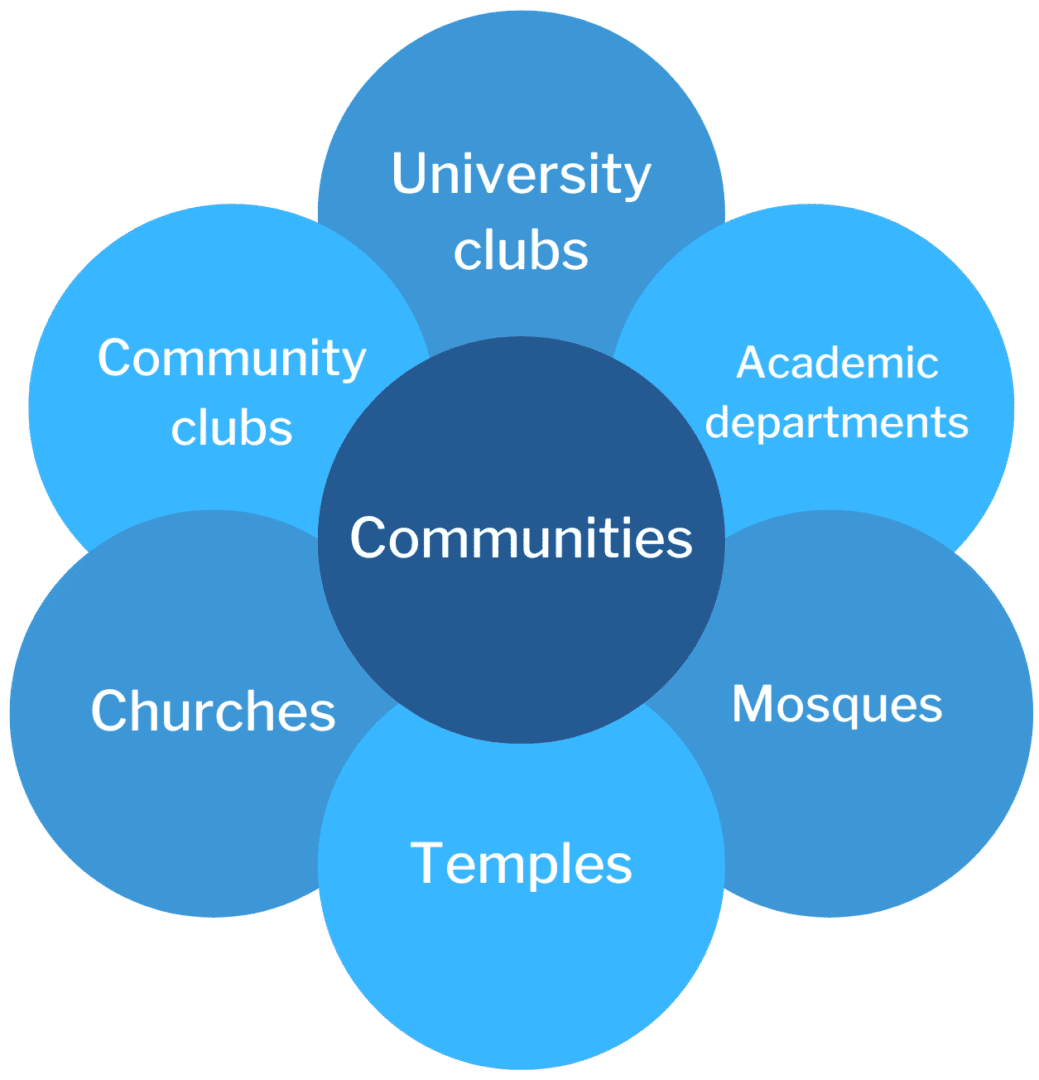
- The community works through the self-directed Study Series education within its own unique approaches, including study groups, men’s groups, youth groups, women’s groups, and full community gatherings.
- Designate a “Block by Block Liaison” for the community to connect with the GPF Office.
- Training Completion: Presentation of a certificate to each participant who finishes the training; “I am a Peacebuilder”
- Option to work with a nearby diverse community and repeat the study, completing a “Community Mapping exercise” and designing a service project together.
- New Peacebuilders are invited to join the Peacebuilding Committee.
The narration of the videos is the educational content of the study series, transcripts of the narration are in the back of the Booklet.
Video Instructions
Following your Booklet, after introducing the topic, having an “ice-breaker” discussion, and reading the quotations, now your group is ready to watch the film together. The film is the educational content. The group will be gathered around the nearest viewable monitor or computer screen. For a larger group, the video can be projected onto a larger screen. Click on the arrow and expand to full screen viewing to watch online, or you can download the video prior to the meeting to avoid any possibility of connectivity issues. (The transcripts of the narration are in the back of the booklet for further or individual study.)
SESSION 1
Understanding Peace in the 21st Century
In our world today there are three main approaches or dimensions of peace. Unlike peacekeeping or peacemaking, which typically involve military and diplomatic efforts to end conflict, peacebuilding is an ongoing process of addressing the root causes of conflict and bringing reconciliation and forgiveness through full acknowledgement of shared human aspirations. Session I examines the roots and impact of identity-based conflict, particularly the pervasive “us vs. them” mentality that drives division, fuels violence, and hinders peace. This mindset, reinforced by our primal brain’s instinct to fear difference, can be transformed through reconciliation and a shift toward a shared human identity. The road to peace is paved with both healing and transformation. Peacebuilding serves as the foundation for this journey, addressing the deep-rooted causes of conflict and laying the groundwork for a stable future. It involves strengthening institutions, promoting justice, and fostering social equity. At its core, peacebuilding aims to create systems that can withstand challenges and prevent the recurrence of conflict. Yet, for these efforts to truly succeed, they must be intertwined with reconciliation—a process that focuses on mending the human relationships fractured by years of division and mistrust. Reconciliation invites communities to confront painful truths, seek justice, and embrace healing, forging bonds that are essential for enduring peace.
SESSION 2
Our Shared Humanity
History has shown that, despite best efforts, political and economic strategies have repeatedly failed to truly resolve identity-based conflicts. We need to develop alternative approaches as a way out of this quagmire such as aligning with the vision of the “One Human Family” which encourages social cohesion and pluralism within a multicultural and diverse society.
Many cultures have similar ethical frameworks that have served as the underpinning of building inclusive and peaceful societies. These ideals are similarly expressed for example in the African ethos of “Ubuntu.” The Global Peace Foundation affirms the importance of universally recognized principles and shared values as essential to building social cohesion within nations and the global community.
Beyond religious differences, there exists an intrinsic shared civic responsibility that unites individuals in a common commitment to ethical living. While faith traditions have widely varying doctrines about spiritual matters, they share broad agreement about how we should live in this life. The essence of shared values such as those encapsulated in civility embody a broad social conscience and a collective dedication to the well-being of all.
SESSION 3
Healing Historical Injustices and the Art of Dialogue (Optional 3.5 Session based on Guest Speaker Videos and Discussion in Resource Portal)
The human family is a group that we all belong to, and just as we value unique characteristics and gifts among immediate family members, so the diversity of the human family can be an enriching source of strength and a basis for mutual respect and peace.
Session 3 focuses on the importance of engaging from the heart, fostering empathy, and empowering local communities to lead the way toward sustainable peace. Participants will learn how authentic engagement across lines of identity can transform relationships, foster reconciliation and drive lasting community change. They will explore the concepts of healing historical injustices and conflict transformation, gaining insight into how acknowledging the past and addressing root causes of conflict can lead to systemic and relational healing.
Through powerful examples from U.S. communities, participants will see how forgiveness, dialogue, and restorative practices promote justice, unity, and positive peace. One of the most valuable and essential tools for all aspects of the peace and relationship-building process is the art of dialogue. When we experience our shared humanity through thoughtful dialogue, a shared meal, have an experience or work together to solve a problem, the beginnings of a relationship can form. And to build this peace, to be and live as one human family, we need to learn the art of dialogue.
SESSION 4
The Global Ethic & Service; Powerful Tools of Peacebuilding
Session 4 examines the significance of a Global Ethic as the basis for dialogue and cooperation among religions, ethnicities, cultures, and in society. The session provides some background on the original formulation of a Global Ethic by theologian Hans Küng at the 1993 Parliament of World Religions in Chicago. The session looks at the values that are shared across religious and wisdom traditions and importance of building dialogue and cooperation to advance the acceptance of a Global Ethic to foster peace in a diverse world.
One proven way to become aware of our “shared identity” is through service or volunteering. Do we naturally feel empathy towards someone who is suffering and who looks very different than we do, speaks a different language, or has different perspectives on real life issues? Doing service and volunteering is a concrete way to grow our emotional sense of belonging to another group and to the larger human family. People who want to be of service can change the world. The good news is that this is not an overwhelming, unattainable task. We can start today in our homes and communities.
Recent Activities
Other Work
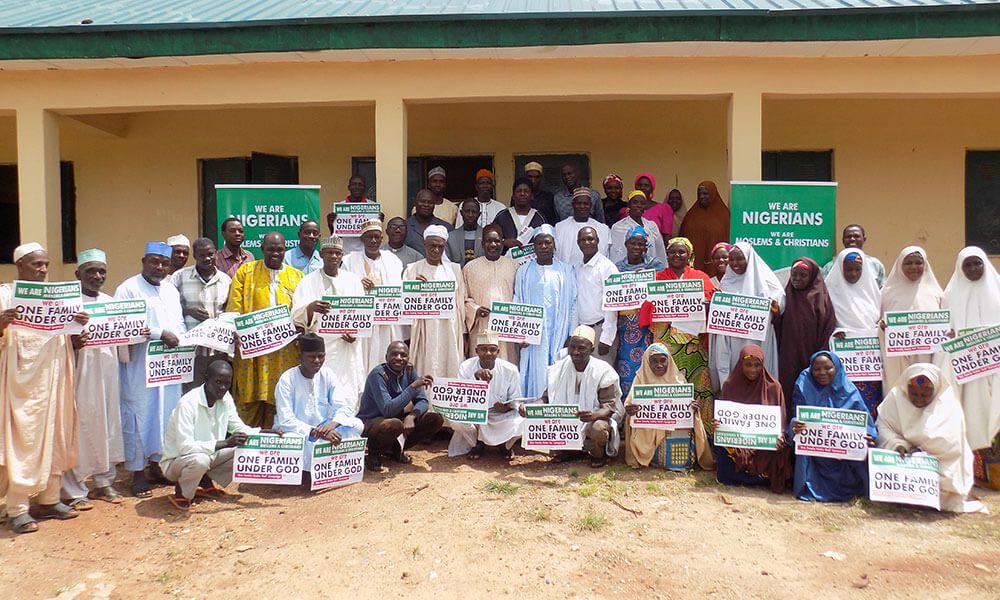
Community-driven Peacebuilding Campaigns in Nigeria
PeaceHub Campaign