
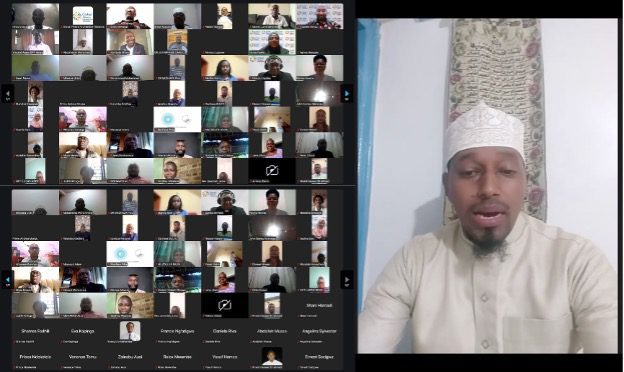
Participants of the Regional Interfaith Dialogue on Preventing and Countering Violent Extremism (PVE)
Religious leaders, peacebuilding practitioners, and development stakeholders from across East Africa and the Intergovernmental Authority on Development (IGAD) region came together on March 24, 2026, for a Regional Interfaith Dialogue on Preventing and Countering Violent Extremism (PVE), reaffirming the critical role of faith communities in building peaceful and resilient societies.
Convened virtually by the Global Peace Foundation (GPF) in collaboration with the United Nations Development Programme (UNDP) and the IGAD Centre of Excellence for Preventing and Countering Violent Extremism (ICEPCVE), the dialogue brought together diverse faith leaders and peace actors to strengthen regional cooperation and address the growing threat of violent extremism through community-based approaches.
At the heart of the discussions was the African philosophy of Ubuntu, “I am because we are,” which emphasizes our shared humanity, mutual responsibility, and interconnectedness. Participants explored how Ubuntu can serve as a guiding framework for strengthening social cohesion, promoting interfaith collaboration, and fostering resilience against extremist ideologies.
The dialogue marked the launch of a regional faith-based network committed to preventing violent extremism and advancing peacebuilding efforts across the region. Through this platform, religious leaders will collaborate, share best practices, and coordinate community-driven initiatives that address the root causes of conflict and radicalization.

Reverend Father Canice Chinyeaka Enyiaka, Ph.D., director of African Peace Initiatives at GPF International
Reverend Father Canice Chinyeaka Enyiaka, Ph.D., director of African Peace Initiatives at GPF International, highlighted the importance of collective action and values-based leadership in responding to contemporary peace and security challenges. Participants emphasized that effective prevention strategies must be grounded in local realities, engage youth and women, and build on the trusted role that faith leaders play within communities.
Representing the IGAD Centre of Excellence, Ms. Martha Njiiri highlighted the value of regional cooperation and knowledge-sharing in addressing complex security challenges that transcend national borders.
During the dialogue, Advocate Hussein F. Sengu, country director of GPF Tanzania, presented four strategic pillars to guide the network’s work: institutional capacity building, interfaith collaboration, community empowerment, and counter-narrative development. He emphasized the long-term nature of the initiative, stating:
“This is not a one-off engagement. It is a long-term commitment to building a sustainable regional network of religious leaders who are equipped, connected, and committed.”

Advocate Hussein F. Sengu, country director of GPF Tanzania
Mr. Daniel Juma Omondi, Africa regional representative for GPF, emphasized the importance of inclusive participation, particularly among women and youth.
“We will ensure women are fully included in all platforms and that youth engagement remains a priority in the next phase,” he said. “We encourage participants to identify local champions within their communities who will sustain peace efforts beyond formal sessions.”
Echoing the spirit of Ubuntu, Peace Service Ambassador H.E. Kambula Milton, president of GPF Uganda, called on participants to unite around shared values as a foundation for peace and prosperity.
“For us to achieve peace and economic stability, we must unite our voices around shared values: ‘I am because you are, and you are because I am.’”
The dialogue concluded with a collective prayer and a renewed commitment to sustained cooperation among faith leaders and peacebuilding partners. Participants affirmed that preventing violent extremism requires more than institutional coordination; it demands a shared vision rooted in human dignity, mutual respect, and collective responsibility.
As communities across East Africa and the IGAD region continue to confront the challenges of violent extremism, the newly established faith-based network represents an important step toward strengthening resilience, fostering social cohesion, and advancing a culture of peace anchored in Ubuntu. The initiative reflects the Global Peace Foundation’s belief that sustainable peace is achieved through collaboration among faith, civil society, education, and government sectors. Through expert convenings and grassroots peacebuilding efforts, GPF continues to address critical challenges facing the human family and strengthen communities around the world. To learn more about GPF’s peacebuilding initiatives and global impact, visit GPF’s What We Do.