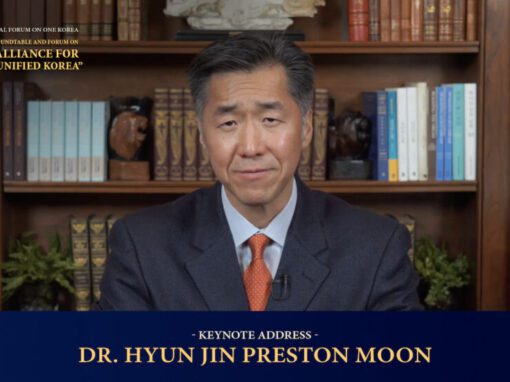
Mr. Hyunseung Lee is a North Korean escapee, human rights advocate, lead program strategist at the Global Peace Foundation, and founder of the North Korean Young Leaders Assembly.
In his recent UPI piece, Lee highlights the need to invest in the next generation of North Korean escapee leaders as they prepare to help shape a free and unified Korea.
Read the piece on UPI: ‘A free North Korea will need founders, too.’
Support the North Korean Young Leaders Assembly
This July, the United States turns 250. There will be fireworks over the National Mall, parades down small-town Main Streets, and the familiar rereading of a sentence that still startles you if you slow down enough to hear it—that all people are created equal, born with rights no government may grant or take away.
I did not grow up with that sentence. I grew up in North Korea, where believing it could cost you your life. The state did not merely govern us; it tried to own the inside of our heads. Loyalty was measured, ranked, inherited. People were sorted at birth into classes of trustworthy and hostile, and the sorting followed you like a shadow you could never outrun. To imagine yourself as free—not someday, not in another country, but free by right, simply because you were born—was the most dangerous thought a person could have.
And yet some of us had it.
That is the thing I want my fellow Americans to understand as you celebrate this anniversary. The men who signed their names in 1776 had no army worth the name, no treasury, no guarantee they would not be hanged for what they wrote. What they had was a conviction so stubborn it outran their own safety. I have met that same conviction. I have seen it in young people who carried it across frozen rivers and through Chinese hiding places and past the constant threat of being sent back to die. They are North Korean escapees, and they are some of the most natural believers in your founding creed I have ever known—because they paid for the belief before they ever heard the words.
For years, I thought escape was the whole story. It is not. Tearing down a wall and building what stands in its place are two different acts, requiring two different kinds of people, and history is unkind to movements that master only the first. Liberation needs courage. What comes after liberation needs something rarer: people who have prepared themselves to lead, to draft laws, to sit across a table from the powerful and not flinch, to imagine a country in detail rather than only in longing.
When the regime in Pyongyang finally falls—and it will, because no system built on that much fear lasts forever—the dangerous question will not be how it ended. It will be who is ready to build what comes next. Will a free North Korea be handed to whoever is closest to the old machinery of power? Or will there be a generation of North Koreans, raised partly in freedom, who understand foreign policy and international law and the unglamorous mechanics of a functioning state, ready to take the pen?
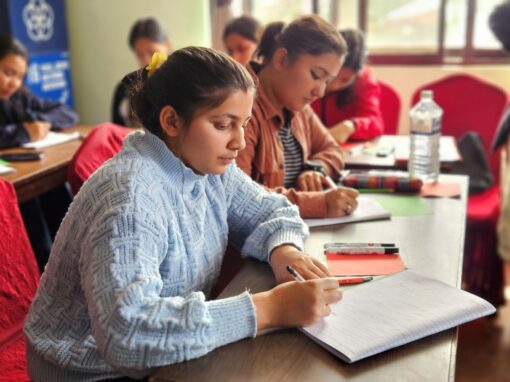
That question is why I founded the North Korean Young Leaders Assembly. Each year, we bring a small group of young North Korean escapees to the United States and put them in the rooms where decisions are made—across from lawmakers, diplomats, scholars, and human rights experts. We do it because I once needed exactly this and never had it. I had survived. I did not yet know how to lead. No one had shown me that the testimony of a person who escaped a dictatorship could move a senator or that a refugee could become a strategist, an advocate, a founder in waiting rather than a permanent victim of someone else’s history.
The transformation is not abstract. I have watched a young woman raised in the “hostile” caste of North Korean society stand in a university seminar she could never once have dreamed of and discuss and debate policy with the poise of someone who knows this is exactly where she belongs. I have watched a young mother who spent years hiding in China, flinching at every knock on the door, learn to speak in a public hearing before the U.S. Congress so that others would no longer have to hide. I have watched a person who once believed he had no voice testify before officials in Washington and say aloud the truth he had risked his life to keep secret. None of them are finished. That is the point. They are becoming.
Americans sometimes ask why this should concern them, an ocean and a closed border away. The honest answer is the same one your founders would have given. The creed you celebrate this summer was never meant to be a private possession. It was a claim about every human being, including the twenty-five million still living inside the most closed country on earth, who cannot read this sentence and would be punished for thinking it. A 250th anniversary that means anything has to mean more than nostalgia for one nation’s good fortune. It has to be a reminder of what the words were for.
There is also a practical stake. The future of the Korean peninsula—its peace, its stability, the shape of a region that matters enormously to the world—will be written in part by which North Koreans are prepared when the moment comes. Investing in that preparation now is not charity. It is foresight.
I think often about the asymmetry of that signing in 1776. A handful of people put their names to a document on behalf of millions who could not be in the room, and on behalf of generations not yet born. The signature was a kind of trust extended across time. The people I work with are trying to extend the same trust toward a country that does not yet exist—to speak, today, for the millions inside North Korea who still cannot speak, and for the free homeland those millions deserve.
This July, as you watch the fireworks, I would ask only that you widen the circle of who you are celebrating. Somewhere not far from those crowds, ten young people who chose freedom over fear will be sketching the blueprint of a homeland they were forced to flee. They are not asking to be rescued. They have already done the hardest part of that themselves. They are asking for what every founder needs: people willing to stand with them while they prepare to build.
Two hundred and fifty years ago, a few people picked up a pen and signed their names to a promise far larger than their own lives. They did not live to see it kept. That was never the point. The point was that the promise could outlast them—that the pen, once lifted, was meant to be passed from one hand to the next, to anyone with the courage to take it up.
Young North Koreans are reaching for that same pen.