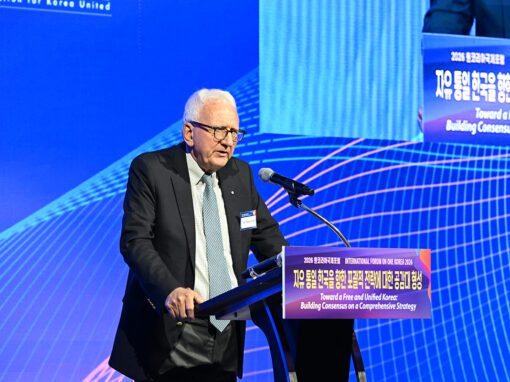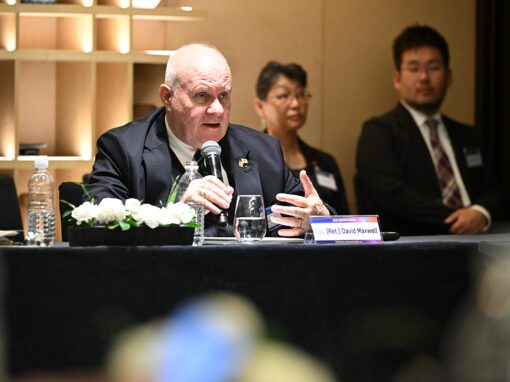
Leading experts from Asia, North America, and the Korean Peninsula gathered for the second 2026 Korean Reunification Strategy Seminar, hosted by the Korea International Working Group on Korean Reunification. The seminar focused on the role of international partners in advancing Korea’s peaceful reunification and strengthening global support for a free and unified Korea.
The forum brought together specialists from South Korea, the North Korean escapee community, the United States, China, Japan, Russia, India, and Malaysia to discuss evolving geopolitical dynamics and opportunities for international cooperation in support of Korean-led reunification efforts.
Building International Support for One Korea
A central theme of the seminar was the importance of international partnerships in creating conditions for lasting peace on the Korean Peninsula.
Dr. Markandey Rai, chairman of Global Peace Foundation (GPF) India and president of the Indo-Pacific Peace Forum, highlighted India’s unique position as a nation that maintains relationships with both North and South Korea. He emphasized that countries committed to dialogue, mutual respect, and peaceful engagement can help create an environment conducive to reconciliation. Drawing on the ideas presented in Towards One Korea and Dr. Hyun Jin Moon’s Korean Dream, Rai argued that the ultimate goal of reunification should be more than a geopolitical outcome. Rather, it should be a humanitarian process that reunites families, heals historical divisions, and creates hope for future generations.
Understanding a Changing Strategic Environment
Participants also examined recent developments affecting the Korean Peninsula, including shifts in North Korea’s strategic posture and the evolving roles of regional powers.
GPF Senior Program Strategist Hyunseung Lee noted that while North Korea’s public rhetoric regarding reunification has changed, the issue remains relevant within the regime’s broader strategic calculations. He emphasized the importance of understanding these changes when developing long-term approaches to peace and reunification.
Experts also explored how regional developments involving Russia, China, India, and the broader international community may influence future opportunities for dialogue and cooperation on the Korean Peninsula.
A Growing Global Network for Peaceful Reunification
The seminar reflected a broader effort to strengthen international cooperation in support of Korean-led peaceful reunification.
Yeqing Li, senior research fellow of GPF One Korea International Support Group, emphasized the importance of preparing for reunification and expanding international engagement. Participants discussed ways to strengthen collaboration among scholars, policymakers, civil society leaders, and international partners committed to peace on the Korean Peninsula.
The Korea International Working Group on Korean Reunification was established to develop practical strategies and policy recommendations for a peaceful and unified Korea. Through ongoing dialogue and research, the group seeks to contribute to international understanding and cooperation that can support the long-term vision of One Korea.
Looking Ahead
As geopolitical conditions continue to evolve, participants agreed that peaceful reunification will require not only Korean leadership, but also sustained international understanding and support.
By bringing together diverse perspectives from across the region and beyond, the seminar demonstrated the growing global interest in a future in which the Korean people can realize their aspirations for freedom, peace, and national unity.