“We must do our best to ensure that the children of Africa have a solid foundation upon which to build their future.” (John Agyekum Kufuor)
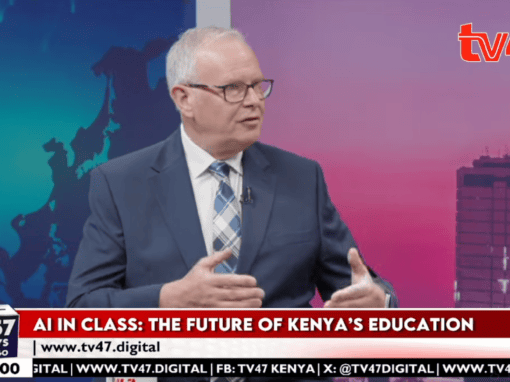
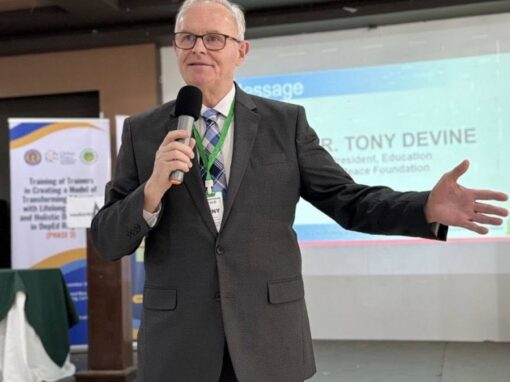
Dr. Tony Devine, vice president of education for the Global Peace Foundation (GPF), recently participated in an interview with Fred Indulmi, host of Kenya’s TV47 Breakfast broadcast. In a world where technology is continuously altering the way we live, the topic of conversation was “AI in Class: The Future of Kenya’s Education.”
Acknowledging the current unprecedented and immediate access to knowledge from the internet and AI, Dr. Devine emphasized the need to transform education from a conventional, knowledge-based system to one that helps form young people into principled and moral individuals. He underscored the underlying importance of GPF’s Transforming Education Blueprint, particularly at a time when the youth population is the highest in history—around 1.2 billion worldwide, including over 400 million young people in Africa. He described this generation as “an incredible asset” who can positively contribute to their countries’ well-being.
According to Dr. Devine, the transformation has to start with educators who transition from roles primarily grounded in helping young people acquire knowledge to roles guiding their holistic development. Speaking about character building, he emphasized its importance, noting, “So, character is not something that’s nice to have. It’s actually essential. It’s connected to the spiritual-moral dimension of who we are as human beings.”
When Mr. Indulmi asked whether focusing too much on knowledge acquisition leads to neglecting other aspects of development, Dr. Devine agreed. He noted that humans have four primary dimensions—a spiritual-moral dimension, an emotional-relational dimension, a physical vitality dimension, and a mental cognitive dimension. He added that the current education system focuses on only one dimension, which is why “we’re actually producing graduates who are only partially formed.”
Dr. Devine addressed the concern that this shift will cause teachers in Africa to lose their jobs. He countered that a Transforming Education Blueprint approach would instead create new opportunities for educators as they take a more active part in holistically guiding young people to become good individuals through character development, relationship building, and teamwork. He described a successful example of this approach at a school in Austin, Texas, where students are taught by an AI system two hours in the morning, while teachers dedicate the afternoon to their holistic development.
Commending Kenya’s Ministry of Education for its transition to a competency-based approach, Dr. Devine noted that it represents an important step in the right direction. He also described a recent and encouraging meeting with the Minister of Education, who received the Transforming Education Blueprint and communicated strong interest in collaborating to chart the way forward.
When asked to describe the Transforming Education Blueprint, Dr. Devine explained that the transformation initially begins with teachers, then students, and then the system. He said, “Fundamentally, like 90% of this is about transforming people. So, this is all about people, transforming people to be better versions of themselves.” Reflecting on its implementation in 2 of 17 regions in the Philippines over the past couple of years—with more than 100 educators at all levels participating in various activities to change old habits, broaden perspectives, and become more engaged with their students —Dr. Devine highlighted how they were able to grow and become “better versions of themselves.” They were then able to cascade this change to their students.
Dr. Devine expressed his hope in the goodness of humanity—that people of all ages and abilities can adopt universal principles and change for the better. Addressing the “currency shift” from knowledge to character, he highlighted the fact that AI is predominantly new to people worldwide. He reiterated that “the thing about AI is that it’s just a tool; it’s value neutral.” He further remarked, “We want to use this new tool and intelligence to advance the human condition. That’s why the blueprint is called the Transforming Education Blueprint, building peace and boundless abundance.”
Acknowledging that implementing the initiative has been a struggle, but a necessary one, Dr. Devine emphasized that the world is always advancing, and people must adapt, including within education. Comparing it to a well-known book about penguins, he stated, “The conventional education system is sitting on a melting iceberg. You can go down with it, refuse to change, refuse to acknowledge where the future is going, which is happening superfast, or move off of it, and transition off of it into solid ground. The solid ground we’re talking about here is we’re moving from knowledge acquisition to the formation of the entire person.” To download the Transformation Education Blueprint, visit Transforming Education | Global Peace Foundation.