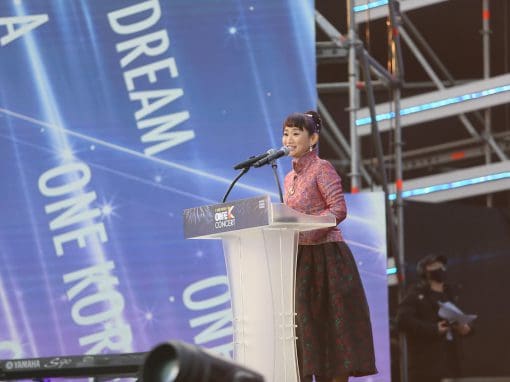
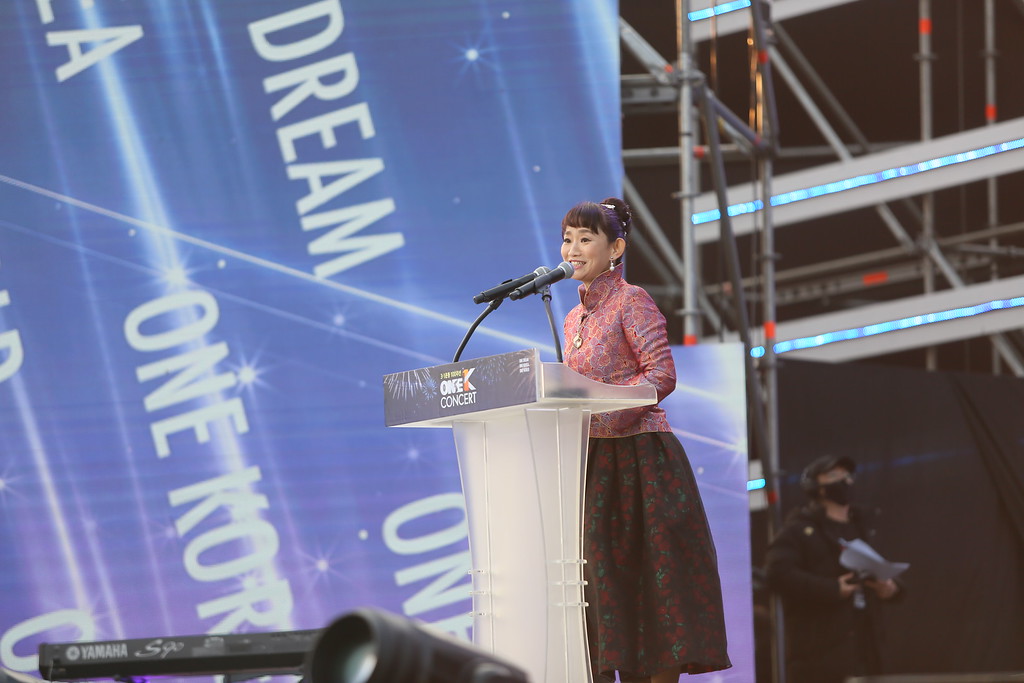
Keiko Kobayashi at the March 1 centennial in Seoul
On March 1, 2019, marking the 100th anniversary of the March 1st Independence Movement that arose on the Korean Peninsula under Japanese colonial rule, the “One K Concert” was held in front of the National Assembly Building in Seoul, Republic of Korea. This gathering was rooted in the noble spirit expressed in the March 1st Declaration of Independence, calling upon Koreans to transcend past grievances and build an ideal nation. It advanced the Korean Dream movement, which seeks to reunite the divided Korean Peninsula and establish a model nation grounded in peace and shared prosperity.
At this historic event, the person who delivered a speech representing Japan was Ms. Keiko Kobayashi, who served as general director, screenwriter, and lead actress of the Japan–China co-produced film JUN AI. In her speech, Ms. Kobayashi expressed deep respect for the heartfelt aspiration of the 33 Korean national representatives who rose up 100 years ago, and passionately spoke about the hope for peaceful reunification.
I, Aya Goto, first watched the film JUN AI in Tokyo in 2013. Since meeting Ms. Kobayashi at that time, we have worked together in Japan and internationally as partners sharing a common vision for peace. In particular, since her appointment in late 2018 as a PR ambassador for the One Korea Global Campaign, she has conveyed the passionate hope for One Korea to audiences around the world.
The footage of her speech on March 1, 2019, was incorporated into both the opening and closing scenes of the film JUN AI, elevating the work into a Japan–China–Korea collaborative production with renewed and profound significance. The film JUN AI quietly portrays the possibility that understanding, empathy, and love can emerge even among people divided by borders, ethnicity, and historical conflict. This theme resonates deeply with the Global Peace Foundation’s vision of “One Family under God,” as well as with the broader One Korea movement advanced in solidarity by diverse civil society organizations. Through cinematic art, the film seeks to inspire spiritual awakening, create spaces for dialogue, expand bonds between people, and ultimately contribute to the building of peace.
As we approach March 1 once again this year, it holds particular significance that JUN AI has been made available as a gift through YouTube for nearly a year, reaching viewers around the world. In addition to the original Japanese version, the film is now accessible with subtitles in English, French, Chinese, Korean, and Japanese continuing to foster empathy, dialogue, and connection across cultures. JUN AI offers a living platform for global reflection and conversation. It is our sincere hope that the film will continue to reach people in many countries and regions, inspiring thoughtful engagement with the themes of peace, reconciliation, and our shared humanity.