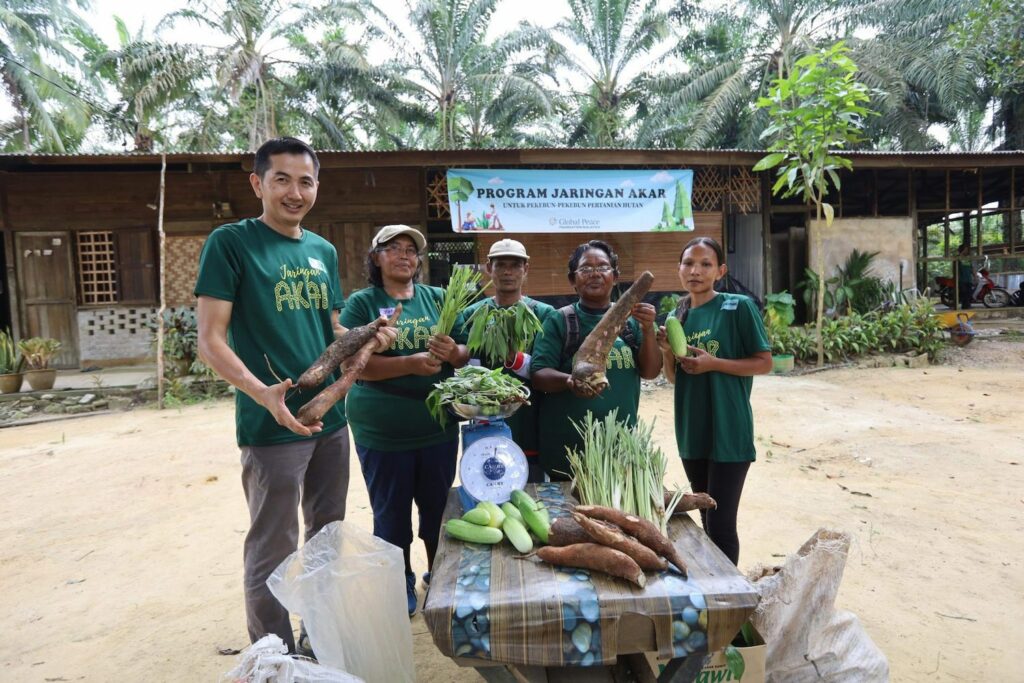
Orang Asli farmers holding their organic harvest
Across communities worldwide, the work of the Global Peace Foundation (GPF) in development and service is grounded in the understanding that peace is sustained not only through dialogue and cooperation, but also through inclusive development that addresses the root causes of vulnerability and inequality. By strengthening livelihoods, improving food security, and expanding economic opportunity, community-based initiatives help reduce marginalization and build the resilience necessary for stable and harmonious societies. This approach is evident in the work of Global Peace Foundation Malaysia, where innovative agricultural and community development initiatives are helping transform the lives of Indigenous Orang Asli communities in rural Malaysia.
Development Gaps amid National Progress
Malaysia has experienced rapid economic development since gaining independence in 1957. Industrial expansion and commercialized agricultural production have contributed significantly to national growth. However, the benefits of this development have not been evenly distributed. Many rural communities, particularly the Orang Asli, the Indigenous peoples of Peninsular Malaysia, continue to face significant economic and social challenges. Poverty levels among the Orang Asli remain significantly higher than the national average, and limited access to economic opportunities, degraded farmland, and inadequate infrastructure have contributed to persistent cycles of vulnerability.
In response to these challenges, GPF Malaysia has partnered with local communities in Pahang state to develop community-led initiatives that build sustainable livelihoods while restoring the natural environment. Two flagship programs, the Moringa Free-Range Chicken Farming Initiative and the Orang Asli Syntropic Farming Initiative, demonstrate how development rooted in local ownership, ecological sustainability, and market access can create meaningful change.
Building Sustainable Livelihoods through the Moringa Free-Range Chicken Initiative
The Moringa Free-Range Chicken Farming Initiative began in 2020 in the community of Muadzam Shah as a pilot effort designed to improve income and nutrition among Orang Asli households. While Malaysia’s poultry industry is one of the most advanced sectors of the national livestock economy, production is largely dominated by large commercial farms. As a result, rural and Indigenous communities often receive little direct benefit from the industry’s growth. The initiative sought to bridge this gap by enabling small-scale farmers to participate in the poultry value chain through a sustainable and community-driven model.
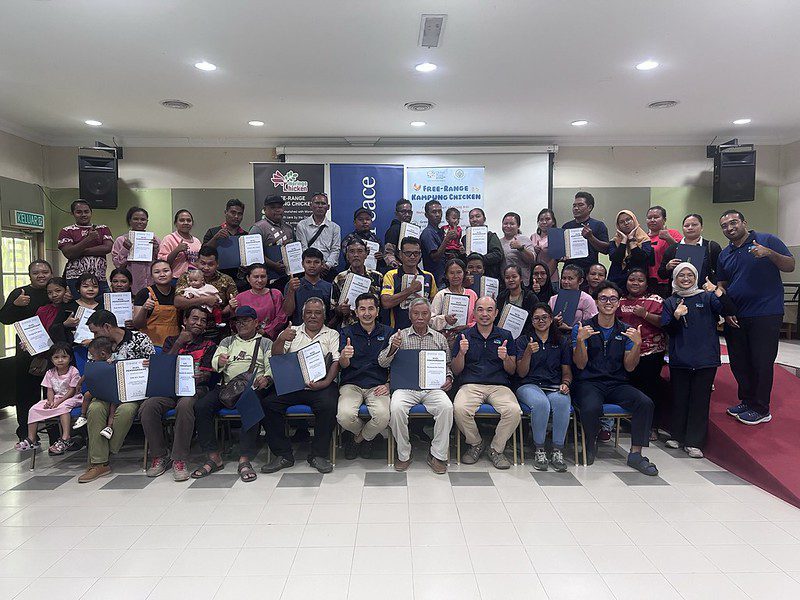
Orang Asli chicken farmers
The program initially focused on building poultry coops and introducing breeding chicks to participating farmers. Over time, it evolved into a comprehensive supply chain system that includes feed production, processing, packaging, storage, and distribution. A distinctive feature of the initiative is the use of moringa leaves as supplementary chicken feed. Rich in essential nutrients such as vitamins A and C, calcium, and protein, moringa provides a natural and nutritious food source for the chickens while reducing reliance on commercial feed.
As the initiative matured, farmers were trained in essential skills such as poultry health management, disease prevention, and the use of mobile and internet-based monitoring tools to improve farm management. The program also established a Halal-certified slaughterhouse and centralized packing system, ensuring that the chickens could be processed, vacuum-packed, frozen, and distributed efficiently to markets.
Expanding Opportunity and Community Impact
The results have been significant. What began with an initial group of 30 Indigenous farmers has grown steadily, reaching 60 farmers by 2025. This reflects both growing confidence among the communities and increasing demand for healthy, antibiotic-free poultry. The initiative has created the “Moringa Chicken” brand, emphasizing the chickens’ natural, free-range production and their origins within Orang Asli communities.
Beyond market success, the initiative has had a profound social impact. Farmers participating in the program have experienced an estimated increase of RM600 in monthly income, improving financial stability for many rural households. With an average household size of five individuals, the initiative now benefits approximately 300 community members. Youth participation has opened pathways for skill development and entrepreneurship, while women’s involvement has strengthened inclusive economic opportunities, with nearly half of participating farmers being female.
Restoring Land and Livelihoods through Syntropic Farming
While the poultry initiative addresses income generation and nutrition, the Orang Asli Syntropic Farming Initiative focuses on restoring degraded land while improving food security. Implemented by GPF Malaysia since 2022 in villages around Bandar Muadzam Shah, the initiative introduces syntropic agroforestry, a regenerative farming method that mimics natural forest ecosystems to rebuild soil health and biodiversity.
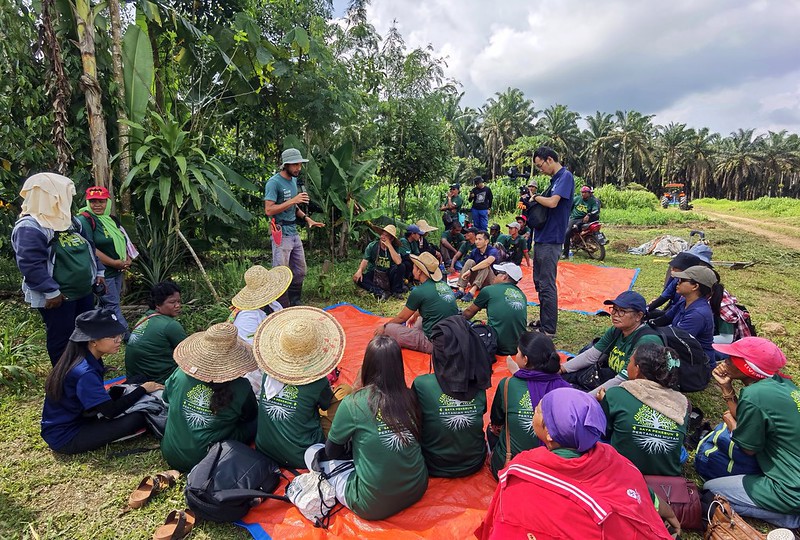
Orang Asli famers learning about syntropic farming at A Little Wild, Kota Tinggi
Many Orang Asli communities possess land but struggle to grow crops due to soil degradation caused by unsustainable farming practices and environmental change. The syntropic farming initiative addresses this challenge by teaching farmers ecological techniques that regenerate the soil while increasing crop productivity. Through continuous training and hands-on support, farmers learn methods such as stratified planting, mulching, pruning, and carbon sequestration.
These practices allow a variety of crops to grow together in a layered system that enhances soil fertility while reducing the need for artificial fertilizers, pesticides, and irrigation.
Regenerative Agriculture Transforming Communities
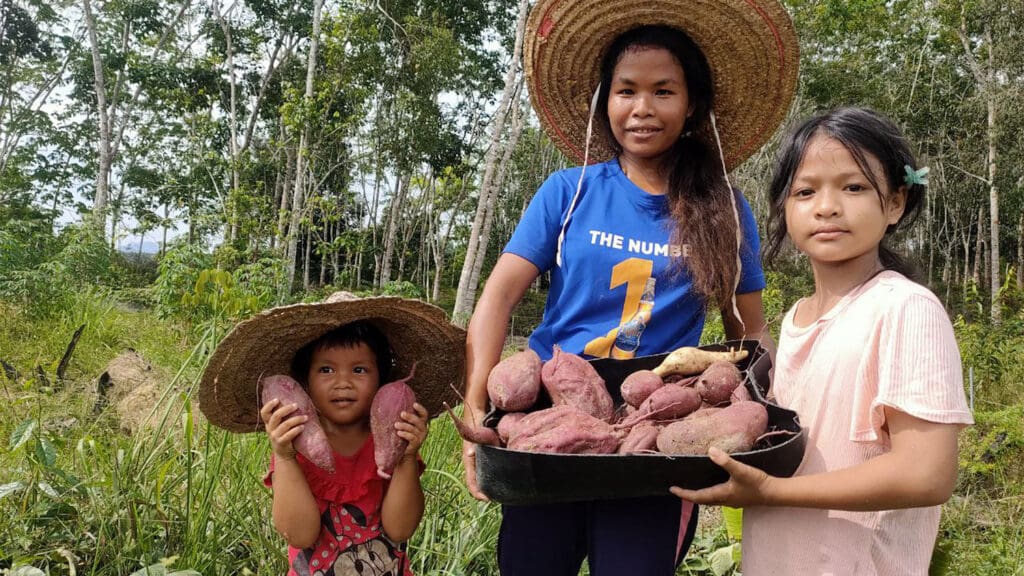
Orang Asli Amai proudly showing their harvested organic produce, which includes a variety of vegetables
Since its launch, the initiative has engaged communities across 21 villages and trained 126 farmers. Together, they have restored 36 acres of land through regenerative planting techniques. Remarkably, within seven months of implementation, previously infertile soil began supporting dense vegetation. Within a year, farmers began harvesting improved crop yields that support both household consumption and local markets.
The initiative extends beyond crop production. Training in food processing has enabled farmers to add value to their harvests by producing items such as dried fruits, particularly bananas and pineapples. These products can be sold in local markets, creating additional income streams for families. At the same time, networks of syntropic farmers have emerged, encouraging peer learning and the sharing of knowledge about sustainable farming practices.
The transformation extends to environmental benefits as well. The regenerative approach improves soil quality, reduces pest damage, and enhances biodiversity. As farmers continue to adopt syntropic methods, degraded land is gradually restored into productive ecosystems that support both people and nature. This contributes not only to improved livelihoods but also to broader efforts to restore forests and biodiversity lost through unsustainable agricultural expansion.
Scaling Sustainable Community Development
Looking ahead, both initiatives continue to scale and evolve. The Moringa Free-Range Chicken Farming Initiative aims to expand production capacity by increasing batch sizes per farmer, improving logistics through bulk transportation, and exploring dedicated cold-chain vehicles to reduce distribution costs. Plans are also underway to expand market access by partnering with high-end restaurants and resorts while reaching urban consumers who increasingly seek ethically produced, healthy food.
Meanwhile, the syntropic farming initiative seeks to expand regenerative agriculture across more Orang Asli communities. By scaling these sustainable practices, GPF Malaysia hopes to strengthen food security while restoring degraded ecosystems and building resilient rural economies.
Together, these initiatives demonstrate how community-led development can generate lasting impact when supported by the right training, resources, and market connections. By linking ecological restoration with economic opportunity, the work of the Global Peace Foundation empowers Orang Asli communities in rural Malaysia not only to overcome poverty but also to become stewards of their environment and architects of their own future, reflecting a broader vision that peace and prosperity grow strongest when communities are equipped with the knowledge, tools, and opportunity to thrive.
Interested in how similar initiatives are transforming communities elsewhere? Explore more development and service work from Global Peace Foundation around the world here.
Discover more of Global Peace Foundation Malaysia’s initiatives and see how sustainable development is transforming Orang Asli communities: