Towards the final stages of the Second World War, the leaders of the US, Great Britain and the USSR met in Tehran, Yalta and Potsdam to discuss the future of Europe. It was decided that Germany would be split into 4 zones, marking the beginning of the division of the German people for generations to come, a parallel to the still remaining partition of Korea which to this day tears through the heart of a people with a shared history, tradition and identity.
Starting from July 1945, Germany was to be split into 4 sectors: an American, British, French and Soviet administered zones. This was agreed upon so that each Allied power could oversee their portion of the reparations owed to them by Germany for the war at their own pace. Berlin itself, lying far within the Soviet administered zone, was split in the same manner. In the following years, the western zones would unite into a bi-followed by a tri-zone and would become an official independent state (the Federal Republic of Germany) in the year 1949. The Soviet Union soon followed suit and allowed their zone to create their own, communist-orientated state, the German Democratic Republic, later that year. These two states are often referred to as West and East Germany, respectively. Similarly, after the end of the Second World War, Korea was occupied by both Soviet and American troops and would later remain divided into North and South along the 38th parallel, solidified by the formation of two separate governments.
From the year 1948, America launched its European recovery program, more commonly known as the Marshall Plan, in which economic aid, worth nearly the equivalent to 100 billion of today’s US dollars, was sent to West Europe in an effort to rebuild their economies after World War II. This, coupled with a relatively free market economy, allowed West Germany to thrive economically, whilst East Germany lived in poverty. Nowhere was the difference in living standards clearer than in Berlin. In the early years after the founding of East and West Germany, traveling between the two states was still possible. In the split former capital of Berlin, people could live on one side and work on the other, which was a common reality. It was not long before Germans began to see the contrast between the neon lit, vibrant, shop-filled streets of West Berlin and the grey, monotonous roads of East Berlin. It was said that one could buy a beer in the East, resell the empty bottle in the West and with the money made, go back and buy another beer and repeat the process until one was too drunk to walk anymore.
As the years went by, more and more Germans decided to permanently move to the West to enjoy a higher standard of living. The East German government saw they had a massive problem on their hands as they could not afford to lose the majority of their working population.
In 1961, rumors of a wall began to spread. The East German head of state at the time, Walter Ulbricht responded with, “Niemand hat die Absicht eine Mauer zu errichten,” stating that no one had the intention to build a wall. A few months later in August 1961, a wall was erected overnight in Berlin and travel between East and West was restricted. Many families found themselves suddenly separated from one another and many others were unable to go to work, school or their church communities on the other side of the wall.
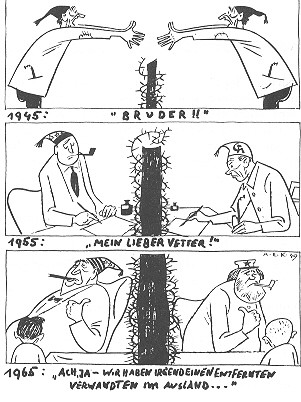
The image above is a caricature from 1949 foreshadowing a more and more separated Germany. The first segment of the caricature displays two brothers reaching out for one another over a wall that separates East and West. At this point, the Berlin Wall did not exist, however, much of the country still had an internal border. In the second segment, 10 years have passed and the same two brothers are writing each other a letter referring to the other as lesser-known family. In the final segment, a further 10 years down the line, the two brothers are mentioning to their own children that they have some distant relatives living outside the country.
The caricature serves as a warning that the more time that passes, the less important reunification seems to become, as old relationships break down. This has unfortunately become a reality for many Koreans, especially for many South Korean youth who do not personally know anyone who lives in the North and do not view the two countries as having a shared national identity.
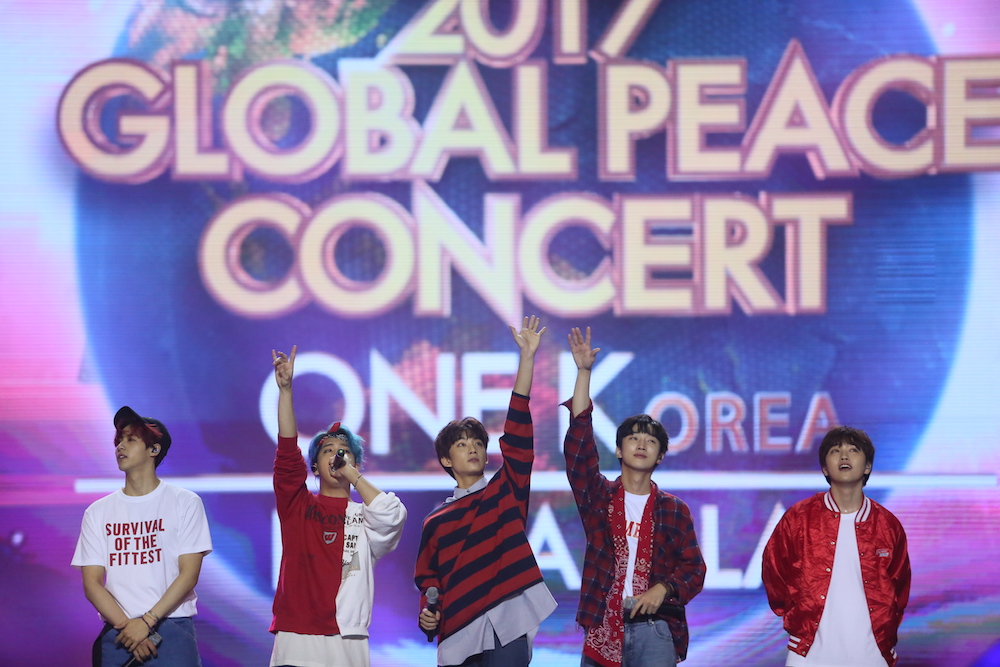
K-Pop stars sing at the 2017 One K Concert in the Philippines
Outside of the two German states, western countries soon developed a strong anti-wall sentiment. Several US Presidents visited the Berlin wall, including Ronald Reagan and John F. Kennedy. Western artists such as David Bowie, Bruce Springsteen and David Hasselhoff held concerts for the removal of the wall, similar to today’s One K Concerts. Anti-wall protests and marches were held in both East and West Berlin. After several decades of tension between East and West Germany, escape attempts to the West and an attempt to starve the West German population by blocking all land and water routes to and from the city, the Berlin Wall fell in 1989 and the country reunified on October 3, 1990, which remains a national holiday.
Today, 75 years after the end of World War II and 100 years since the March 1st Movement marking the beginning of the Korean independence movement, Korea remains divided. It is time to reignite the desire to attain a single united Korean people, not only to rejoin old families torn apart decades ago, but to bring about peace and stability in the East Asian Pacific region and therefore the rest of the world. In this sense, the issue of Korean unification is a world issue. Once again, the world turns towards a divided nation in anticipation for the future.
This article is about the One Korea Global Campaign, a popular movement to expand Korean-led grassroots initiatives and international support to advance the peaceful reunification of the Korean peninsula. The Global Peace Foundation is a founding member of Action for Korea United, a coalition of 900 civic society organizations in Korea that is spearheading the Korean-led efforts of the One Korea Global Campaign. For more information on the campaign and the March 1 Korean Independence Movement 100 year commemorations visit: 1dream1korea.com