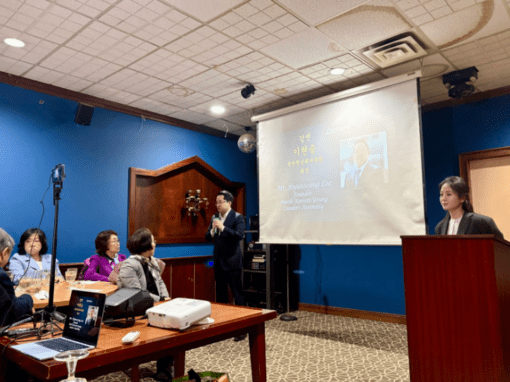
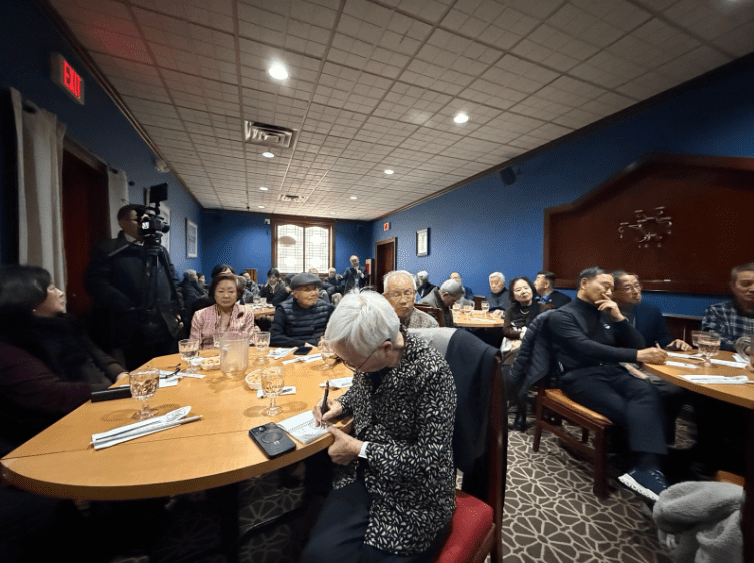
Attendees of the Potomac Forum held on February 12 listen attentively to the lecture.
In February 2026, at the Potomac Forum held in Annandale, Virginia, Hyunseung Lee (Founder of North Korea Young Leaders Assembly (NKYLA), co-organized by Global Peace Foundation) and Eunsook Jang (NKYLA Alumni) delivered a lecture on North Korean human rights. Despite the regime’s systematic indoctrination, they testified that North Korean residents are gradually discovering the truth through small pieces of outside information—and that this awareness will ultimately become a catalyst for change in North Korea.
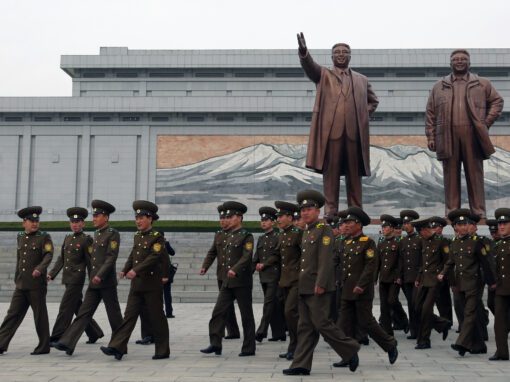
Lee explained the dynamics of change in North Korea and addressed why ordinary citizens are unable to stand up to the regime. He pointed to the regime’s strict information blockade—banning the internet, foreign media, and publications—as well as educational control, where citizens are exposed only to state-approved narratives and have no opportunity to encounter alternative perspectives. He further emphasized that independent organizations or gatherings are legally prohibited, and that collective punishment policies—including guilt by association across three generations—create a structure in which resistance is virtually impossible. In many cases, individuals are sent to prison camps without due process and never return. “If one person engages in anti-government activity, not only that individual but also grandparents, parents, and extended family members are punished,” he stressed, underscoring how the system makes resistance realistically unattainable.
In response, Jang shared that precisely because of this reality, exposure to outside information—particularly depictions of a free society governed by a legal system with defense attorneys, prosecutors, and judges ensuring due process—was profoundly shocking to her. Through foreign media, she gradually came to recognize that the North Korean regime was fundamentally flawed. Contrary to state propaganda claiming that North Koreans are the happiest people in the world, she slowly realized that those living outside North Korea enjoyed far greater freedom and dignity. This realization became the most significant motivation behind her decision to defect. Just as small pieces of information accumulate and can ultimately lead to life-risking escapes, she concluded, the collective efforts of civil society and the leadership of North Korean defectors can help accelerate the realization of a unified Korean Peninsula.
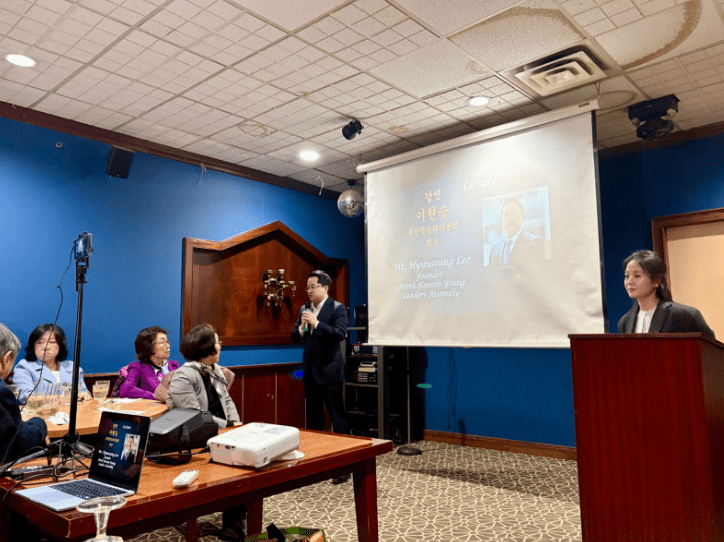
Hyunseung Lee (left) and Eunsook Jang (right) respond to questions during the Q&A session at the Potomac Forum.
Lee also expressed concern over the recent circulation of North Korea’s Rodong Sinmun within South Korea, warning that the publication employs propaganda techniques reminiscent of Nazi-era agitation and that uncritical exposure to its messaging risks normalizing the regime’s narratives. In the same context, he addressed the theory of permanent division on the Korean Peninsula, criticizing the so-called “two-state theory” as an anti-national and ahistorical policy. He argued that despite differences in rhetoric or framing, North Korea’s fundamental objective of achieving unification through force has not changed.
Through the North Korean Young Leaders Assembly (NKYLA), Lee and Jang are working to elevate these issues to the policy level by engaging U.S. policymakers, United Nations officials, and think tank experts. Founded by Lee in 2023, NKYLA invites 10–12 North Korean defector youth to the United States each year to help cultivate them as future leaders preparing for unification. The initiative also advances meaningful policy and international efforts aimed at bringing genuine change to North Korea—for the sake of families who remain inside the country and for the broader Korean people.
Approximately 50 Korean-American community leaders residing in the greater Washington, D.C. area attended the forum. Even after the formal lecture concluded, more than ten participants actively raised questions, reflecting strong interest and continued discussion on the future of North Korea and the Korean Peninsula.