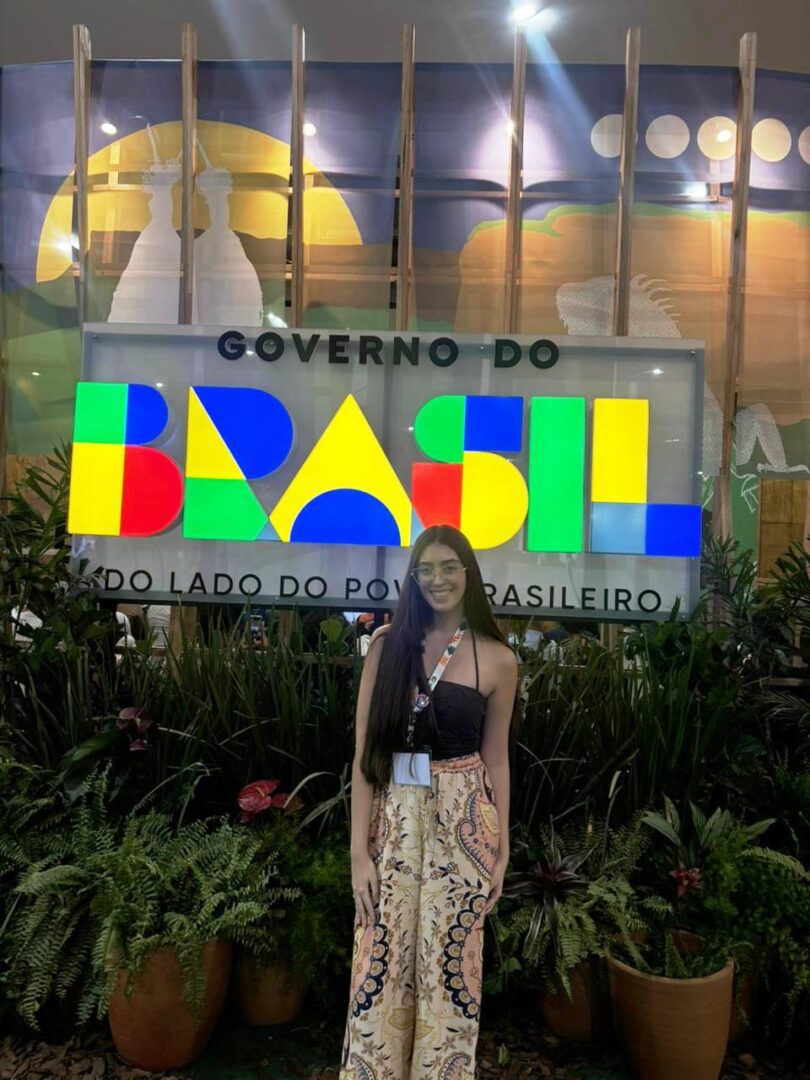
Diana Godinho at COP30 in Brazil.
Belém, Pará, felt like more than a host city; it felt like a message. Holding COP30 in the Amazon region grounded global climate discussions in lived reality. Conversations about forests, finance, and resilience were no longer abstract—they were anchored in the air, the land, and the communities of the region itself. COP30 brought together governments, civil society, businesses, and youth to reflect a shared responsibility to care for the environment and for one another, beyond political or ideological divisions.
At the heart of COP30 was climate finance—whether the international community would treat it as a meaningful tool for delivery or allow it to remain a promise without follow-through. The “Belém Political Package” was presented as a bundled set of decisions intended to demonstrate progress across interconnected areas, including just transition, adaptation, trade, technology, and inclusive participation. Running through every discussion was pressure to significantly scale financial support for developing countries, often framed around moving toward approximately $1.3 trillion per year by 2035, along with new processes designed to prevent momentum from fading once the conference ended.
Brazil also advanced a concrete, Amazon-linked initiative: the Tropical Forests Forever Facility (TFFF), an investment mechanism aimed at large-scale tropical forest protection, with a cited goal of around $125 billion. More than a technical proposal, the TFFF served as a statement of shared responsibility—that tropical forests, and the people who depend on and protect them, must be central to global climate solutions rather than treated as a secondary concern.
At the same time, COP30 exposed ongoing limitations in the multilateral process. The conference faced criticism for failing to secure strong language on fossil fuel reduction, with outcomes leaning toward compromise that many observers viewed as insufficient. A similar pattern emerged around deforestation, where discussions pointed toward future roadmaps but stopped short of the clarity and urgency needed by frontline communities. Another recurring concern was the persistent gap between commitments and delivery on loss and damage. While mechanisms continue to develop, available resources remain far below what affected communities require. Beneath the headline numbers lay a deeper challenge of accountability—ensuring that commitments translate into timely, predictable, and accessible support.
Within this broader context, my engagement at COP30 centered on three interconnected priorities: youth leadership, host-country responsibility, and inclusive decision-making. Youth participation was not symbolic; it was essential to grounding negotiations in human timeframes, not just policy calendars. Youth voices consistently highlighted the distance between long-term targets and the immediate realities facing communities in need of adaptation and resilience today. I also followed how Brazil positioned its priorities—particularly around tropical forests, climate finance, and pathways for economic transition—recognizing that host-country leadership shapes what becomes possible within global negotiation spaces.
Inclusive participation was a further priority, not as a political concept, but as a practical one. Climate outcomes are shaped by who is present at the table, whose lived experience informs decisions, and whether solutions reflect the full range of human knowledge and capability within communities. Durable and peaceful climate solutions depend on broad participation, shared ownership, and respect for human dignity.
I also elevated an issue often treated as secondary but deeply structural: the relationship between climate change and access to education. Climate disruptions to schooling deepen inequality, weaken social cohesion, and limit future capacity for leadership, adaptation, and peacebuilding in vulnerable societies.
COP30 in Belém demonstrated real ambition in how it framed delivery, particularly through its emphasis on climate and Amazon-linked mechanisms like the TFFF. It also elevated Indigenous visibility in ways that should become a baseline expectation rather than a special feature. At the same time, the conference underscored the limits of consensus when major political and economic interests collide. Fossil fuels, deforestation pathways, and financial accountability remain areas where “agreement” can still fall short of what people and ecosystems require.
For me, COP30 offered both a window into high-level diplomacy and a reaffirmation of Global Peace Foundation’s peacebuilding approach that real change is ultimately about people. It is about protecting human dignity, strengthening communities, and fostering cooperation in the face of shared challenges. The measure of success will not be the ambition of commitments alone, but whether they arrive in time to build trust, resilience, and peaceful futures in a changing world.

Diana Godinho
The views expressed are those of the author and do not necessarily reflect the views of Global Peace Foundation. Diana Ferreira Godinho is a B.A. candidate in Public Management and International Studies at Stetson University and co-founder and vice president of PROAME (Projeto Amor ao Próximo), a community initiative in Goiás, Brazil, focused on food security. She is a volunteer for the One Korea initiative in Brazil.