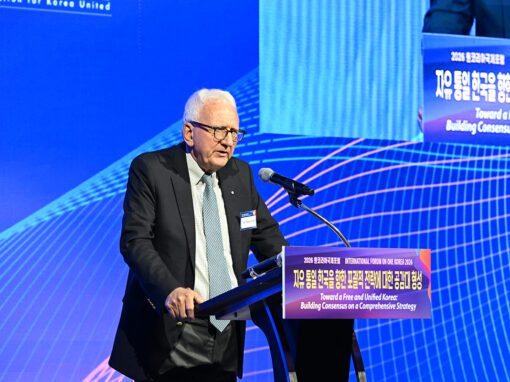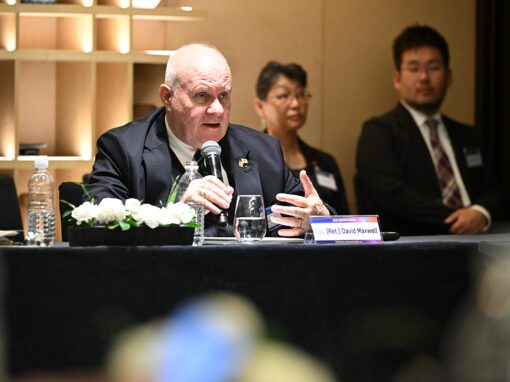
The following remarks were delivered by Col. (Ret.) David Maxwell at the 2026 International Forum on One Korea in Seoul on October 2, 2026. Maxwell serves as a Senior Fellow at the Global Peace Foundation and brings decades of military, policy, and security experience focused on the Korean Peninsula and the ROK–U.S. alliance.
At the center of his message is a practical challenge: if an opportunity for peaceful unification emerges, will Korea, the United States, and their partners be prepared to act?
The full text of his remarks follows.
Good afternoon. I want to begin with a confession. I am saddened. And, frankly, I am troubled to be standing before you once again speaking about Korean unification while the 26 million Koreans in the north continue suffering unbelievable horrors while we only talk.
This may be the third, fourth or fifth time I have spoken at a conference like this about unification. What progress have we made? But there is hope. What if internal change in the north produces new leadership willing to seek peaceful unification; are we prepared to seize that historic opportunity for all the Korean people in the north and the South?
I first came to Korea in 1986 and spent my first three years on the DMZ. For much of the last four decades, I have studied Korea, trained in Korea, planned for contingencies on the Korean Peninsula and argued for unification.
And yet, here we are. Korea remains divided. Support for unification has weakened. And too many people have simply come to accept division as normal.
In the United States, I am often ridiculed for my focus on unification. Americans ask me, “Why are you so interested in unification when Koreans themselves do not want it? Why should Koreans pay for unification? Why should they risk disrupting their lives? If Koreans in the South want peaceful coexistence, why should an American argue for something different?”
Those are fair questions. But I think they are the wrong questions. The question is not whether unification will be difficult or expensive. Of course it will.
The question is: What is the cost of permanent division? And perhaps an even more important question is: What happens to the Korean people in the north if we simply accept permanent division?
So, What Comes Next?
My belief in unification did not begin as an abstract political idea. It came from military planning. In the 1990s, I wrote a monograph on the catastrophic collapse of north Korea. Later, when I returned to Korea for my third military tour, I worked at the ROK/U.S. Combined Forces Command.
Those were extraordinary times. The 1994 Agreed Framework had tried to address the north Korean nuclear program, and it ended in failure in 2002. At the same time, north Korea was suffering through the Arduous March and a devastating famine. We had to confront a question that many people did not want to contemplate: What happens if the Kim family regime collapses?
One of the people with whom I worked on trying to answer this question could not be here today. Mr. Robert Collins is my good friend and my mentor. He has taught me more about north Korea than anyone else. And because of his extraordinary language capabilities to include speaking in north Korean dialects, he has interviewed more escapees from the north than any American. Bob and I, under the enlightened leadership of Gen. John Tilelli, spent a great deal of time thinking about what collapse could actually mean.
And what we discovered was frightening, challenging, and overwhelming for most political and military leaders.
We examined the danger posed by weapons of mass destruction. We examined massive refugee flows and internally displaced people. We examined humanitarian catastrophe. We considered what would happen if government, party, and military authority broke down and military units no longer responded to central control. We worried about factional fighting and the possibility of civil war. We worried about foreigners who might become trapped or even taken hostage. And above all, we worried that instability and collapse could lead to war.
These were immense problems. But the more we planned, the more we became troubled by another question. It is the question every military planner must eventually ask but should always start with:
What comes next? What is the political end state? If the regime collapses, what follows it? If there is a humanitarian catastrophe, what political arrangement ultimately restores stability? If there is a war, what political condition are military operations supposed to support?
There has to be an acceptable durable political arrangement that serves the interests of the Korean people and creates the conditions for lasting peace and prosperity.
Military forces can secure weapons. They can control terrain. They can provide humanitarian assistance. They can help displaced people. They can defeat enemy forces. But military power cannot answer the fundamental political question: What kind of Korea should emerge when the crisis is over?
As we worked through these problems, Bob Collins, Gen. Tilelli and I kept coming back to the same conclusion. There was only one logical, durable political end state: unification.
Not because it would be easy, not because it would be inexpensive and certainly not because we wanted the Kim family regime to collapse. But because every other outcome other than unification left the fundamental problem unresolved: the Korea question.
That realization drove us back to history. We went back to the 1953 Armistice Agreement. Paragraph 60 called for a political conference to address the unresolved Korean problem.
The military commanders had done what military commanders could do. They stopped the fighting. But military commanders could not solve the political problem. That responsibility belonged to political leaders. And that political problem remains with us today. It is the Korea question, the unnatural division of the Korean Peninsula.
More than 70 years later, we have become very good at managing the consequences of division. We deter war. We defend the Republic of Korea. We respond to provocations. We negotiate over nuclear weapons. We impose sanctions. We try to provide humanitarian assistance. And we conduct diplomacy. All of these things are necessary.
But I want to ask a different question: Are we trying to manage the consequences of division forever, or are we trying to solve the Korea question?
My answer is clear. The durable political end state must be a free and unified Korea. I call it the United Republic of Korea, or UROK.
A Single Sentence
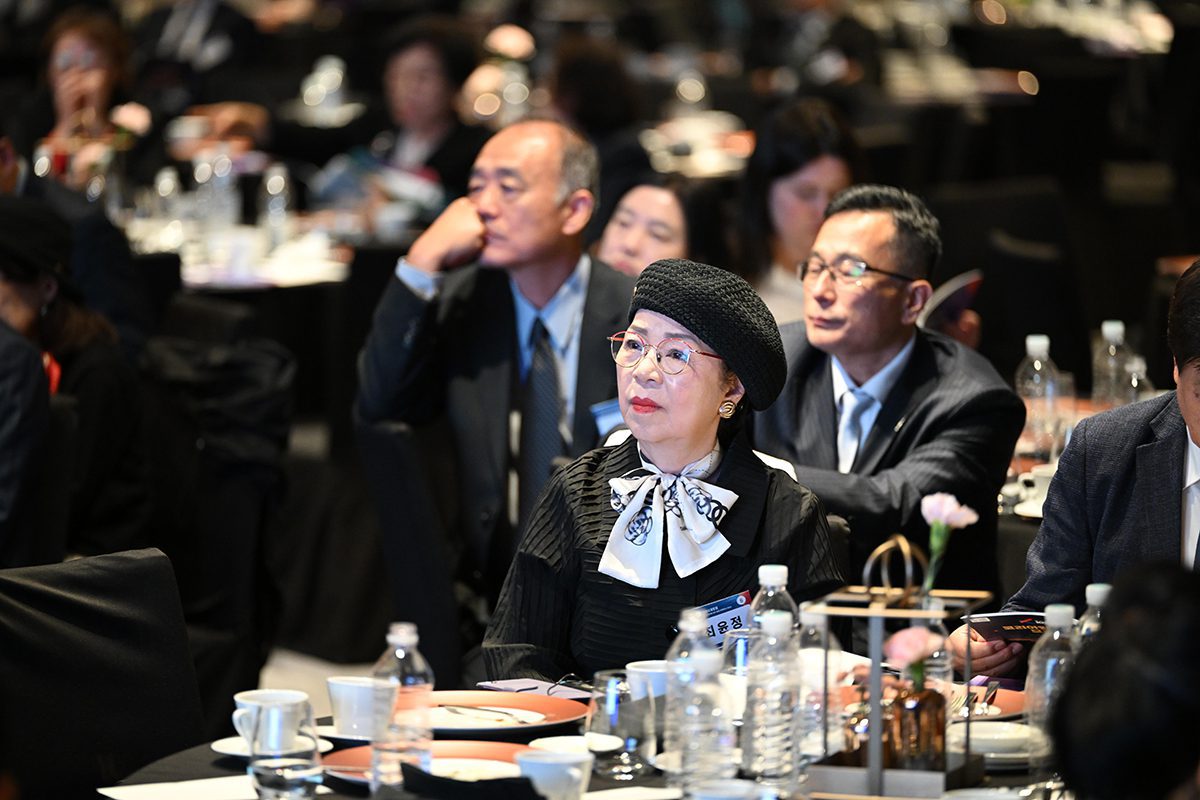
Participants listen attentively to presentations at the 2026 International Forum on One Korea.
If you remember nothing else that I say today, I ask you to remember this single sentence:
“Unification first, then denuclearization and peace; the path to unification is through information and human rights.”
For decades, we have generally thought about this in the reverse order. First denuclearization, then peace, then improved relations. And perhaps, someday, somehow, unification. But what if we have the sequence backward?
Kim Jong Un tells us that he will not give up his nuclear weapons. His “treasured sword” of nuclear weapons support the survival of his regime. And his regime depends upon maintaining the political system that divides Korea. So, perhaps we should stop asking how we can solve each symptom while leaving the underlying political condition untouched. What if solving the Korea question creates the conditions for denuclearization and a durable peace and prosperity?
And this brings me to human rights. Human rights are not separate from security. They are not something we discuss after we solve the nuclear problem.
Human rights are central to unification because the Korean people in the north must have agency over their own future. Please heed the work of Greg Scarlatiou, who is president of the Committee for Human Rights in North Korea (HRNK). Read the committee’s reports to understand the plight of the Korean people in the north.
The people in the north need information. The people in the north need knowledge about the outside world. The people in the north need to understand life in South Korea. The people in the north need to understand their universal human rights. And they need the ability, ultimately, to determine the government under which they live. Self-determination of government is a fundamental right in Article 21 of the U.N. Declaration of Universal Human Rights.
That is why I say the path to unification is through human rights.
But What Will Unification Cost?
I know what many Koreans will say. Unification is too expensive. I understand that fear. Koreans watched German reunification. They saw enormous economic costs and social disruption. Young Koreans today understandably ask why they should sacrifice their prosperity and their futures for something they did not cause. We should not dismiss those concerns. We should answer them.
But we should also ask: expensive compared to what? Unification carries enormous costs. But permanent division carries a strategic, human, and economic price, as well.
Permanent division means continued military confrontation. Permanent division means continued nuclear danger. Permanent division means enormous defense expenditures. Permanent division means periodic crises. Permanent division means continued separation of the Korean people. And it means the possibility that another Korean war could produce losses in blood and treasure beyond anything we can imagine.
So, my second proposition is this: Unification will create major costs for the government and the people. But permanent division carries greater strategic, human and economic burdens with no durable return.
We cannot compare unification with an imaginary future in which division remains peaceful, stable, inexpensive, and risk-free forever. That future does not exist. But a better one does.
To counter the negative economic arguments against a United Republic of Korea, I recommend you pay attention to three people who are bullish on the economic potential of unification: Dr. Nicholas Eberstadt of the American Enterprise Institute and his research on the potential for rapid GDP growth in a free and unified Korea, billionaire investor Jim Rogers, who said a unified Korea could become “an unbelievably exciting country” and one of the world’s most attractive investment opportunities, and Chairman Preston Hyunjin Moon, who said unification would potentially produce a “second Miracle on the Han River,” rather than an economic disaster.
Four Paths
We also have to confront another uncomfortable truth. We do not know how unification will occur. I see four broad paths: first, peaceful unification; second, war; third, regime collapse; and fourth, internal political change in the north.
Peaceful unification is what we should seek. This is the moral high ground. But I do not believe peaceful unification is possible while Kim Jong Un remains committed to preserving his regime and perpetuating division.
War is the worst case. We must deter it. We must do everything reasonable to prevent it. But if deterrence fails and war occurs, when the north Korean regime and military are defeated, we will immediately confront the question of Korea’s political future.
Regime collapse will be complex, dangerous and tragic, so we should not wish for it. Collapse could produce terrible human suffering. And a regime that believes it is facing extinction could choose war in a desperate attempt to survive. We should not predict collapse. But we must prepare for its possibility.
Internal political change in the north may seem like an outlier. But I believe it deserves far more attention. What happens if new leadership emerges inside north Korea? What happens if that leadership concludes that the existing system cannot survive? What happens if those leaders conclude that the best future for themselves and for the Korean people in the north lies in peaceful unification? That possibility is one reason why information is so important.
Prepare for Peace
Here is the paradox: Peaceful unification may be the most desirable path, but it is also the most complex to prepare for, the least likely to achieve as long as Kim remains in power.
Think about what it requires. We must eventually integrate two economic systems, two political systems, two militaries. And two societies whose experiences and cultures have increasingly diverged during more than seven decades of division. That requires extraordinary preparation.
And here is the key point: Planning for peaceful unification has practicality regardless of which of the four paths occurs.
If peaceful unification becomes possible, we will need those plans. If war occurs, we will need much of that planning afterward. If the regime collapses, we will need it under even more difficult circumstances.
And if internal change produces new leadership willing to seek peaceful unification, we must be prepared to seize that historic opportunity.
Therefore, planning for peaceful unification is not planning for an unachievable dream. It is strategic preparation for uncertainty.
The question is not simply: When will Korea unify? The better question is: If the opportunity for unification comes unexpectedly, what will we wish we had started doing twenty years earlier? The answer is: almost everything.
So, we should start now. As the old adage says, “the best time to plant a tree was 20 years ago and the next best time is right now.”
What Are You Doing?
And that brings me to all of you. Everyone in this room is here because you care about unification. But I want to challenge you.
How many people have you talked to about unification who are not in this room? Have you talked to your neighbors? Your coworkers? Your children? Your fellow students? Have you talked with young Koreans who oppose unification? Have you listened to why they oppose it? Have you talked with Americans who think Korea’s division is simply Korea’s problem?
We can hold conferences. We can write papers. We can make speeches. But if we only talk to each other, what have we accomplished?
Unification needs popular support. That requires education. It requires information. It requires persuasion. And it requires listening to people who disagree with us.
Governments must prepare for unification. Governments must develop policies and plans. But governments rarely sustain difficult policies without political support. So, we must build that support.
And we must help the Korean people in the north gain access to information so that they can understand the choices available to them. This cannot be only a government project. It must become a people’s project.
Why I Remain Embarrassed
I began by telling you that I am saddened and troubled. In fact, I am professionally embarrassed. I have spent decades thinking about this problem. I have planned for collapse. I have studied war. I have studied deterrence. I have studied the Kim family regime. I have advocated for unification. And yet I have failed to do enough to advance it.
But there is something that would trouble and embarrass me much more. It would be coming back here 10 years from now — another conference, another speech, the same people, the same arguments and another decade of division. Another decade of nuclear danger.
Another decade in which the Korean people in the north remain without the freedoms enjoyed by their brothers and sisters in the South and those of us in America. Another decade in which we manage the Korea question rather than solve it.
So, I ask each of you: What are you going to do? Do not leave here simply believing in unification.
Talk about it, study it, listen to those who oppose it. Answer their concerns honestly. Explain the costs honestly. But demand equal honesty about the terrible burdens of permanent division. Speak out about human rights in north Korea. Support efforts to provide information to the Korean people in the north. Demand that governments prepare for peaceful unification. And expand the community of people who believe that the Korea question can finally be solved.
We cannot know which of the four paths history will take. We cannot know when an opportunity will come. But we can decide whether we will be ready.
The end state is a free and unified Korea. A United Republic of Korea. U-R-O-K. Or “You Rock.”
The Korea question has remained unanswered for more than 70 years. What are we going to do about it?
And so again, I leave you with a single sentence that I hope you will remember and put to use: “Unification first, then denuclearization and peace; the path to unification is through information and human rights.”
Thank you.