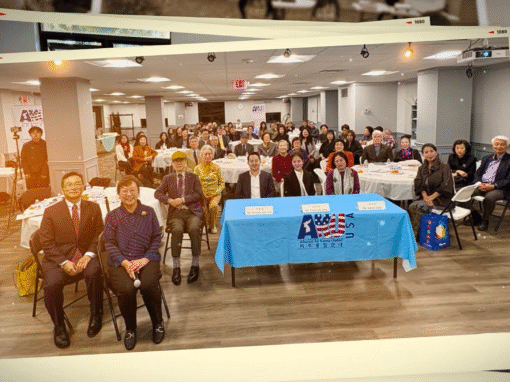
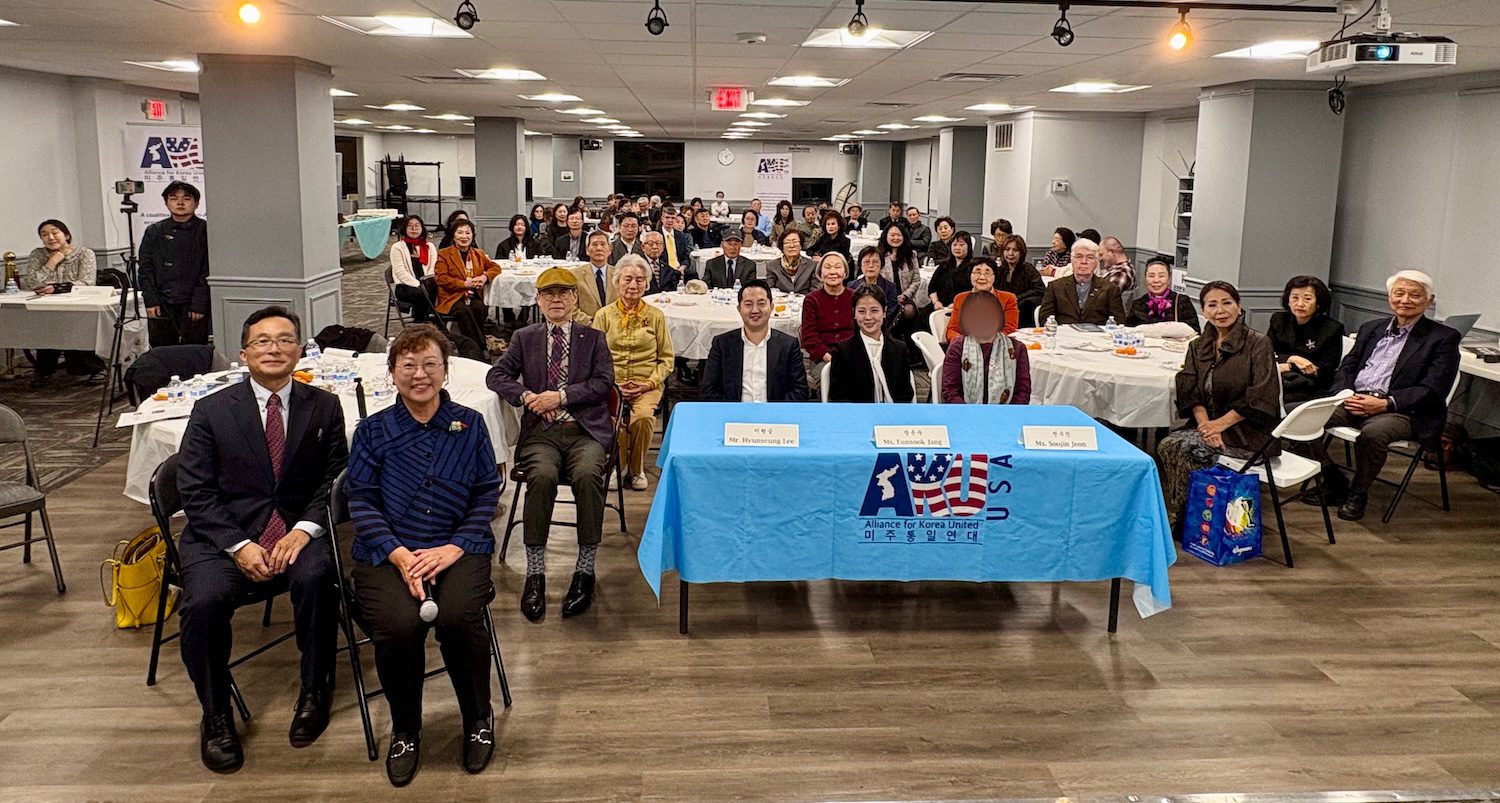
Audience at the Talk Concert with Young North Korean Escapees.
The reality of human rights in North Korea, the importance of young leadership, and the vision for unification were presented with great interest at the Talk Concert with Young North Korean Escapees held on November 23, 2025.
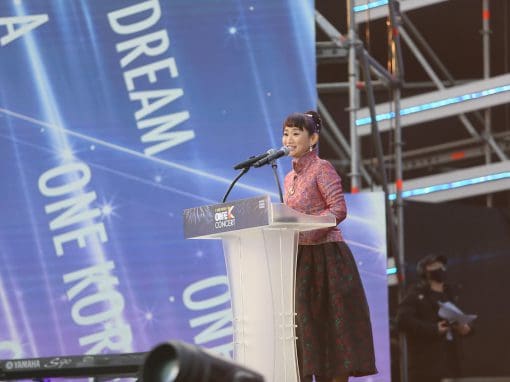
The event began with a music video of “Korean Dream: Come, O Glorious Light!” The 80 Korean Americans in attendance were deeply moved by the performance, applauding as Ms. Yusook Kim took to the stage.
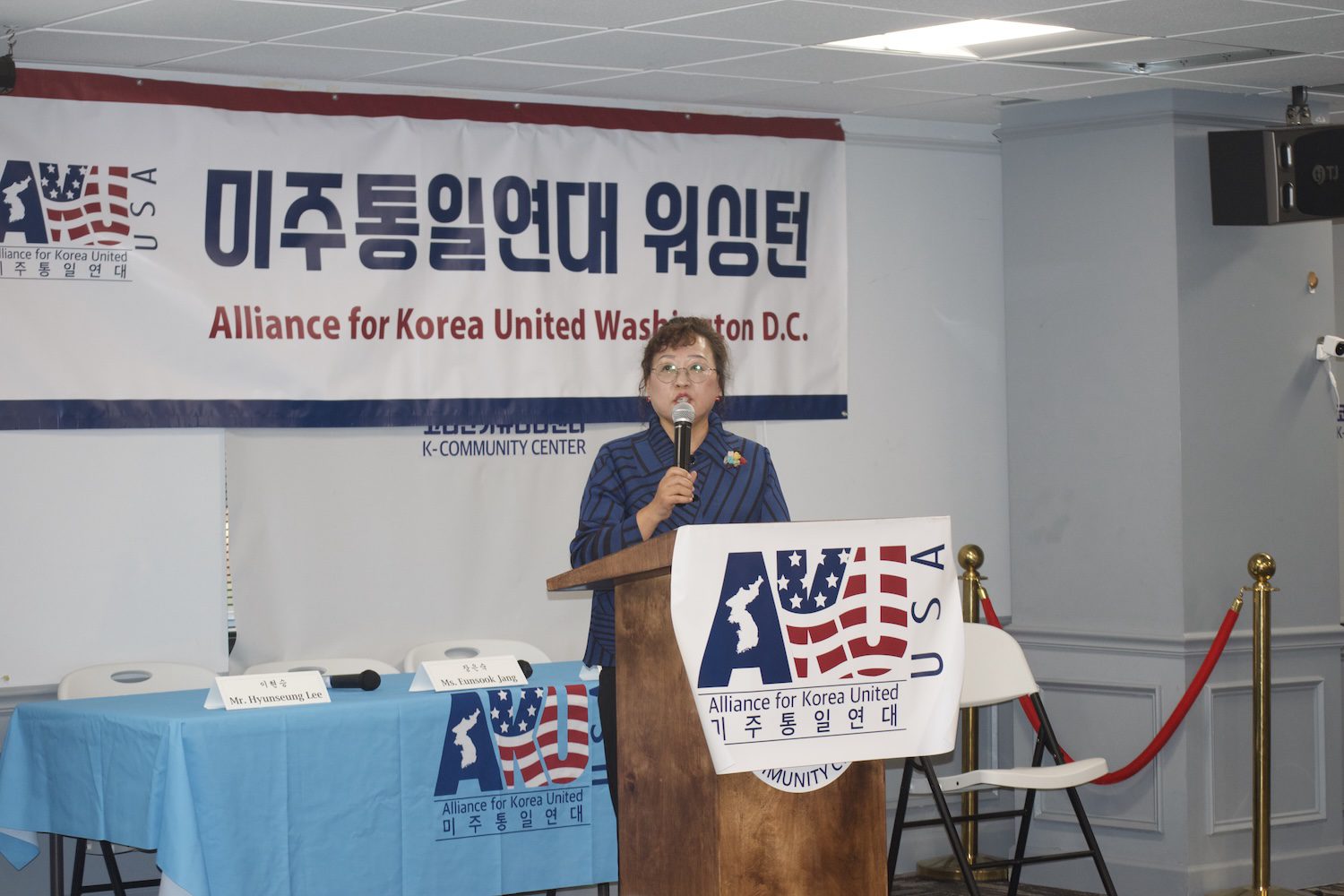
Ms. Yusook Kim speaking at the 2025 Talk Concert.
To mark its second anniversary, Ms. Kim, the president of Alliance for Korea United Washington, presented a report on the organization’s activities, including the Capitol Hill forum, North Korean Defectors Day events, the Korean Independence Day forum, a “Beyond Utopia” documentary screening with the cast, the Korean Dream Speech Contest with Ambassador Julie Turner, and the Korean Dream Festa in Seoul. She concluded by highlighting the motto, “Our activities are based on the acronym HOPE: Human rights movement, One nation, Peace movement, and Establishing a new nation.”
The first video presentation featured Mr. Cheolhwan Kang, the author of the well-known book “The Aquarium of Pyongyang,” who has also met with US President George W. Bush. He emphasized the human rights upfront strategy, “By focusing on resolving North Korea’s human rights issues, which will ultimately lead to the resolution of the nuclear issue and the North Korean problem.” He explained how the 2-state theory emerged, “The lives of North Korean residents have become even more dire than during the Arduous March in the late 1990s… It’s because the North Korean people believe that the ultimate solution to the North Korean issue, their own problem, is unification.” He concluded with the importance of vision for Citizen-led unification, “North Korean People are coming to South Korea and looking towards the United States, and now I believe that unification is the only answer. With this vision of unification called the Korean Dream, we can awaken the people of South Korea and create a path to unite with the people of North Korea.”
The second video presentation featured Mr. Ilkyu Lee, who served as a counselor at the North Korean embassy in Cuba until 2023. He explained his motivation, “My defection was a process driven by long-accumulated despair. In North Korea, not only ordinary citizens but even the elites live a life where they cannot predict tomorrow. North Korea is a place where everyone knows that the regime is going down the wrong path, yet no one can escape it, and we must pass on that harsh reality to future generations.” Then, he implored the international community, “Today, the Korean Wave has become the biggest threat to Kim Jong-un’s regime maintenance and the fourth generation of hereditary succession… Dictatorship cannot last forever… Please never forget their suffering, despair, and longing for freedom. And kindly stay with us until the day when North Korean residents can enjoy freedom, human rights, and democracy.”
Before the panel speeches, a video of the North Korean Young Leaders Assembly was presented.
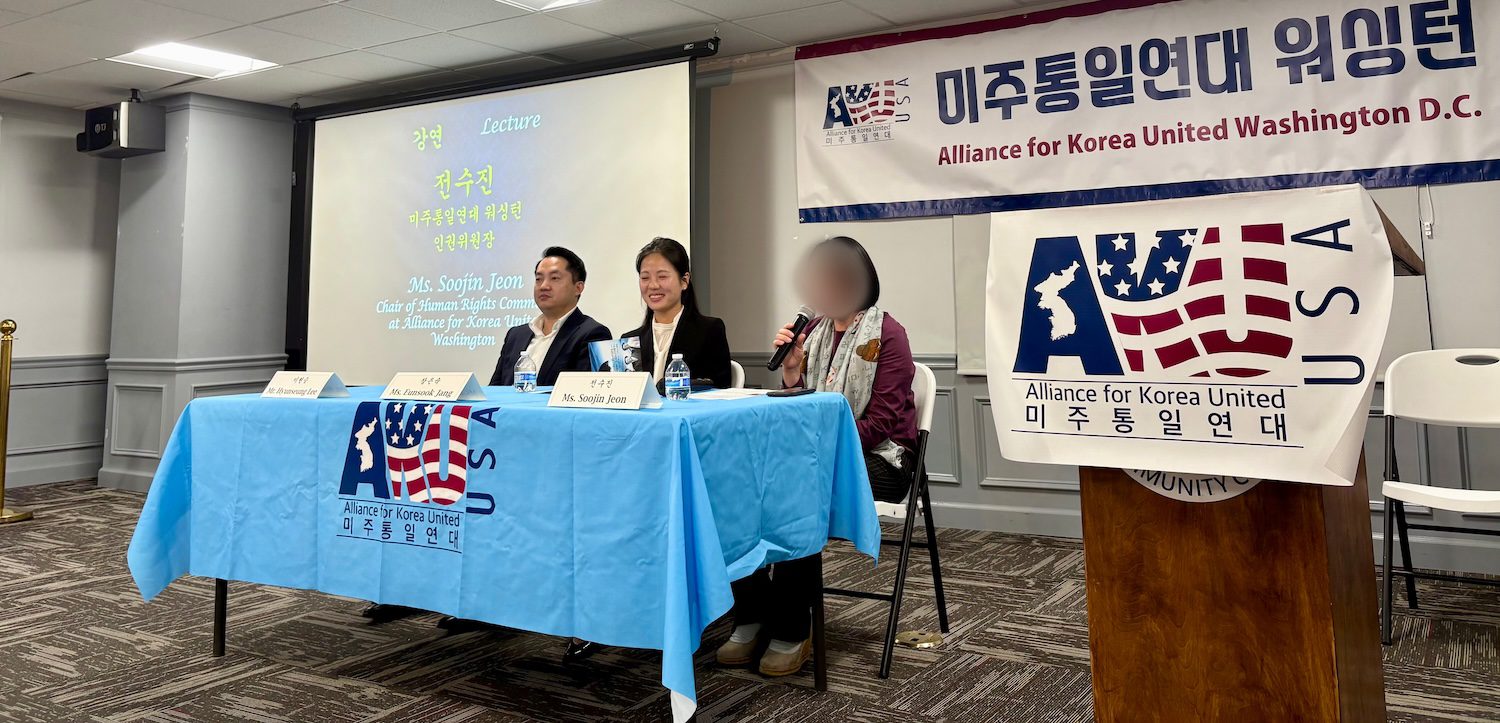
Panelist of speakers at the Talk Concert with Young North Korean Escapees.
Mr. Hyunseung Lee, the chairman of the North Korean Young Leaders Assembly, explained that North Koreans cannot stand up to the regime because of its “absolute control system.” 1. Prohibition of spontaneous organizations and meetings. “If you were to form such a group or organization, you and three generations of your family would be purged (guilt by association, three-generation annihilation)”. 2. Residents are required to join various organizations and are subject to constant surveillance. 3. There is no freedom of the media, publishing, or the internet. He added that the regime’s control is even stronger than South Korea’s past military dictatorship and maintains Total Control Zone camps with no judicial process and no possibility of release.
Furthermore, he explained the reasons why North Korean residents are unable to recognize the problems of the regime: 1. Information blackout: The internet, external media, and publishing are all prohibited. 2. Educational control: They are only exposed to information provided by the regime, and they have no choice but to look forward. “The fact is, they don’t even know what the North Korean regime is doing wrong.” 3. Some Korean content is available, but the dramas do not lead to awareness for regime change.
Mr. Lee concluded with the two solutions: 1. Education through information from the free world, 2. Cultivating the next generation of leaders. “Just as President Syngman Rhee cultivated leadership in the United States and built a free and democratic system in South Korea, we believe that North Korean young leaders need to go to the United States and around the world to build a free and democratic system in North Korea and liberate the North Korean people from oppression.” He then introduced the Assembly’s work over the past three years.
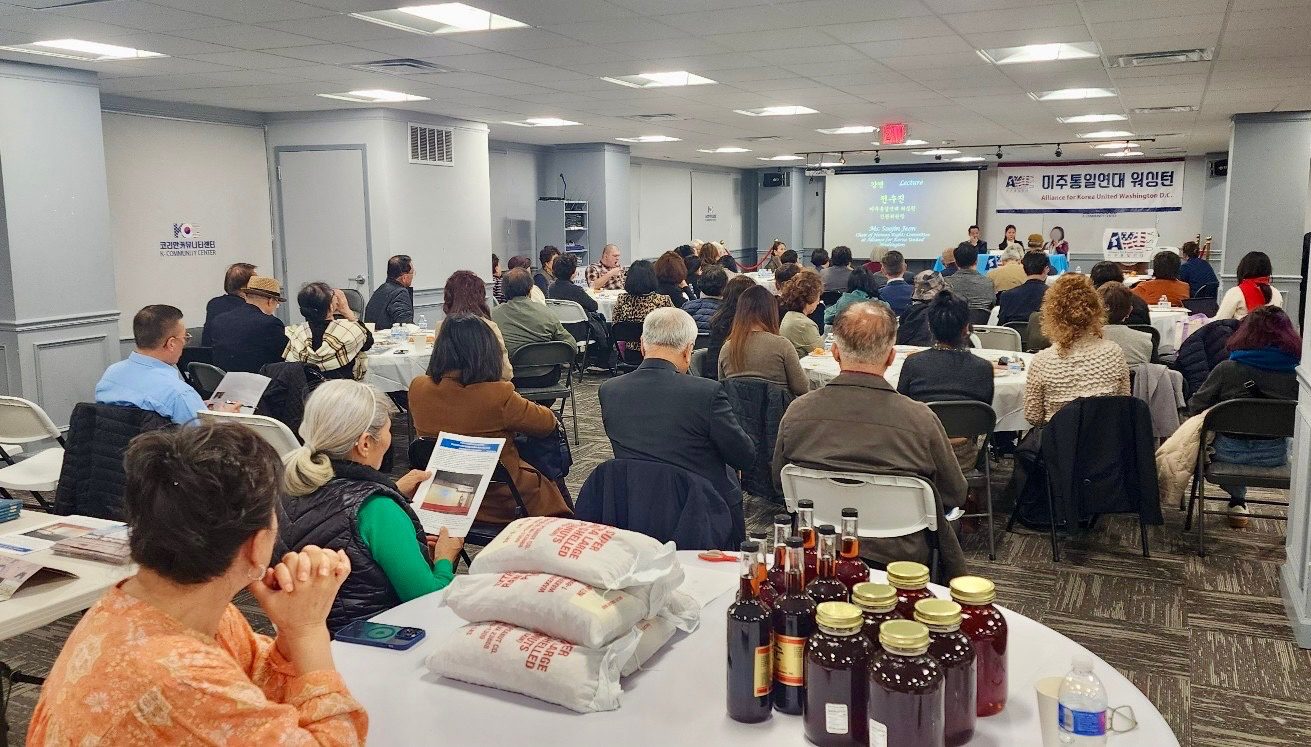
Talk Concert with Young North Korean Escapees
Ms. Eunsook Jang, a Fulbright scholar, intern at the Global Peace Foundation and the Hudson Institute, and attendee of the 2024 and 2025 North Korean Young Leaders Assembly, shared her story of defection. She was arrested twice and interrogated by the North Korean Ministry of State Security. On her third attempt, she escaped through China, Laos, Thailand, and finally South Korea. “I recently watched the documentary ‘Beyond Utopia,’ and it made me imagine all the experiences I went through when I defected from North Korea. Watching the video was very emotionally difficult, and it also made me think of my family and friends still in North Korea, so it was a very sad time.” She expressed her motivation for pursuing higher education as a North Korean defector. “After graduating from Jangdaehyun School in Busan, an alternative school for North Korean defectors, and entering the Department of Political Science and International Relations at Korea University, I no longer hid or concealed my identity as a North Korean defector. Instead, I sought out opportunities that I could pursue precisely because I was a defector, which led me to become a Fulbright scholar and come all the way to Washington… As a North Korean defector and a young person who defected from North Korea, I’m currently studying diligently because I want to think about how I can contribute when the Korean Peninsula is unified, and specifically, what kind of systems I can help build through that learning process (political transition, economic development, and transitional justice).”
Ms. Soojin Jeon, who served as a committee chair at AKU-Washington and previously worked as a news podcaster for Radio Free Asia Korean, recalled a moment from the 1980s when North Korean television broadcast footage of South Korean university students protesting. The students were chanting slogans such as “overthrow the regime” and calling for the “withdrawal of U.S. troops.” She explained that in North Korea, survival itself is difficult due to hunger, constant surveillance, and torture. Because of this, she made the decision to cross the river, thinking, “I’m going to die here anyway, so it’s better to escape and die.” She said that she defected more out of fear and desperation than for ideological reasons, sharing, “In my naive youth, I defected without any plan. I thought I would earn money in China and return, but 27 years have passed, and now I am in my 40s.” She continued, “When I see elderly separated families who have spent their entire lives longing for their hometowns, I want to return to my own hometown as soon as possible, before it’s too late, and reunite with the people I miss.”
During the Q&A session, Ms. Jang shared her view on unification. She said that North Korean human rights must be prioritized during negotiations, and that the 34,000 North Korean defectors should not see their identity as a disability but as a strength given to them by God. She asked, “What can I do in this society, and what can I do as a North Korean defector, starting with unification?” She emphasized the need to develop leadership and abilities in this area.
Mr. Hyunseung Lee addressed international relations, saying, “Currently, North Korea is balanced between Russia and China and has been leaning heavily toward Russia, so from South Korea’s perspective, I believe the ROK-US alliance is the most important alliance. The moment the ROK-US alliance weakens, China and Russia will no longer respect South Korea. The moment South Korea moves away from this alliance, South Korea will be treated as nothing more than a complete stranger than North Korea.
Lastly, a Christian pastor emphasized, “What’s important is that the people who spoke here today will have a great opportunity to demonstrate leadership once North and South Korea are unified. A strong ROK-U.S. alliance is important, but it can only succeed if it brings all Koreans together and moves them forward. If we create more opportunities for these young leaders to share their stories, the world, especially here in America, will change dramatically. With God by our side, I believe we can accomplish anything. Please continue moving forward with a clear vision.”