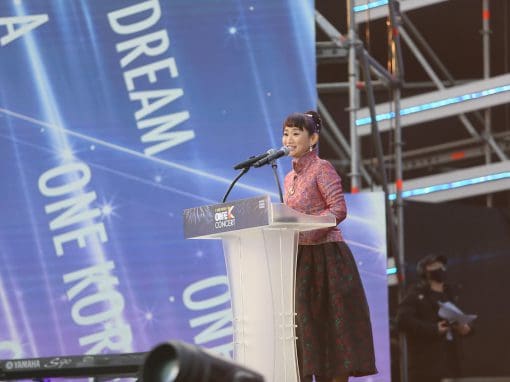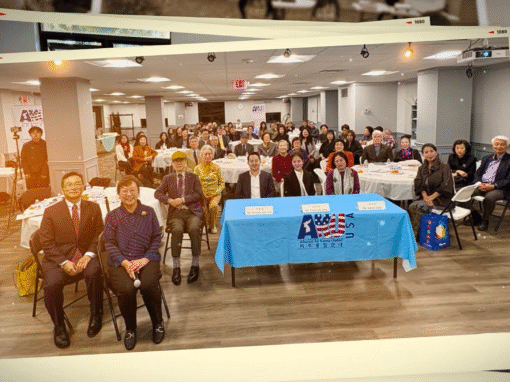
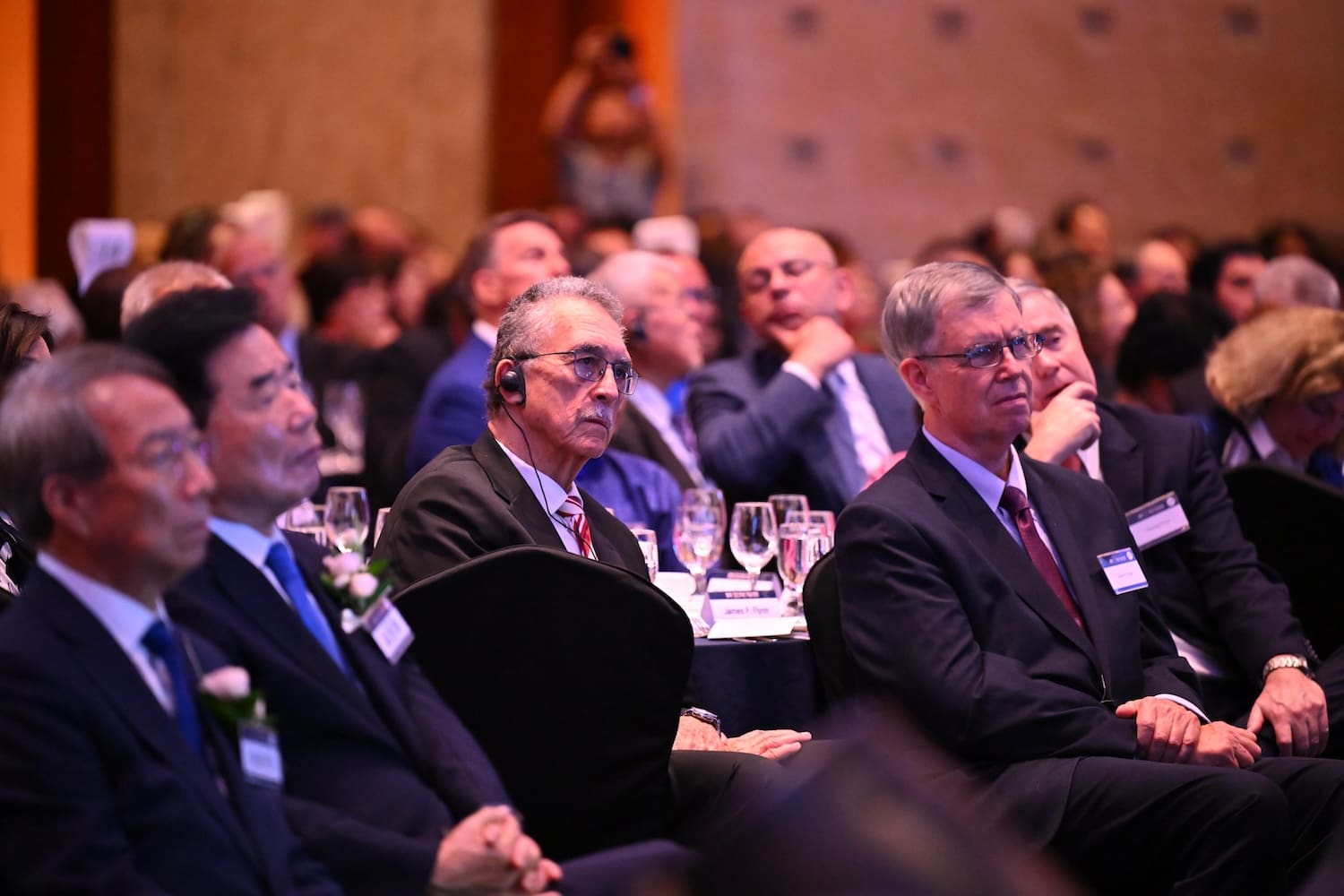
An international audience gathers in Seoul for an AKU banquet commemorating the 80th anniversary of Korea’s Liberation Day.
When Action for Korea United (AKU) was launched in 2012, it was founded on a bold conviction that the Korean people themselves, guided by the ancient principle of Hongik Ingan, to live for the greater benefit of humanity, must take the lead in achieving reunification. More than a decade later, AKU has grown into the largest grassroots coalition for reunification in Korea, bringing together over 1,000 civic organizations. Its guiding vision, known as the Korean Dream, coined by Dr. Hyun Jin P. Moon, presents unification not simply as a political or territorial resolution but as a profound opportunity to build a nation that contributes to peace and prosperity in Northeast Asia and the wider world. A key partner in this work is the Global Peace Foundation (GPF), whose founding role and global reach have given strategic direction and international momentum to the cause.
Action for Korea United General Assembly
The year 2024 proved to be a milestone in this unfolding story. With the 80th anniversary of Korea’s liberation approaching in 2025, citizens, faith leaders, young people, scholars, local governments, and international partners rallied in record numbers to reaffirm their shared destiny. Throughout the year, AKU sustained a remarkable pace of activity that combined national mobilization with international outreach. A series of historic events drew large crowds, highlighted the urgency of reunification, and laid the groundwork for the One Korea Global Campaign of 2025.
The year began with the AKU General Assembly in February, where more than 130 leaders outlined the roadmap for the Korean Dream 10 Million Campaign. From there, the calendar was filled with initiatives that deepened civic engagement, including the September promotional vehicle campaign that activated hundreds of citizen promoters in public squares.
National Liberation Day Commemoration Events
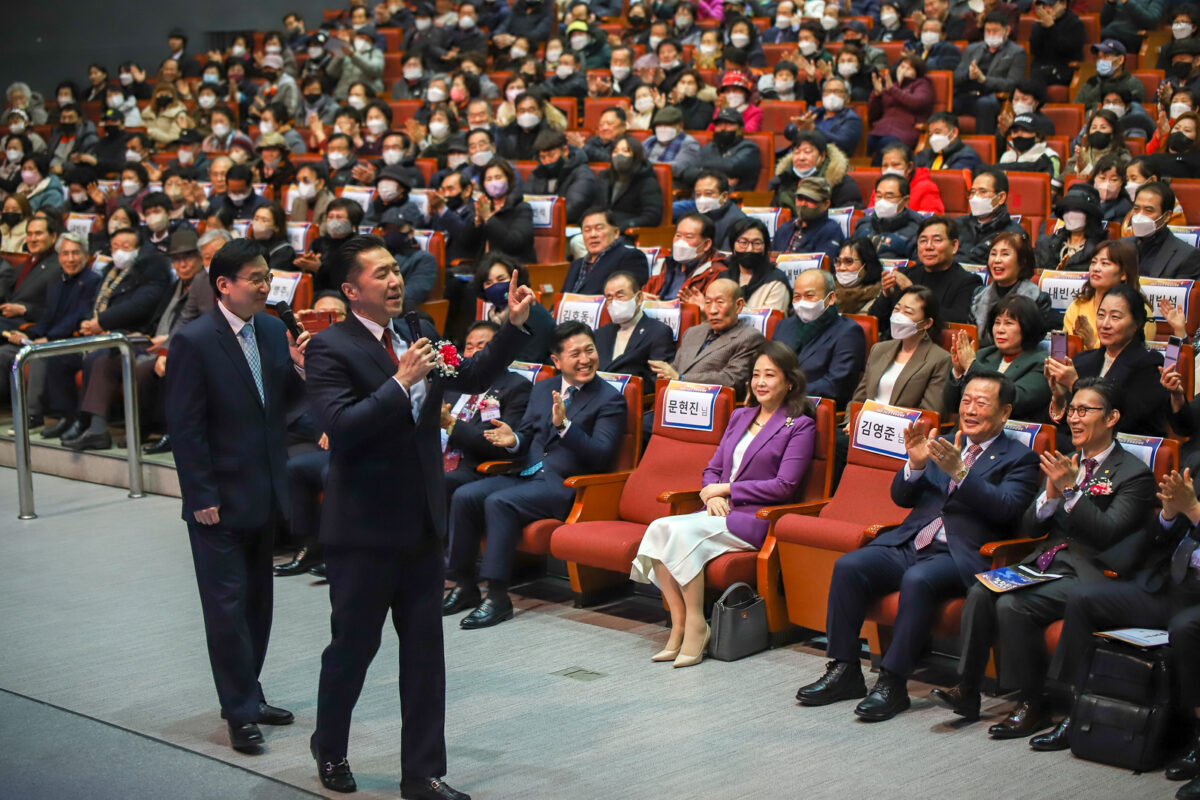
Dr. Hyun Jin P. Moon speaks at a rally in Honam region, South Korea.
National commemorations played a particularly powerful role in uniting citizens. On March 1, on the anniversary of the 1919 Independence Movement, gatherings were held in 17 cities with more than 20,000 participants. These commemorations connected Korea’s historical struggle for freedom with the present vision of a unified future, reminding participants that reunification is not merely a diplomatic aspiration but a civic responsibility.
On August 15, Liberation Day was marked with simultaneous rallies in ten cities involving more than 2,000 people. The events were not only commemorative but also forward-looking, unveiling the roadmap for the Korean Dream 10 Million Campaign and screening films such as Beyond Utopia, which placed a human face on the urgency of unification by sharing the stories of North Korean escapees.
The year’s largest gathering came on September 28, when more than 30,000 people filled Imjingak Peace Park for the Korean Dream Grand March for Korea United 2024. Supported by the Ministry of Unification, Gyeonggi Province, Paju City, and the Global Peace Foundation, the event blended civic energy and cultural expression. There were taekwondo demonstrations that sought world record recognition, musical performances by renowned artists and defectors, and a drone show accompanied by fireworks that lit up the night sky with images of peace and aspiration.
Role of Religious Communities
Religious communities also played a decisive role in 2024. In April, the Christian Leaders’ Unification Convocation drew 1,200 pastors and church leaders who pledged to align their spiritual vision with the national vision for reunification. Catholic, Buddhist, and Confucian leaders likewise lent their voices through forums and interfaith gatherings, demonstrating that the call for unification transcends doctrinal boundaries. These efforts emphasized a central truth of the Korean Dream: that unification must be rooted in values capable of bridging faith, ideology, and generational divides.
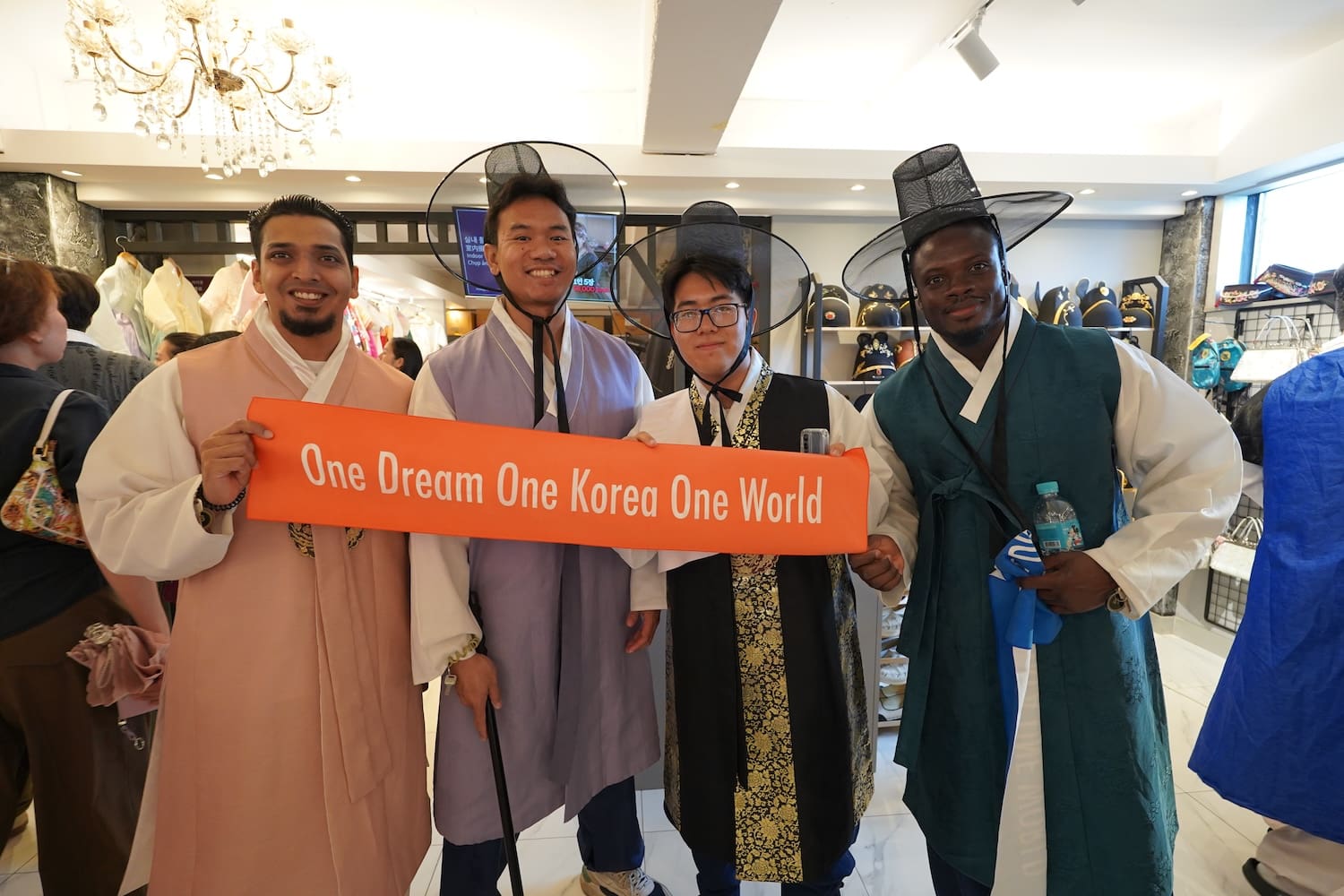
International youth participate in a summer camp hosted by the Global Peace Foundation.
Youth Empowerment and International Engagement
AKU also invested heavily in empowering young leaders. In January, the Youth Vision Camp trained more than 100 student leaders in civic action and the history of the Korean Dream. Later in August, the Global Peace Youth Summer Camp brought together 500 young people from 28 countries for exchanges with Korean youth, tours of the Demilitarized Zone, and solidarity events such as the Korean Dream Festival at Sinchon Square. The Korea International Model United Nations, also held in August, engaged more than 100 youth from 28 countries in debates on Korean peninsula issues, while other cultural forums and concerts reached thousands more. Through music, art, and digital media, young people carried the message of reunification into spaces that resonate with their generation.
Local Governments and Civic Volunteerism
Equally significant was the collaboration with local governments and civic volunteers. Unification Vision Seminars were organized across 17 provinces, drawing over 700 local government leaders, and by the end of the year, 155 cities and counties had formally adopted unification declarations. Civic volunteerism added another layer of grassroots momentum. More than 5,000 community forums involving 78,000 people created spaces for dialogue and education, while monthly volunteer activities such as kimchi-making with North Korean escapees, clean-up projects, and coal briquette distribution reinforced the spirit of solidarity at the community level.
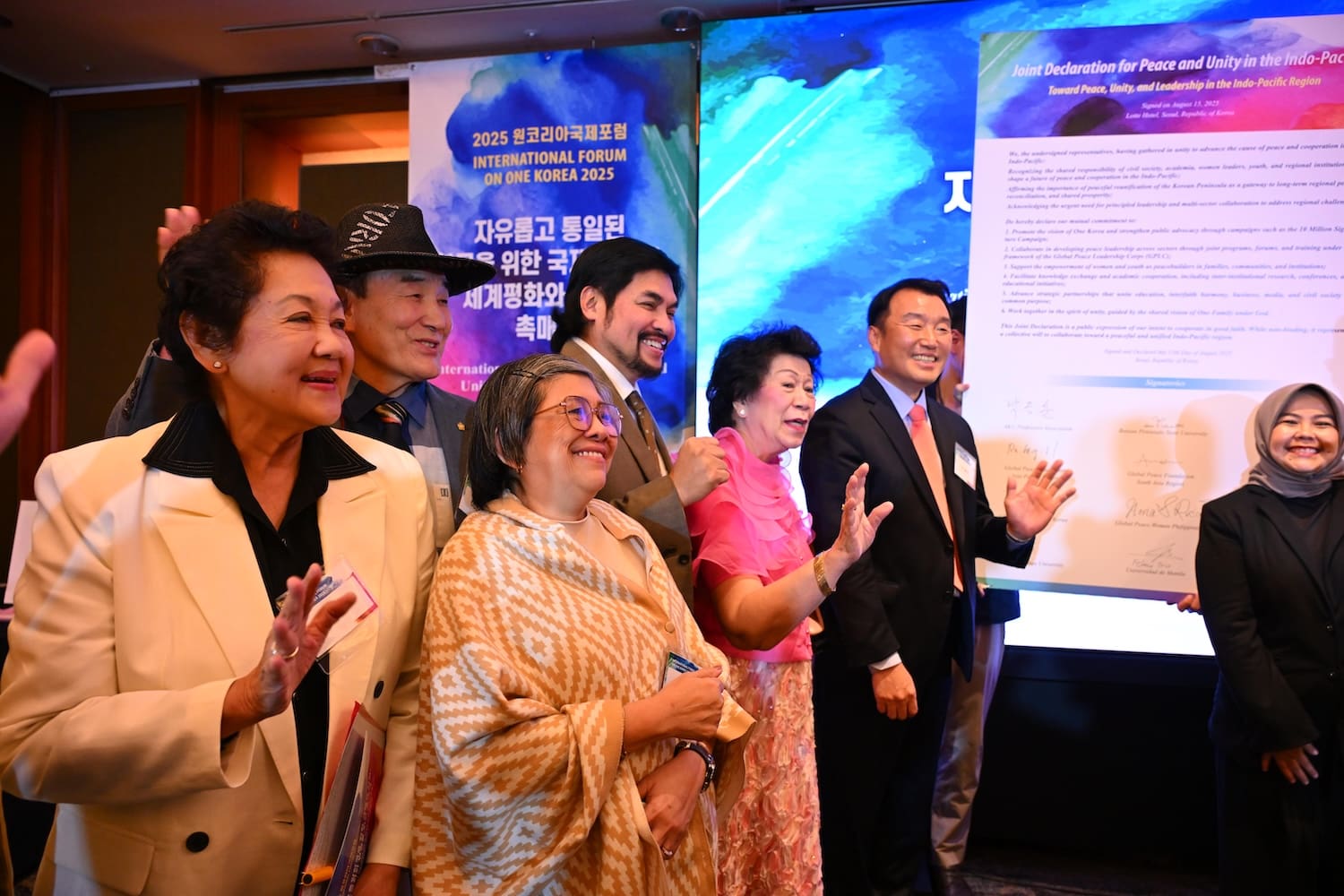
Signing ceremony involving Global Peace Leadership Corps, Global Peace Women Korea, regional delegates, and the Indo-Pacific Peace Forum in support of One Korea at the 2025 International Forum on One Korea.
International Forum on One Korea
The Global Peace Foundation’s leadership was especially evident throughout the year. As a founding partner of AKU, GPF’s chairman, Dr. Hyun Jin P. Moon, provided the philosophical framework of the Korean Dream and ensured that reunification was framed as a values-based project rather than a political undertaking. In September, GPF co-hosted the International Forum on One Korea, which convened scholars, policymakers, escapees, and faith leaders to consider strategies for peace, human rights, and economic cooperation. With keynote remarks by Dr. Hyun Jin P. Moon and contributions from international experts such as the former Prime Minister of Mongolia, the forum placed Korea’s unification squarely on the global agenda. Beyond convenings, GPF mobilized diaspora communities, supported interfaith partnerships, and worked to align international public opinion around the Korean Dream, thereby connecting domestic civic action to a larger peace movement.
One Korea Global Campaign in 2025
If 2024 marked a year of national mobilization, 2025 has emerged and promises to be the year of global engagement. The One Korea Global Campaign in 2025 is designed to transform the domestic momentum of 2024 into a worldwide wave of solidarity.
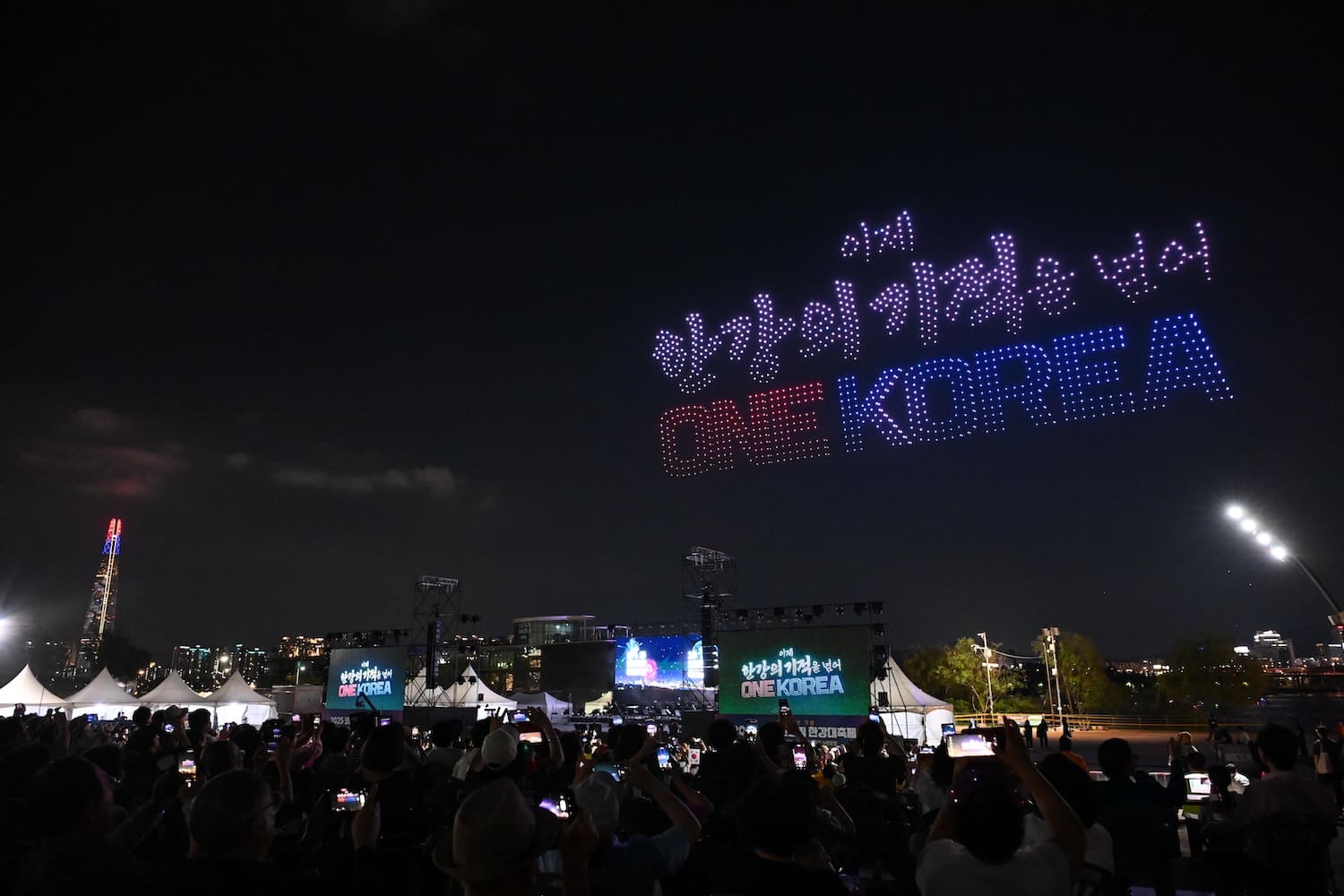
Drone show at the Korean Dream Hangang Festa 2025
By mid-August 2025, Seoul hosted the International Forum on One Korea and the Korean Dream Hangang Festa, held in commemoration of the 80th anniversary of Korea’s liberation. During the forum, civil society played a central role. Global Peace Foundation reports that the second day of the forum, August 15, focused heavily on strengthening international cooperation. Delegates from various countries reaffirmed their commitment to the ideals of peace, human rights, and reconciliation. Faith communities reiterated their support, recognizing that spiritual and moral leadership must accompany political and diplomatic efforts. The forum also served to showcase the Korean Dream Hangang Festa, one of the culminating events, demonstrating how cultural celebration, public space, and citizen participation can carry forward the message of unification in accessible, joyful, and all-encompassing ways. Keynote speeches, especially by Dr. Hyun Jin Preston Moon, emphasized that the movement does not end with Korea’s borders but belongs in global dialogue. The attendance and media coverage accentuated that the Korean Dream has captured both domestic imagination and international interest.
A Shared Global Vision
Looking back on all that happened, 2024 was unquestionably a year of building foundations, aligning vision, broadening participation, and situating the cause of reunification firmly in the international conscience. The first half of 2025 has carried that foundation forward into expansive global momentum. What began in small forums and city resolutions, in faith gatherings and youth camps, has now reached summits, concerts, and forums with global audiences. Reunification is no longer only a Korean aspiration; it has become a global conversation.
As 2025 unfolds, people everywhere are invited to share in the vision of the Korean Dream. The Korean reunification is a movement driven by the conviction that it must be achieved by the people and for the people.